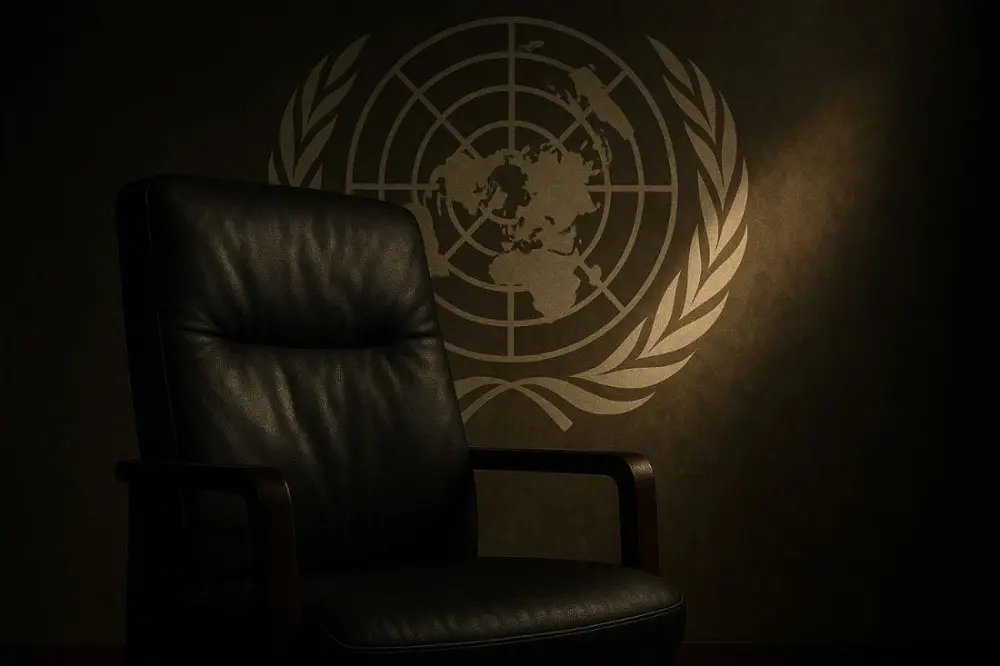
What if the UN reaches January without a Secretary-General?
By Josué Fiallo

On 16 October, as the Security Council counted the votes from its sixth straw poll to choose who will succeed António Guterres at the head of the United Nations (UN), the United States ambassador, Mike Waltz, told the press something worth reading twice. What matters, he said, is getting it right, “not necessarily based on timelines or other constraints.” Asked whether the decision might slip beyond 1 January, he replied that his country would prefer to conclude it before Guterres’s term ends. A preference is not a commitment.
It was the first poll with colour-coded ballots, which reveal whether a candidacy faces opposition from a permanent member, though not which one. According to the results published by PassBlue, still unofficial, Rebeca Grynspan received nine encouragements, five discouragements and one “no opinion”; Rafael Grossi and Carolyn Rodrigues-Birkett received eight, six and one, respectively. Grynspan reached exactly the nine votes required for a recommendation; she is missing the other half of the rule: that no major power oppose her. All three received two discouragements from permanent members. The ballots do not say from whom. A diplomat did: Grynspan’s, the diplomat said, came from the United States and the United Kingdom.
Further down, Macky Sall, Olara Otunnu and María Fernanda Espinosa each received three discouragements from permanent members, while Ivonne A-Baki, who was said to have Washington’s support, received all five. On the three leading candidacies, the permanent members are not united: they are divided. In 2016, the first colour-coded poll left Guterres without a single discouragement, and the next day the Council recommended him. This time, none of the seven emerged unscathed. The question is no longer academic: what would happen if January arrived without an agreement?
It is important to avoid alarmism. A discouragement is not yet a veto: in the formal vote, a major power may abstain. In 1996, France opposed Kofi Annan in several polls and lifted its objection on 13 December, the day the Council recommended him. In 1981, Javier Pérez de Cuéllar also emerged in December as a compromise candidate after weeks of reciprocal vetoes. But two potential vetoes per candidacy mean persuading two capitals, not one, and a responsible organization prepares alternatives before it needs them.
Article 97 of the Charter of the United Nations establishes that the General Assembly appoints the Secretary-General upon the recommendation of the Council. Agreement among the five major powers is not enough: it also requires support from elected members and appointment by the Assembly.
A September report by the civil society coalition 1 for 8 Billion, which campaigns for the election of the first woman Secretary-General, examines the possible ways forward. Prepared by Fred Carver and Ben Donaldson at the request of Plataforma CIPÓ, it distinguishes three problems: appointing someone, extending a term, and ensuring administrative continuity.
The solution involving the least legal uncertainty would be an acting Secretary-General recommended by the Council and appointed by the Assembly. That is what happened with U Thant in November 1961, following Dag Hammarskjöld’s death. But an acting Secretary-General must also overcome the veto: changing the length of the appointment does not eliminate political differences.
There is another useful precedent: in 1966, both organs briefly extended U Thant’s term while they resolved the question of his continuation in office. A month later, he was re-elected. The jointly agreed extension served as a bridge to an agreement, not as a substitute for the procedure.
A unilateral extension would be more controversial. In 1950, the Assembly extended Trygve Lie’s term by three years through resolution 492 (V), without a new recommendation from the Council. The Soviet bloc refused to recognize his continued tenure. The solution preserved the office but did not ensure political acceptance.
Today there is an additional obstacle: Council resolution 2580 (2021) expressly set 31 December 2026 as the end of Guterres’s term. The authors maintain that the Assembly retains the authority to change it. This is a reasoned legal argument, not an undisputed power.
The obstacle is not only legal. Al Majalla magazine reported, citing confidential documents, that Washington does not want Guterres to remain after December. It also reported Russian reservations about the role that the then presidency of the Assembly sought for that organ. These are indications of political resistance, not a joint resolution against an extension.
Moreover, any extension requires the incumbent’s cooperation. The Assembly can debate its powers; it cannot presume Guterres’s willingness to remain. A legally defensible solution may be politically unworkable.
Waltz adds another piece to the puzzle. If Al Majalla is correct, the power that declares itself least constrained by the calendar would also be the least willing to extend the current term. In any negotiation, whoever is in the least hurry sets the price, and Washington has just said that urgency will not dictate its decision. The 31 December deadline puts less pressure on those who hold a veto than on everyone else. The bridge used in 1966 becomes less viable; the 1961 route, an acting Secretary-General agreed upon by the major powers, gains ground.
The Deputy Secretary-General’s office does not provide automatic succession either. Resolution 52/12 B allows its holder to stand in during absences but stipulates that the Deputy Secretary-General’s term must not exceed that of the Secretary-General. Covering an absence during an ongoing term is not the same as inheriting an office whose term has ended.
The report proposes combining a brief extension, an extension of the Deputy Secretary-General’s term, and a subsequent resignation by Guterres, so that she would take over in an acting capacity. The arrangement requires cooperation and a legal interpretation that could be challenged. It is not an established line of succession or an adopted decision.
Appointing someone directly through the Assembly would be even more debatable. The report invokes precedents from the Organization’s founding, but acknowledges the obstacle posed by Article 97. In 1950, the International Court of Justice held that the Assembly could not admit states without a recommendation from the Council. That advisory opinion does not decide this succession question, although it makes it difficult to justify dispensing with that step.
If those alternatives fail, the need to administer the UN would remain. Richard Gowan of the International Crisis Group mentioned in Devex the possibility of continuity through the Office of Legal Affairs. This is an attributed hypothesis, not an official rule of succession.
The distinction matters: maintaining operations is not the same as possessing unquestioned authority to exercise the functions of Secretary-General. A contested leadership arrangement could keep offices open while weakening representation, mediation and institutional accountability.
Resolution 79/327 provides for an expedited selection process in the event of an unforeseen interruption of a term. It does not expressly regulate the ordinary expiration of a term without a successor. That distinction explains why legal guidance is needed in advance, rather than improvised interpretations on the last night of the year.
There is another risk: that urgency could be used to impose a late candidacy without sufficient scrutiny. Waltz did not close that door, and the straw poll opened it wider. Presenting more candidates, he said, is a sovereign right of states. Nor did he deny the Politico report that Washington does not support any of them: he dismissed it as another story based on anonymous sources.
An acting appointment can buy time; it could also become a shortcut back to the private deals that the reforms sought to limit. Continuity and transparency must be protected together.
The region is also called upon to respond. Waltz said Washington “understands” the desire for regional rotation and would welcome a woman if she were the best candidate, but that it is only seeking “the best”: someone who would take the UN back to basics, to peace and security, and put it “on a diet.” The region’s turn and the prospect of the first woman Secretary-General are thus subordinated to a criterion defined by those who hold a veto. If none of the region’s three leading candidates can overcome the discouragements, its turn could be lost to a late candidacy from another region. The region would do well to defend the procedure too: that is where its votes carry weight.
That arena offers a concrete first step. I suggest that the countries of Latin America and the Caribbean encourage the presidency of the Assembly to request legal guidance from the Secretariat on interim arrangements, before December turns uncertainty into urgency.
In my view, any arrangement should specify its duration, powers, accountability and timetable for completing the selection. Defending a regional candidacy and demanding legitimate leadership are compatible responsibilities. The latter protects the credibility of the former.
In July, I wrote that the white smoke had not yet appeared. In October, the question is what the UN will do if it still has not appeared when January arrives. Preparing for disagreement does not weaken the Council: it reminds it that blocking a candidacy does not exempt it from ensuring institutional continuity.