The Year Institutions Choose Their Owners
Guatemala 2026: Second-Degree Elections, Nominating Commissions, and the Future of Constitutional Democracy
By Josué Fiallo
February 7, 2026
There comes a moment in the life of every republic when institutions cease to be abstract structures and become mirrors — reflecting, with brutal fidelity, who occupies them and for what purpose. Guatemala is living that moment now. Not tomorrow. Not next quarter. Not when the 2027 general elections dominate headlines. Now.
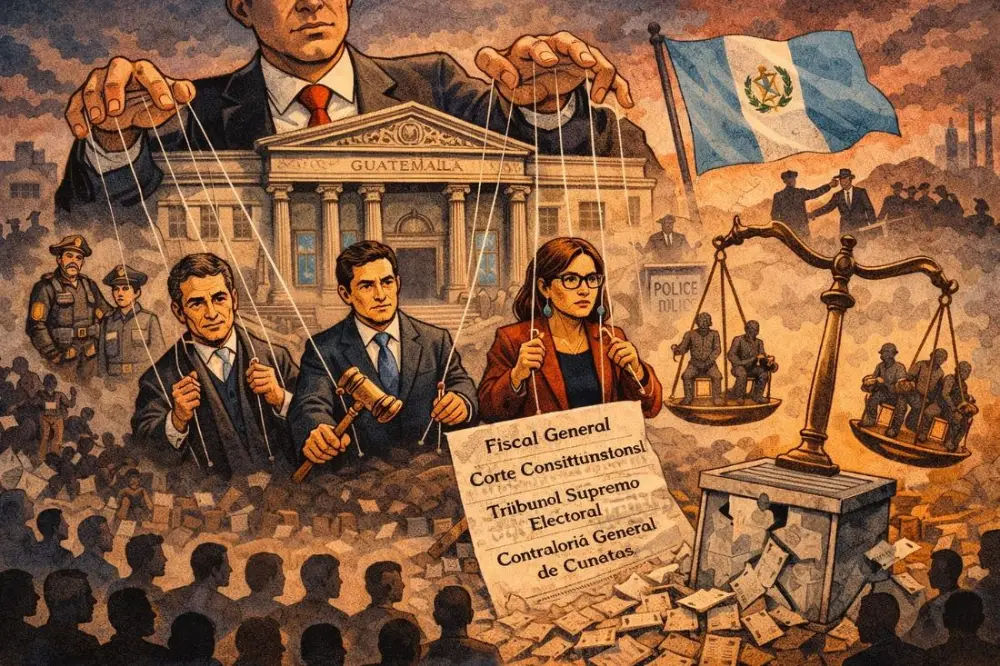
In these days of February 2026, while the world’s attention drifts toward other dramas, decisions are being made — behind closed doors, in technical commissions and guild assemblies — about who will interpret the Guatemalan Constitution for the next five years, who will organize upcoming elections, who will direct criminal prosecution, who will oversee the state’s accounts. This is not a bureaucratic renewal. It is a silent referendum on whether Guatemala will be a functioning democracy or a simulation draped in constitutional garb.
Guatemalan constitutional scholars say that a convergence like this — Supreme Electoral Tribunal (TSE), Constitutional Court (CC), Attorney General, Comptroller General of Accounts, all in a single year — occurs every forty years. If so, what happens between February and May 2026 will shape Guatemala’s power architecture well into the 2030s. And what shapes that architecture is not the popular vote, but a mechanism political theory calls “second-degree elections”: the people do not elect judges or the prosecutor; they elect those who elect them.
Second-degree elections rest on a premise that, stated candidly, sounds like this: some decisions are too important to be left to the ordinary citizen. Designed to filter passions, that premise has become in Guatemala the perfect excuse to exclude citizens from overseeing their own rights.
Hamilton and Madison articulated it in the eighteenth century when designing the United States Electoral College: popular passion, they believed, should be filtered through the deliberative reason of qualified representatives. The logic is respectable — constitutional adjudication requires technical evaluation beyond universal suffrage — but it hides a risk that Latin American experience has documented with painful abundance: when intermediary electors answer to power networks rather than merit, the filter stops purifying and starts contaminating.
In Guatemala, that risk is not hypothetical. It is recent history. The “Parallel Commissions” case — partially dismantled between 2015 and 2020 thanks to the International Commission against Impunity in Guatemala (CICIG) — showed that nominating commissions had been captured by networks that distributed judgeships as concessions: judicial protection in exchange for reciprocal impunity and access to state contracts. Those same networks orchestrated CICIG’s expulsion in 2019. It was not a sovereign decision with unforeseen consequences; it was a self-protection operation designed to ensure the capture mechanism could continue without oversight.
Numbers tell the story words disguise. In 2026, Guatemala simultaneously renews five full and five alternate judges of the TSE, five full and five alternate judges of the CC, an Attorney General, and a Comptroller General of Accounts. Each process has its own nominating commission, its own calendar, its own balance of forces.
Consider the first test: the TSE. The nominating commission, chaired by the rector of the University of San Carlos of Guatemala (USAC) — accused of proximity to cooptation networks — received more than a hundred applications. Civil society filed objections against 38 aspirants, documenting ties to Parallel Commissions, inclusion on the Engel List, and participation in the criminalization of human rights defenders.
The slate of twenty candidates must be delivered to Congress this February. From that list, 160 lawmakers — in a Congress where conservative blocs (Vamos, Valor, UNE, CREO) control the majority, and where Movimiento Semilla, stripped of legal status and fragmented by persecution, lacks the arithmetic strength to stop the steamroller — will choose the judges who will organize the 2027 and 2031 elections.
The second test is the Constitutional Court. The CC is composed of five judges designated by five entities: the President of the Republic, Congress, the Supreme Court of Justice, the Guatemalan Bar Association (CANG), and the USAC Superior University Council (CSU). On February 4, CANG held its vote. Two days earlier, the Sixth Chamber of the Administrative Litigation Court excluded approximately seven thousand professionals from related disciplines from the electoral roll, restricting the vote to active, dues-paying attorneys.
The maneuver — so labeled by observation organizations and by the Organization of American States (OAS) Special Mission itself — favored candidates associated with traditional power groups. The first round produced no absolute majority. The runoff is scheduled for February 12.
While CANG decided its part, another move was unfolding at USAC. Attorney General Consuelo Porras — sanctioned by the United States and the European Union, accused of turning the Public Prosecutor’s Office into an instrument of political persecution for eight consecutive years — submitted her application on February 6 to the USAC Rector’s Office to seek a CC seat by designation of the Superior University Council.
Her real objective, analysts say: to retain immunity shielding her from potential criminal proceedings after leaving the Prosecutor’s Office in May. Porras is not alone. The current president of the CC is also seeking reappointment via USAC. Fourteen candidates are competing for one seat and one alternate. The election is set for February 16.
The detail that poisons the process is not only a questioned rector. It is that 30 of the 41 CSU councilors have expired mandates — not due to bureaucratic negligence, but as the result of years of deliberate cooptation by networks that have not hesitated to resort to intimidation and physical violence to retain control of student, faculty, and professional representations within USAC. The rector presides, with a double vote, over a body where the majority answers to him. He is not an arbiter. He is the operator of a machine.
What sustains a democracy when the institutions meant to protect it are captured by those who need it not to function? The Chilean academic Carlos Peña has written that three pillars sustain an open society: the judiciary, the media, and universities. In Guatemala, all three are compromised. The judiciary has been subject to documented capture. USAC is led by a rector whose legitimacy is questioned. And the media face criminalization.
When all three pillars crack at once, what collapses is not an official or a process; it is society’s very capacity to distinguish between the lawful and the arbitrary, between law and its simulacrum.
The government of Bernardo Arévalo operates under severe legislative minority conditions: a party judicially canceled, a fragmented caucus, and a Congress controlled by blocs whose cohesion does not stem from ideology but from a shared need for protection. The government has announced it will convene professionals to designate its CC judge starting February 9 and has urged voting “with a clear ethical compass.”
But a compass does not replace a balance of forces, and in Congress arithmetic is implacable. Under institutional suffocation, the only variable capable of altering the equation lies not in the chamber but in the streets. The government depends, now more than ever, on citizen indignation breaking the Executive’s political isolation.
Where does this lead? Two scenarios define the range of the possible.
In the first — most likely given the evidence — conservative blocs consolidate total control. The new TSE would organize the 2027 elections under a cloud of doubt. The Public Prosecutor’s Office would move from a sanctioned prosecutor to a successor cut from the same cloth. And the Constitutional Court would be sealed off to block any reform for the next decade. A hollow democracy. A constitutional shell with an impunity-filled core.
In the second — less likely but not impossible — citizen oversight that raises the political cost of brazenness, combined with international pressure and fractures within conservative blocs themselves, produces mixed outcomes in which at least some seats fall to independent profiles. It would not be a democratic spring. It would be a tense, fragile stalemate — but preferable to total capture.
There is, however, a variable conventional analyses underestimate: the relationship between the Arévalo government and Washington. Guatemala is now one of the few countries in the hemisphere where the U.S. administration finds an interlocutor aligned with the anticorruption and pro-democracy agenda. More than fifty individual sanctions since July 2021 — thirty for corruption, twenty-four for antidemocratic actions — the Engel List active, fourteen designations under the Global Magnitsky Act.
The United Nations has been explicit. The OAS has issued alerts. And according to sources close to bilateral dialogue processes, Washington already has the information needed to act with precision if appointments tilt decisively toward capture. As the world’s oldest book says: those who seek, find. And according to those in the know, they have already found everything they need to persuade.
But the medicine should not be romanticized. A democracy that depends on external pressure to correct its own processes is confessing the depth of its illness, not celebrating its cure. Washington’s pressure is selective, geopolitical, and reversible — what favors the anticorruption agenda today may be subordinated to other priorities tomorrow — and the risk that the remedy reinforces dependence rather than sovereignty is real. Guatemala needs international pressure to buy time. But a clock only matters if someone inside builds what is missing.
The United Nations Special Rapporteur, Margaret Satterthwaite, put it precisely in January: “Guatemala must avoid repeating past situations in which individuals associated with abuses of power or serious human rights violations succeeded in obtaining appointments to these key positions.” The phrasing is diplomatic. The reality it describes is not.
Forty years for all the pieces to align on the board again. Five months to decide who moves them. And ninety-nine days between today and the swearing-in of the next Attorney General.
Beyond May, however, Guatemalan society faces a conversation it can no longer postpone: modernizing the mechanisms that produce these crises. Nominating commissions, second-degree elections, designation processes that allow a Superior University Council with expired mandates to choose who will interpret the Constitution for five years — all of this scaffolding was designed to protect democracy and has become the preferred instrument of those who undermine it. The system does not need patchwork. It needs a new cycle.
The battlefield will be 2027. A recent survey of opinion leaders already issues the most unsettling warning: a citizenry weary of good intentions could end up opting for a radical, populist figure — even an autocrat who endangers institutional order itself. Strong leadership and a heavy hand would be rewarded over technical capacity and temperance, the study warned. Frustration, when it finds no democratic channel, produces monsters.
The Constitution forbids Arévalo’s reelection — an entrenched, unamendable article — and the atmosphere already anticipates more than thirty-five parties contesting the race: twenty-six registered with the TSE and another twenty-five committees in formation completing requirements. In that political archipelago, emerging figures from the governing camp identified by the same survey — Ministers Patricia Orantes and Anabella Giracca, legislators Andrea Villagrán and Samuel Pérez (promoters of the party in formation “Raíces”), and Guatemala City councilor Ninotchka Matute — carry a responsibility that exceeds electoral ambition: to articulate a future-oriented proposal that tells the country, clearly, how they intend to dismantle the system that today enables capture.
Because that is the question 2027 will ask everyone who aspires to govern Guatemala: will you move to transform this opaque, manipulable, dangerous system, or will you preserve it because it suits you?
In Guatemala, February 2026 does not smell like spring. It smells of file ink, of cold coffee in rooms where what should not be negotiated is negotiated, of judicial resolutions issued hours before a vote to alter its outcome. It smells of urgency. And, for the first time in years, it smells of fear among those who know they are being watched.
In the corridors hangs the question no one voices aloud: institutions have already ceased to belong to the state. The real question is whether anyone will have the will — and the strength — to reclaim them.