- Panamá: Dignidad y Soberanía en los Tratados Torrijos-Carter
- Telenovelas de sangre: la ilusión fatal del cambio de régimen
- Telenovelas of Blood: The Fatal Illusion of Regime Change
- Cuando el «realismo» se vuelve excusa
- When ‘Realism’ Becomes an Excuse
- El Regreso de Monroe: República Dominicana ante la Estrategia de Seguridad Nacional 2025 de Trump
Panama: Dignity and Sovereignty in the Torrijos-Carter Treaties
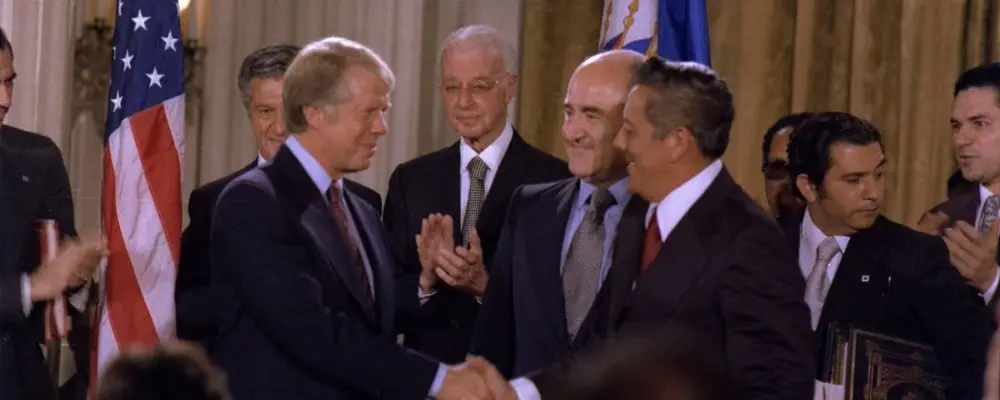
September 7, 1977, marked a historic milestone for Panama and global diplomacy when the Torrijos-Carter Treaties were signed, which not only redefined the administration of the Panama Canal but also consolidated principles of national sovereignty and international cooperation.
This transcendental event was not just a pact between Panama and the United States, but also a powerful affirmation of self-determination and mutual respect between nations.
Geopolitical Transformation and Sovereignty
Since its inauguration in 1914, the Panama Canal has stood out as a marvel of modern engineering, transforming not only the physical landscape but also global geopolitics by connecting the Atlantic and Pacific oceans.
Its construction was a technical feat, but also a focus of political and social controversy, particularly regarding Panama’s sovereignty. For decades, U.S. control of the canal was seen as a symbol of interventionism and inequality in international relations.
The signing of the Torrijos-Carter Treaties radically changed this scenario. These treaties not only scheduled the transfer of the canal to Panama by 1999 but also represented a significant advance in international law, demonstrating that long-standing disputes can be resolved through constructive dialogue and negotiation.
Economic and Administrative Impact
Since Panama assumed full control of the Canal, it has shown impressive administration, making the waterway more efficient and profitable. This management has not only strengthened the Panamanian economy through direct revenue, but has also fostered the development of related sectors such as logistics, maritime, and tourism.
The Canal expansion, completed in 2016, is a testament to Panama’s success in improving this critical route. By allowing the passage of Post-Panamax ships, this expansion has significantly increased the canal’s capacity, thus enhancing global trade and solidifying Panama’s position as an international logistics hub.
Neutrality and Global Security
One of the most innovative aspects of the treaties was the establishment of the principle of perpetual neutrality of the canal, ensuring its continuous operation and open access to all nations on equitable terms, even in times of international conflict.
This provision not only underscores the canal’s strategic importance but also sets a precedent for the peaceful management of other critical transit routes around the world.
Legacy in International Diplomacy
The treaties have also profoundly impacted the international perception of the United States and Panama. For the United States, the peaceful return of the Canal has served to improve its image in Latin America and beyond, showing a commitment to principles of equality and respect for national sovereignty.
For Panama, these treaties have strengthened its status as a respected actor on the international stage, capable of negotiating on an equal footing with world superpowers.
Education and Political Legacy
At the educational and political level, the treaties are frequently studied as a prominent example of the peaceful resolution of conflicts. In law and international relations schools, they are discussed as exemplary cases of how diplomacy and compromise can overcome even the most complex geopolitical challenges.
National Identity and Unity
The Torrijos-Carter Treaties marked not only a significant political and economic milestone for Panama but also deeply strengthened the country’s national identity. By regaining control of the Canal, Panama not only secured a vital economic asset but also reaffirmed its identity as a sovereign and capable nation.
This process has instilled a profound sense of pride and unity among Panamanians, redefining what it means to be Panamanian in the 21st century.
Panama reveals itself in its fullness through the rich cultural diversity of its people. This identity is a splendid mosaic, formed by the vibrant colors of its indigenous, Afro-Caribbean, European, and many other origins that intertwine in the social fabric of the country.
The construction of the Panama Canal brought with it thousands of migrants who not only contributed their labor but also their customs, music, cuisine, and traditions, enriching the country’s cultural landscape. These migrants, coming from various parts of the world, brought a fusion of cultures that has shaped modern Panamanian identity.
This diversity is reflected in the country’s music, cuisine, and festivities. The pollera, cumbia, and tamborito are examples of how imported traditions have adapted and found a new home in Panama, celebrating the diversity of its roots in every festival and celebration.
Panamanian cuisine, with ingredients such as corn, rice, seafood, and tropical fruits, intertwines techniques and flavors brought by migrants, creating dishes that narrate the history of cultural mixing and encounter. This seasoning is a love letter to its multicultural history, where every bite tells a story of encounter, adaptation, and community.
The entrepreneurial spirit and resilience of Panamanians have also been strengthened by the teachings and experiences of those who came from afar.
Panama has known how to grow and adapt to new times, skillfully balancing the preservation of its cultural heritage with the modernization of its infrastructure and economy. This balance manifests itself from the historic Casco Viejo to the vibrant skyline of Panama City.
The dignity and strength of the Panamanian people, forged through their struggle for sovereignty and evidenced during the negotiations of the Torrijos-Carter Treaties, continue the legacy of resistance and perseverance left by those migrants.
This chapter of their history was not only a political victory but also a moment of consolidation of the Panamanian national identity, which reaffirmed its position as a sovereign and globally respected nation.
It is essential to recognize and value the immense sacrifice and rich cultural heritage of the thousands of migrants who helped build the Panama Canal. Their legacy endures in the spirit, culture, and daily life of Panama, reminding us that this nation is not only a bridge between seas, but a crucible of cultures that has forged a legacy of unity, diversity, and resilience that resonates in every corner of its vibrant landscape.
In conclusion, the Torrijos-Carter Treaties are much more than legal documents; they are a symbol of what is possible when nations treat each other with respect and work together towards common goals.
They have transformed a source of conflict into a model of international cooperation, and their legacy continues to inspire Panama and the world to seek constructive solutions to global challenges.
We celebrate not only a political victory or technical achievement but the indomitable spirit of the Panamanian people and their continued commitment to peace, justice, and international cooperation.
(I acknowledge the use of ChatGPT 4 (OpenAI, https://chat.openai.com) to translate the original text from Spanish to English.)