What Do We Have? Facts, Not Smoke (I)
By Josué Fiallo
31 January 2026
Washington, October 30, 2013
When the official vehicle pulled away from the State Department heading to the hotel, I sat in the back seat next to two of the principal officials of our delegation. Looking straight ahead, I said to the one beside me:
—You know that what was really happening wasn't said in there. That will have consequences.
His response, with a hint of disdain, was brief:
—We'll sort that out back home.
That phrase encapsulated the problem. Part of our leadership had cultivated the conviction that the crisis was manageable in domestic terms, that the real battlefield remained solely in Santo Domingo. It was comforting, I suppose, that ability to believe that "back there" and "over here" were still separate worlds. But that day, in Washington, the board had already shifted. We had forgotten something fundamental: that unity of foreign action is not a bureaucratic luxury, but a condition for survival when your international reputation is at stake.
The Dominican Republic was going through the most severe diplomatic crisis in decades. On September 23, the Constitutional Court had issued ruling 168-13, which declared that children of foreigners in irregular migratory status born on Dominican soil did not acquire Dominican nationality by birth. The decision had retroactive effects to 1929 and affected tens of thousands of people—mostly of Haitian descent—who had been born in the country and considered themselves Dominican. The international community responded forcefully: human rights organizations denounced a mass denationalization; allied governments expressed concern; the media seethed with daily headlines and fiery editorials.
In Santo Domingo, the internal response fragmented between unchecked ultranationalist rhetoric and an uneven understanding of the magnitude of the problem. I was deeply concerned, not only about the long-term implications, but about something more subtle: I was not convinced that everyone in the government understood the same problem in the same way.
The delegation traveled with uneven confidence. The Minister of the Presidency understood the complexity of the scenario; he knew that what was at stake was not just a legal case, but the defense of our image as a State respectful of international law. I was an ambassador on secondment, integrated into the team as political and technical support: I drafted documents, took notes, helped design strategy, generated proposals. I always sat in the second row, right behind the minister. That position had an advantage: I could see the whole picture—the gestures, the glances, the papers passing from hand to hand.
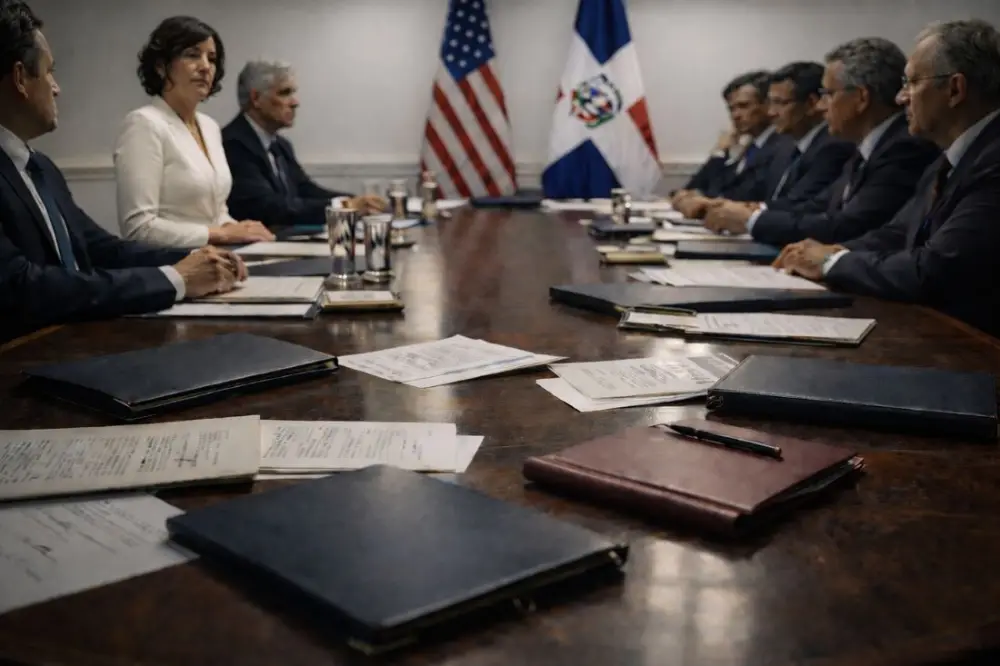
We arrived at the designated floor of the Harry S. Truman Building, where the Bureau of Western Hemisphere Affairs is located—the office in charge of U.S. policy toward Latin America and the Caribbean. On the American side, Roberta Jacobson led a team of six officials; on ours, the Minister of the Presidency headed a delegation that included the Minister of the Interior, the president of the Central Electoral Board, the legal counsel, and several embassy officials.
We entered the meeting room and waited a few minutes. Then Jacobson came in with her team. She was a tall figure, with presence. She approached the table, placed both hands on the surface, leaned toward us, and before sitting down, delivered the phrase that set the tone for the encounter:
—We want to know what you are going to do. We are very concerned about the situation in Ecuador, Venezuela, Nicaragua, and we did not see this coming.
On our side, the Minister of Interior took the floor. At that moment I understood something that years later would become a principle: that defending sovereignty is not just about affirming the country's political independence, but also demonstrating that you are capable of managing your internal affairs in accordance with international law. Sovereignty misunderstood is isolation; properly exercised, it is mutual respect among equals.
Language revealed another fissure. Of the entire Dominican delegation, only two of us spoke English fluently. Jacobson is fluent in Spanish, but my team opted for an approach that trusted the nuances would get lost in improvised translation. Between the linguistic stumbles and the constructions left hanging in the air, our message acquired an ambiguous quality, open to multiple interpretations. In high-level negotiations, mastery of technical language is not optional if the goal is to defend positions with precision and credibility.
The contradictions began when we tried to describe what the country was doing. In the Dominican Republic, a roadmap was already being developed and concrete policies were being discussed; yet at the table, the choice was made to minimize scope, soften tensions, suggest that the impact would be less than what we knew it to be. The body language on the other side was telling: arms crossed, fixed gazes, little note-taking. Over time, one learns to read these signals: you can distinguish when an interlocutor receives with openness, with disdain, or with that particular mix of fascination and alarm that a slow-motion disaster inspires.
In the end, when we managed to explain the roadmap more concretely—the scope of the ruling, the political efforts to build internal consensus, and the organizational progress of the immigrant regularization plan—the atmosphere relaxed somewhat. The Americans committed to not issuing an immediate public statement. It was a vote of confidence conditioned on the country demonstrating with facts that the response would be up to the task.
As we left, several staffers approached me—advisors who are the eyes and ears of those offices. They wanted clarity. They confessed they hadn't quite understood. For a few minutes, I explained to them, in English and with precision, what was being done, the internal political pressure, how the government was navigating between domestic institutions and international obligations.
I then understood the structural role of staffers: they are the ones who process information, filter it, organize it, and then push proposals up to higher levels. In a relationship with the United States, working only with the visible heads is a mistake. It is wise to also build trust with those who sustain the machine from within. That is strategic coordination: not just speaking with the minister, but with the person who prepares their memos.
In parallel, our government hired lobbying firms in the United States and Europe. But we discovered they needed more than checks and slogans: a coherent narrative, solid data, stories anchored in real people, spokespersons who know how to sustain the message under pressure.
That is why we assembled an interinstitutional crisis team: Presidency, Foreign Affairs, Interior, Migration, private sector, press, communicators, analysts. We met several times a week to align messages, prepare inputs, anticipate scenarios. That was what we would today call an interagency coordination mechanism: different bodies, with different mandates, but united by a common objective and a clear line of communication.
From that experience, every briefing for an important meeting became more rigorous: clear talking points, defined red lines, sequence of ideas, answers to the difficult questions. And a silent guideline that still accompanies me today: "no surprises." Inside, we can debate everything. Outside, there is only room for a mature and coherent line. Another rule crystallized: words backed by facts. No talking point without a process underway. The opposite is gunpowder near fire.
Days later we met with the Congressional Black Caucus—the group of African American legislators in the U.S. Congress. It was a broad meeting, chaired by Charles Rangel. One of the members, Representative Kennedy, had been a Peace Corps volunteer in Puerto Plata years before. He knew the subject well; he asked tough, specific, incisive questions.
The conversation started elsewhere. That night could be the last of the World Series. The Boston Red Sox were arriving at game six with the lead, and David Ortiz was the great star of the series. Talking about Ortiz and Pedro Martínez was not a trick; it was an honest way to acknowledge a shared biography between the Dominican Republic and Boston. That brief exchange lowered defenses, allowed the rest of the meeting to proceed with a less accusatory and more analytical tone.
I learned something more: read biographies, not just résumés. That too is diplomacy: building human bridges before negotiating positions of State.
Seven Principles I Learned in Washington
That week was not just a crisis; it was a school. What I learned became principles that guided my work in the years that followed:
1. Technical mastery before charisma. Meticulous preparation—knowing every figure, every legal precedent, every position at stake—is more useful than improvised eloquence.
2. Language as a tool of sovereignty. In international negotiations, depending on translations means surrendering part of control. If you want to participate with leadership in international forums, it is wise to speak their language.
3. Prepare the room before the argument. Major decisions are rarely made in the meeting room. They are made in prior conversations, in contacts with staffers, in the groundwork that builds trust before the microphone is turned on.
4. Speak with those who sustain the machine. Mid-level officials are institutional memory and continuity. Ignoring them is speaking to the facade of the building, not its structure.
5. No surprises: discipline inside, coherence outside. Intense debate in private, single line in public. Institutional maturity is also heard.
6. Every word needs verifiable grounding. Promises without processes underway generate more distrust than silence. Facts first.
7. Read biographies, not just titles. Understand personal histories, connections, trajectories. Not to manipulate, but to connect with the whole person. Diplomacy is, in the end, a profoundly human craft.
A Call from Washington
To those who serve the State: It is not enough to come to a table with titles and positions. You must come with mastery of the subject, clarity of direction, and the ability to speak—literally and politically—the language of those on the other side. The defense of sovereignty and the territorial integrity of the country begins with the seriousness with which we prepare each encounter.
Ask each morning, honestly: "What do we have?" What facts, what mistakes, what progress, what weak flanks? Who decides, who influences, who resists, who could be an ally?
Abandon the fantasy that "we'll sort that out back home." "Back home" no longer exists: what is said in Washington, Brussels, or New York has direct consequences in the factory, on the farm, in the neighborhood. What is left unsaid, also. Coherence between domestic policies and foreign action is not a luxury; it is a necessity. Interinstitutional coordination is not bureaucracy; it is diplomatic survival.
The country needs permanent coordination mechanisms, not improvised crisis teams every time a problem erupts. It needs a clear institutional system, with technical leadership from the Foreign Ministry, with high-level coordination bodies that align positions before the country speaks publicly.
To academics and the next generation of diplomats: Invest in what sometimes seems secondary: languages, reading context, practicing negotiation under pressure, continuous training in international law and contemporary diplomacy. You cannot seriously influence if we always depend on others to translate the world for us. Professionalizing the foreign service is not an academic whim; it is the difference between successfully defending national interests or returning empty-handed.
Our country needs public servants who are not afraid of method, who take preparation seriously, who understand that a nation's reputation cannot be improvised. Who know that true influence is not about dominating the photo of the day, but about building, meeting after meeting, the image of a country that says what it does and does what it says.
A country that defends its sovereignty without isolation, that promotes its constitutional values in the international arena, that protects its nationals wherever they may be, that contributes to international peace and security, that negotiates from dignity and mutual respect.
That is the kind of influence that will make us more respected when we sit down, again and again, at the tables where part of our future is decided.