- Crónica de un Viaje Imposible: La Representación Dominicana que Nunca Llegó a México (1910)
- La odisea diplomática y artística de la instalación del busto de Juan Pablo Duarte en la Unión Panamericana
- Primera Parte: El Panamericanismo antes de la Creación de la Unión Panamericana
- First Part: Pan-Americanism before the Creation of the Pan-American Union
- Segunda Parte: El Panamericanismo después de la creación de la Unión Panamericana
- Second Part: Pan-Americanism after the creation of the Pan-American Union
Chronicle of an Impossible Journey: The Dominican Delegation That Never Reached Mexico (1910)
In the early 20th century, as emerging nations sought to solidify their relationships on the global stage, national celebrations became important diplomatic moments. One such emblematic date was the first centennial of Mexico’s independence, a country with which the Dominican Republic maintained cordial relations. This key moment in Mexican history not only commemorated emancipation from colonial rule but also the consolidation of Mexico as a symbol of freedom and independence in Latin America. It was in this context that the Caribbean nation enthusiastically received the invitation to participate in these significant festivities.
In May of 1910, an invitation arrived in Santo Domingo, signed by Federico Gamboa, Mexico’s Undersecretary of Foreign Affairs. This long-awaited document was the manifestation of the “cordial relations” that united the two nations, expressing Mexico’s desire for the Dominican Republic to designate a representative for the centennial commemoration of its independence. The invitation, beyond protocol, underscored a gesture of friendship, of brotherhood between two countries that shared a history of struggle for freedom. In its content, Gamboa solemnly expressed:
“In view of the cordial relations that happily bind us to this friendly nation, the president has graciously decided that, as I have the honor to do, the president of the Dominican Republic and its government are invited to designate a person or persons to represent them on this occasion, which for us is so momentous and unforgettable.”
Alongside the letter were two copies of the program for the celebrations that Mexico would carry out throughout September 1910. The invitation not only represented an act of respect but also a call to participate in commemorating a struggle that resonated deeply with the American nations that had lived under colonial rule.
For the Dominican Republic, attending this event was not just a matter of diplomacy but a moral duty. The historical ties and shared principles with the young Mexican nation made this invitation an honor that could not be overlooked. Diplomatic relations between the two nations were relatively young but firm, and the Dominican presence at Mexico’s centennial meant much more than a mere act of protocol. It was, in essence, a reaffirmation of a brotherhood rooted in the struggle for independence and freedom.
Enthusiasm did not take long to arise. On May 24, the Dominican Foreign Ministry promptly responded, announcing the designation ofAmérico Lugo as its representative. In that communication, Lugo was highlighted as a “law graduate and a person of notable intellect and intelligence,” ideal for representing the country with dignity on such a transcendental occasion. Everything seemed to be going smoothly, but fate had already begun weaving the first complications.
Américo Lugo, a prominent figure in Dominican intellectual circles, was at that time in Buenos Aires, Argentina, attending the Fourth Pan-American Conference. This event, of great importance to continental diplomacy, had unexpectedly extended its duration, causing the first setback to Dominican plans.
On August 19, as the Mexican festivities approached, the Dominican Foreign Ministry sent a telegram to Lugo asking if he would arrive in time for the centennial events. Lugo’s response, received on August 21, was a blow to the heart of Dominican diplomatic efforts: due to the extended conference, it was “impossible to go to Mexico.”
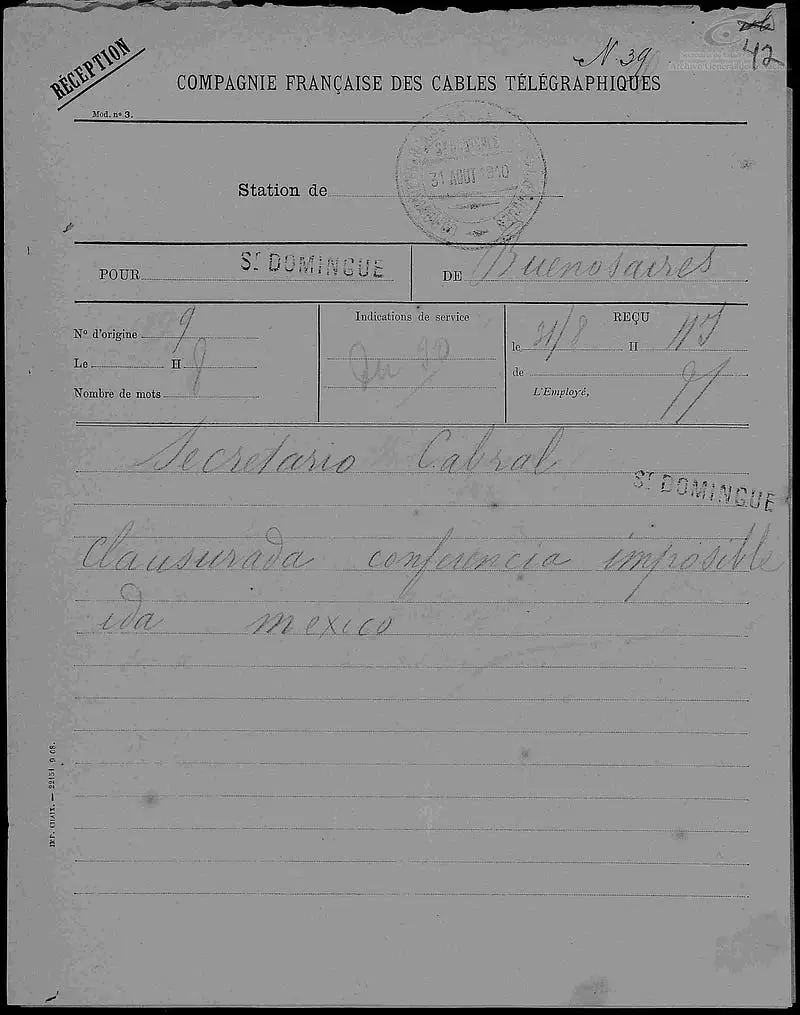
This setback forced the Dominican Republic into a race against time to find a substitute. Time was running out, and options were dwindling. The news reached President Ramón Cáceres on August 21. With Lugo unable to attend, Licenciado José María Cabral y Báez, from Santiago, recommended finding someone in Mexico who could represent the Dominican Republic, suggesting this be a prominent figure in the host country. However, Tejera, the Foreign Minister, did not see this option as viable and urgently sought the President’s direct intervention to make a final decision.
Here, an unexpected twist emerged. On August 22, President Cáceres suggested that Tejera consult Federico Henríquez y Carvajal, one of the nation’s most learned minds, on whom to designate in Mexico to represent the Dominican Republic. In his response, Henríquez recommended Dr. Joaquín Demetrio Casasús, a legal luminary in Mexico, as the ideal candidate to assume that responsibility. Additionally, he proposed Pedro Nicolás Henríquez Ureña as Secretary.
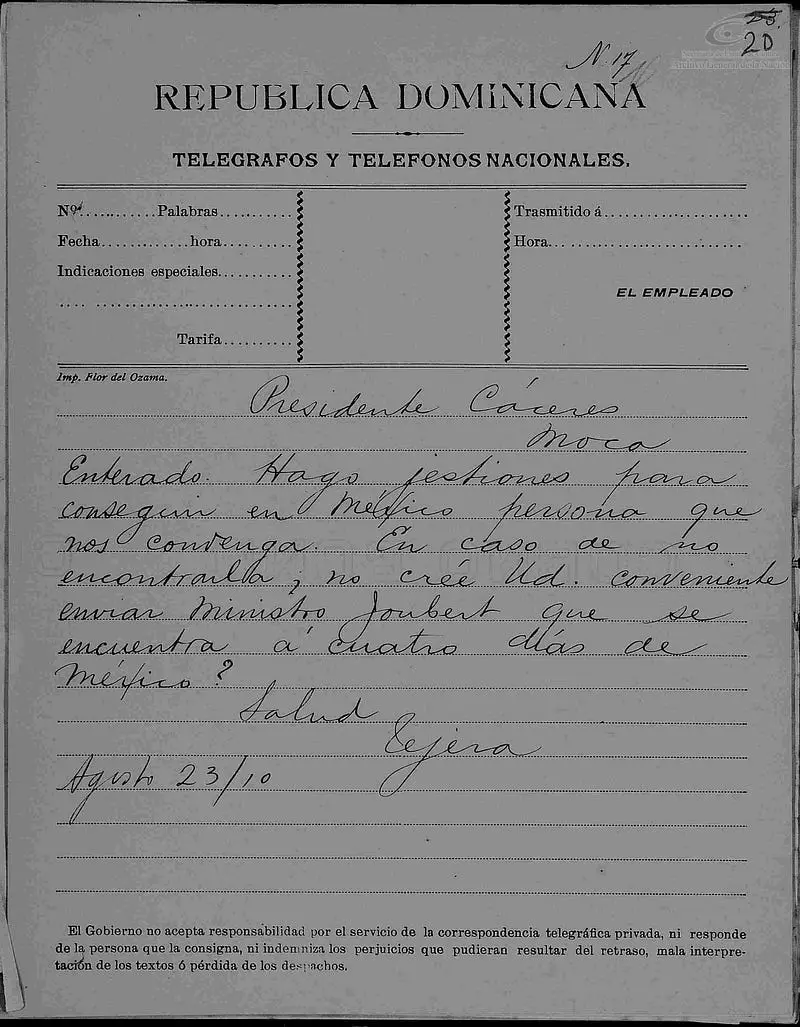
However, even with this weighty recommendation, President Cáceres left open the possibility that, if time ran out, Emilio Joubert, the Dominican Minister in Washington, be appointed, as he was only four days away by train from the Mexican border.
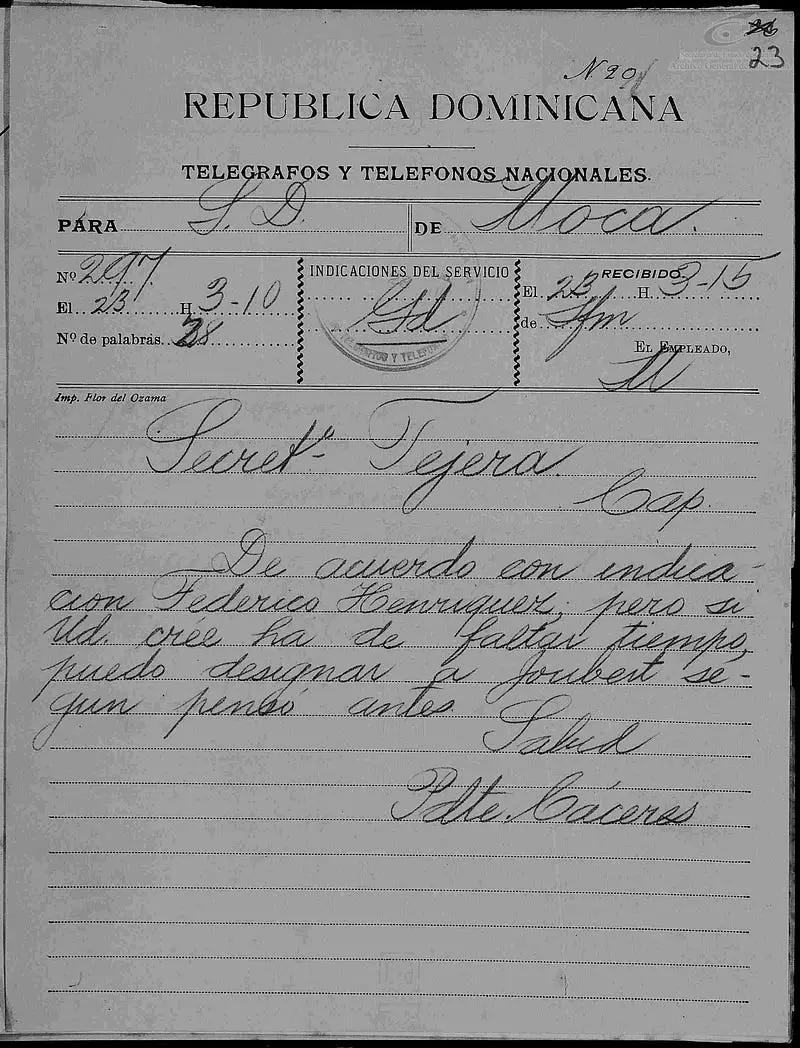
On August 23, Tejera sent a telegram to Dr. Joaquín Demetrio Casasús, a distinguished figure in Mexico, asking him to accept the Dominican representation at the event. Casasús, however, responded two days later that his Constitution prohibited him from accepting such assignments without prior authorization from the Mexican Congress, which would not meet until after September 16, when the celebrations would already be over. In his telegram, Casasús clarified:
“Our political constitution prohibits accepting commissions from foreign governments without prior permission from Congress. This will meet on the sixteenth of September, and as it is a new Congress, it will not be in a position to hold sessions until a week later. Consequently, permission could not be obtained until my services would no longer be timely for the Dominican Republic…”
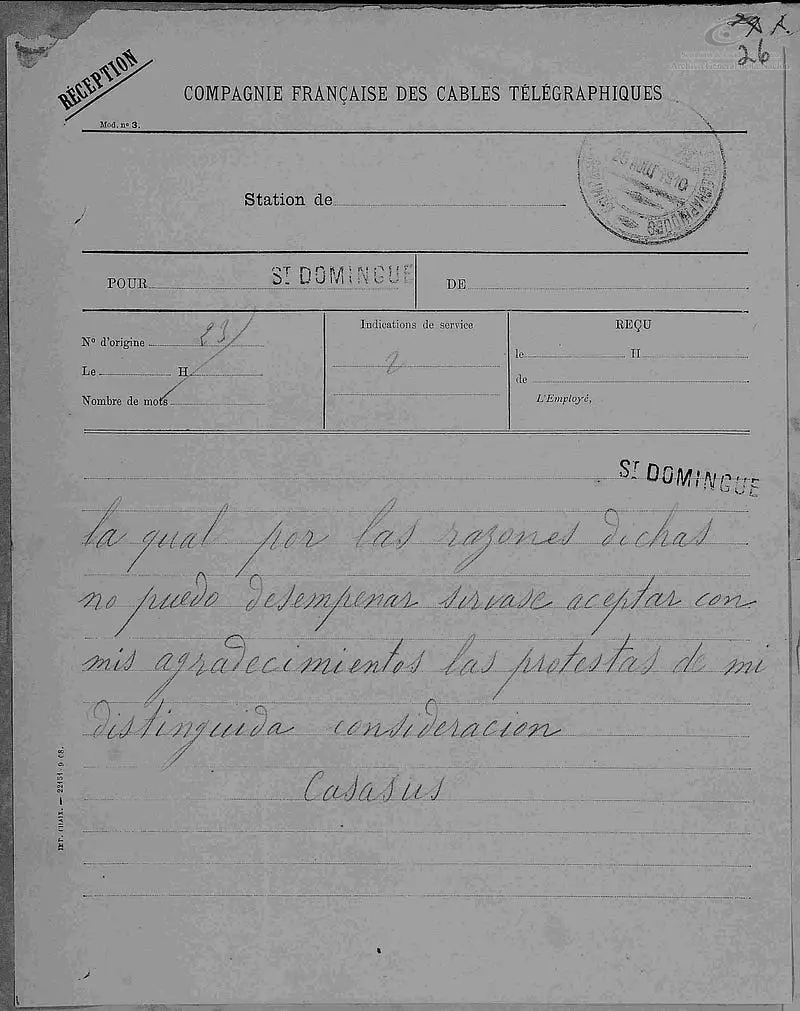
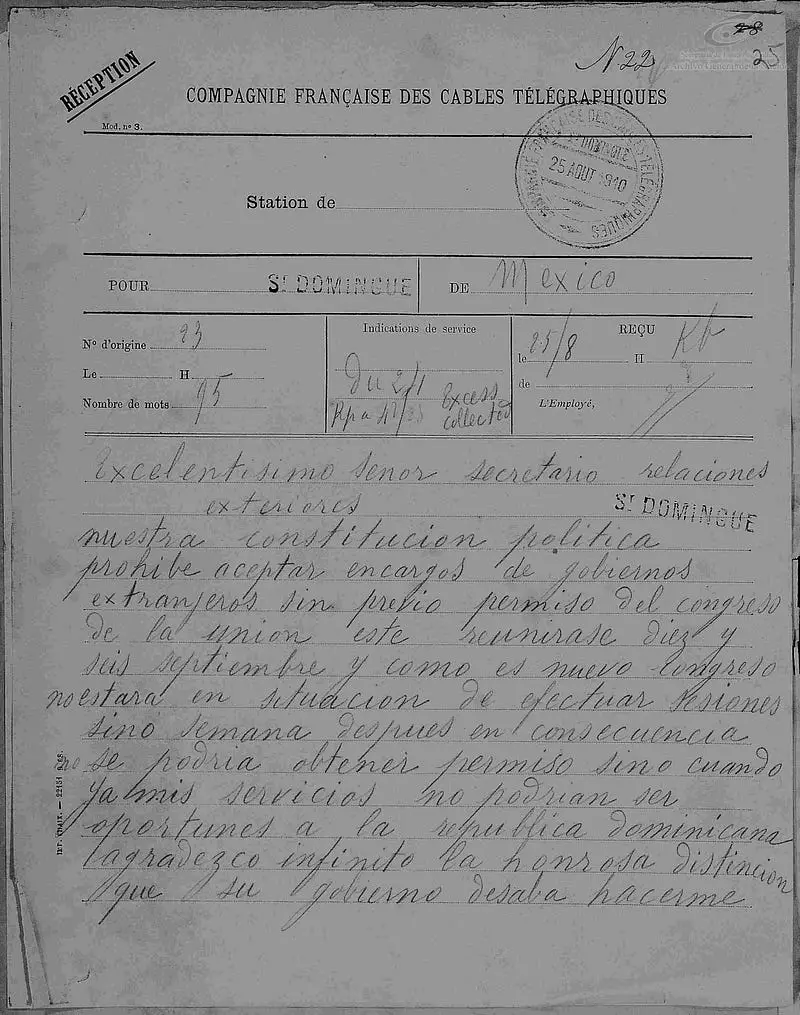
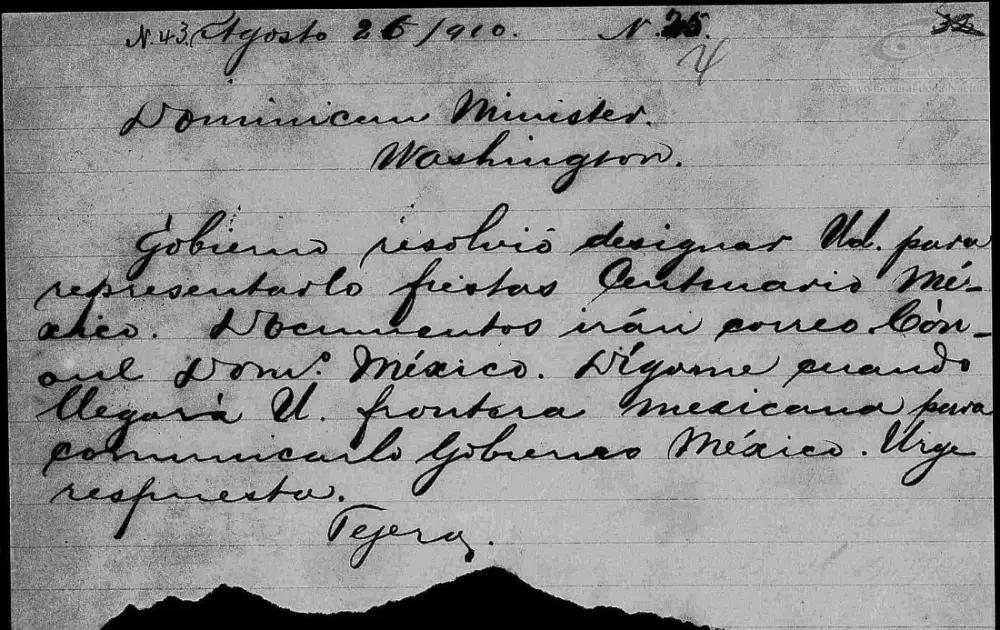
Casasús’ refusal was a hard blow, and President Cáceres had to make a final decision. Emilio Joubert, the Dominican Minister in Washington, was then suggested as the only viable option to represent the country in Mexico. Joubert was an experienced diplomat and well-acquainted with the responsibilities of the role. Quickly, the Dominican government processed Joubert’s appointment, and on August 26, the Mexican government was informed of his designation:
“Since delegate Lugo is unable to attend the Centennial Celebration, the Dominican Government has appointed our Minister in Washington, Joubert, to represent it,” wrote Tejera in a message to Enrique Creel, Mexico’s Foreign Minister.
Creel, on August 28, responded cordially:
“I have received the esteemed message of your excellency regarding the appointment of Mr. Joubert to represent that country at the centennial of independence.”
Joubert, who was thousands of miles away in Washington, prepared for the journey, a trip that would take four days by train to reach the Texas border at Laredo on September 2. On August 29, the Dominican Secretary of Treasury and Commerce confirmed the provision of 600 pesos, a considerable sum at the time (equivalent to more than twenty thousand dollars today), to cover the travel expenses.
It seemed that everything was finally under control and that the Dominican Republic would be present at the grand event of its sister nation.
However, adversity, always unpredictable, struck once more. On August 30, just days before his expected arrival, Joubert sent a heartbreaking telegram: he had fallen ill with the flu and could not make the trip. This misfortune shattered Dominican efforts.
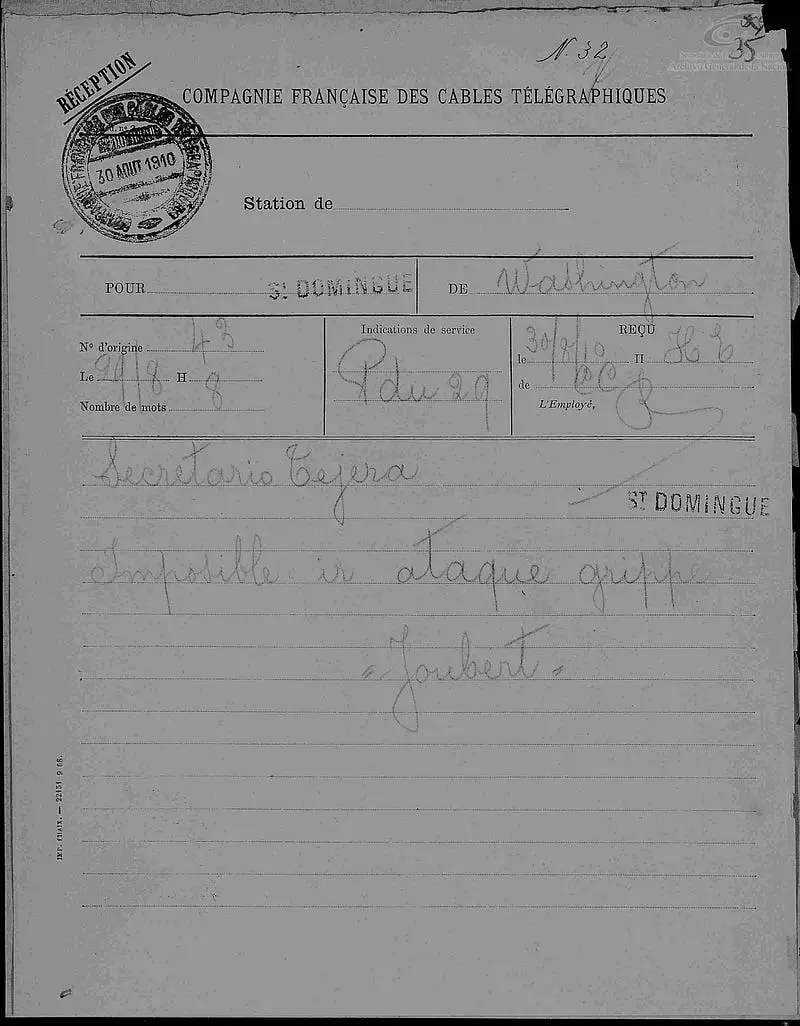
With no more options, the government had no choice but to send formal apologies to the Mexican government.
On September 3, the Dominican government deeply regretted its absence but offered its excuses to Mexico for the unforeseen circumstances that had thwarted its plans. Enrique Creel, the Mexican Foreign Minister, responded with understanding, though not without a touch of regret:
“I received with sorrow the telegram from your excellency communicating that the Dominican government will not be represented at the centennial festivities.”
This account, reconstructed from telegrams and official communications, transports us to an era when distances and technological difficulties were immense. The relentless efforts of Dominican diplomacy clashed again and again with the obstacles of fate, symbolizing the complexities of the diplomatic world at the beginning of the 20th century. From Lugo’s inability, the negotiations with Casasús, to Joubert’s unexpected illness, the Dominican Republic tried its utmost to be present at Mexico’s centennial. But, as in life itself, sometimes even the best-laid plans are derailed by circumstances beyond anyone’s control.
This episode of Dominican diplomacy, though marked by absence, also stands as a testament to the unwavering will of a nation to fulfill its duty and honor its commitment to a sister nation. The Dominican odyssey to Mexico, cut short at the last moment, reflects the complexities of international relations in an era where speed and communication were monumental challenges.
The lesson from this story goes beyond the historical anecdote. In a world increasingly interconnected, where distance has been nearly eradicated by modern technology, this account is a reminder of the fragility of human plans. That the Dominican Republic could not be present in Mexico did not tarnish the “cordial relations” between the two nations. On the contrary, the Dominican absence is a testament to perseverance, commitment, and mutual respect — values that, more than a century later, continue to guide diplomacy between these two brotherly peoples.
This story invites us to reflect on how the diplomatic world has changed since then. Today, videoconferences and intercontinental travel are routine.
However, despite the advances, the essence of diplomacy — the effort to build bridges, overcome differences, and create understanding between nations — remains as relevant and challenging as it was in 1910.
More here: https://x.com/JosueFiallo/status/1840168435172405383