- Crónica de un Viaje Imposible: La Representación Dominicana que Nunca Llegó a México (1910)
- Chronicle of an Impossible Journey: The Dominican Delegation That Never Reached Mexico (1910)
- La odisea diplomática y artística de la instalación del busto de Juan Pablo Duarte en la Unión Panamericana
- Primera Parte: El Panamericanismo antes de la Creación de la Unión Panamericana
- Segunda Parte: El Panamericanismo después de la creación de la Unión Panamericana
- Second Part: Pan-Americanism after the creation of the Pan-American Union
First Part: Pan-Americanism before the Creation of the Pan-American Union
“Deeply imbued with these ideas, I invited… the governments… to form a confederation and gather in the Isthmus of Panama or another eligible point a plurality, an assembly of plenipotentiaries from each State to serve us as counsel in major conflicts, as a point of contact in common dangers, as a faithful interpreter in public treaties when difficulties arise, and as a conciliator, in short, of our differences.” Simón Bolívar December 7, 1824
On the occasion of the upcoming bicentennial of the call for the Amphictyonic Congress, it is appropriate to undertake a historical review of the emergence and development of regional multilateralism in the Americas. This analysis allows us to understand the roots and challenges that have shaped integration efforts in our region over two centuries.
Pan-americanism is a diplomatic and political movement whose main objective has been the integration and cooperation among the nations of the Western Hemisphere, particularly between the countries of Latin America and the United States. From its inception, panamericanism sought not only solidarity and mutual understanding but also the creation of a regional system based on respect for national sovereignty and equality among nations.
This movement emerged in the context of the Latin American independence movements of the 19th century, as a response to the threats of European intervention and the need for the young republics to protect each other mutually. The influence of liberal ideological currents spreading in Europe after the French Revolution was key in forming the ideals of freedom and justice that guided Latin American leaders, such as Simón Bolívar.
During his stay in Europe, Bolívar witnessed the political reorganization that followed Napoleon’s fall, which solidified in him the idea that the Latin American republics should unite to resist the imperialist ambitions of European powers. In the famous Oath of Mons Sacer in 1805, Bolívar vowed not to rest until he liberated Latin America from Spanish rule, symbolizing his commitment to the independence cause and his vision of a confederation of united republics.
Thus, from his early years, the foundations of panamericanism were influenced by Simón Bolívar’s thinking. Bolívar, at the Congress of Panama, formally proposed the union of the new republics to face foreign threats. His vision of unity was complemented by the Monroe Doctrine, proclaimed by U.S. President James Monroe, which declared that any attempt at European colonization in the Americas would be seen as a threat to the security of the United States. Although the Monroe Doctrine was initially a unilateral policy, it laid the groundwork for a broader inter-American understanding by establishing the premise of protecting the continent from foreign influences. However, it also generated tensions, as Latin America began to see this policy as a possible means for the expansion of U.S. control, thereby affecting bilateral relations throughout the 20th century.
By the 20th century, panamericanism acquired new dimensions, transcending its defensive origin against Europe and adopting broader economic and cultural objectives. The nations of Latin America, which originally sought to protect their sovereignty against foreign intervention, began to explore forms of economic and diplomatic cooperation that would promote trade, cultural exchange, and regional peace (Macquarrie, 1954). Not only governments promoted this movement; civil organizations also firmly believed in hemispheric integration and mutual cooperation. These ideas culminated in the creation of the Pan American Union in the early 20th century, which formalized the principles of panamericanism and paved the way for the founding of the Organization of American States (OAS) in 1948.
1. The First Attempts at Inter-American Cooperation
After the Latin American independence movements, political fragmentation and rivalries among the new republics posed a significant obstacle to unity. Simón Bolívar, convinced of the need for a confederation, conceived the Amphictyonic Congress of Panama in 1826. This congress was an attempt to consolidate a league of Latin American nations that could coordinate foreign policy, commerce, and defense, following the ideals expressed by Bolívar in his Jamaica Letter of 1815, where he envisioned an “august congress” that would unite the American republics under a common project.
The celebration of the Congress of Panama was also a response to the imperialist movements of the time. Despite the proclamation of the Monroe Doctrine in 1823, which established that the Americas should be free from European colonization, Bolívar distrusted the United States and feared that its growing influence could alter the balance of power in Latin America. Although some leaders, like Francisco de Paula Santander, advocated for U.S. participation in the congress, Bolívar was skeptical, concerned that this country might use the event to exert influence over the internal affairs of Latin American nations.
The Congress of Panama in 1826 was the first major effort towards inter-American cooperation. Bolívar, recognized for his leadership in the independence struggles, convened the new republics of Latin America to form a defensive alliance that could face foreign threats, especially those from European powers. Although the congress failed to establish a formal and lasting organization, it represented an important milestone, laying the groundwork for future attempts at hemispheric cooperation.
Bolívar, influenced by revolutionary experiences, believed that the union of Latin American republics was crucial to maintain their sovereignty and independence against recolonization attempts. However, the congress faced various obstacles, such as political differences among countries and logistical problems, limiting the full participation of some nations. Additionally, certain local elites distrusted external influence, making the creation of a lasting structure difficult. Despite these limitations, the Congress of Panama left a symbolic legacy as the first serious attempt to establish a regional union, and its ideals continued to influence the development of panamericanism in the following decades.
This initial effort highlighted the importance of inter-American collaboration in the face of common threats, such as foreign intervention. Although the Congress of Panama did not achieve its immediate objectives, it set a precedent for future leaders who would also see hemispheric cooperation as a way to ensure the stability and development of American nations. Despite its organizational failure, the Congress of Panama was a key starting point on the path toward greater inter-American integration. Many of the ideals defended by Bolívar would be taken up and renewed during the Pan-American conferences of the 20th century.
2. The Congress of Panama: Initiative and Failure
Despite Bolívar’s aspirations, the Congress of Panama faced significant obstacles. Some Latin American leaders, such as Bernardino Rivadavia of Argentina, feared that the proposed confederation would pose a threat to their national interests. Similarly, the effective participation of delegates was limited, and ideological discrepancies among attendees hindered progress. These factors, combined with the internal political instability of many nations, contributed to the failure of Bolívar’s project for a supranational confederation that would defend the autonomy of Latin American republics against foreign powers.
Bolívar aspired for the congress to be a space similar to the Isthmus of Corinth for the ancient Greeks, where Latin American republics could resolve their differences and coordinate efforts on matters of peace and war. However, the deep political divisions and the particular interests of the new Latin American nations weakened this effort. Despite its failure, the Congress of Panama left a symbolic legacy that would influence future attempts at Latin American integration and the Pan-American conferences of the 20th century.
3. The Monroe Doctrine and Panamericanism in the 19th Century
The Monroe Doctrine, proclaimed in 1823, was initially well received by some Latin American nations as a mechanism to protect against European colonial ambitions. However, as the United States expanded its influence in the region, the doctrine was viewed by many as a pretext for intervention in the internal affairs of Latin America. This interventionism, which became more evident during the 19th century, undermined trust in the United States as a defender of Latin American sovereignty and created tensions between the north and south of the continent.
Tensions between Bolivarianism and Monroeism continued throughout much of the 19th century, and this conflict between the leadership aspirations of the United States and the autonomy of Latin American countries became a constant in hemispheric relations. The Monroe Doctrine, while laying the groundwork for hemispheric protection against European powers, also opened the door to new forms of American influence in Latin America, causing many Latin American countries to distrust the intentions of their northern neighbor.
During the 19th century, panamericanism remained a growing ideal, driven by the consolidation of the new Latin American republics. A key milestone in this process was the Monroe Doctrine of 1823, which established that any attempt at colonization or intervention by European powers in the American continent would be considered a threat to the United States. This doctrine was initially a unilateral policy, and although it was well received in Latin America, it also drew criticism. Latin American countries began to perceive the Monroe Doctrine as an excuse for the United States to intervene in their internal affairs, fostering an unequal relationship.
When evaluating the impact of the Monroe Doctrine on inter-American relations, it is essential to recognize both its benefits and limitations. On one hand, it provided a framework for defense against foreign powers, ensuring that European colonial efforts did not advance on the continent. On the other hand, it also marked the beginning of an unequal relationship between the United States and Latin America, where the growing American influence was often seen as a new form of interventionism. This imbalance became evident during the second half of the 19th century when the United States adopted a more active foreign policy in the region, driven by commercial and strategic interests.
Leaders like Henry Clay and John Quincy Adams promoted commercial integration between the United States and Latin America, seeing the region as a strategic market for American exports. However, efforts to establish deeper commercial relationships faced political and social challenges in the Latin American republics, many of which were plagued by internal conflicts and territorial disputes. The lack of a formal structure for inter-American cooperation and instability in several countries hindered the creation of an effective panamericanism.
Panamericanism in the 19th century was a phenomenon marked by an unstable relationship between cooperation and tension. Although the Monroe Doctrine established the foundations for hemispheric protection, it also opened the door to new forms of American influence, which in subsequent decades would be questioned by Latin American republics. These dynamics of tension and cooperation would pave the way for the creation of formal institutions capable of better managing inter-American relations.
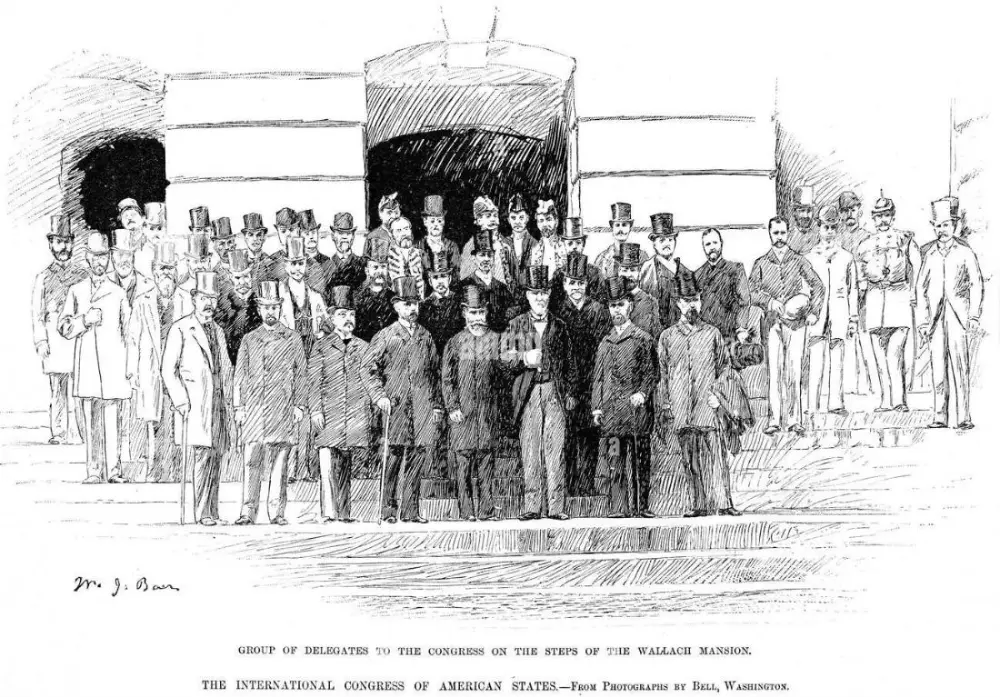
As the 19th century came to a close, panamericanism began to consolidate with the first International Conference of American States in 1889–1890, driven by Secretary of State James G. Blaine. This event represented the first institutional step toward a more structured and lasting hemispheric cooperation.
4. James G. Blaine and the First International Conference of American States (1889–1890)
The true institutional impetus for panamericanism arrived with the First International Conference of American States, organized in Washington D.C. in 1889–1890 by U.S. Secretary of State James G. Blaine. Blaine, a staunch advocate of hemispheric cooperation, saw in this conference the opportunity to strengthen both the political and economic ties among American nations, especially through commerce.
The main objective of the conference was to promote peace and economic cooperation in the hemisphere, and Blaine understood that inter-American trade could serve as a bridge for integration. During the conference, delegates from 18 American countries discussed a series of topics related to commerce, international arbitration, and conflict prevention in the region. One of the most important outcomes of the conference was the creation of the Commercial Office of the American Republics, the precursor to what would later become the Pan American Union.
This organization, which initially had the mission of promoting trade among hemisphere countries, was also established as a diplomatic forum to peacefully resolve disputes and improve mutual understanding among nations. Blaine’s conference represented a turning point in the history of panamericanism, as it established the first formal institution dedicated to inter-American cooperation.
The creation of the Commercial Office was only the first step in the institutionalization of panamericanism.
5. Institutional Panamericanism in the 20th Century
By the late 19th and early 20th centuries, panamericanism began to institutionalize, culminating in the creation of the Bureau of the American Republics in 1890, as a result of the First International Conference of American States organized by U.S. Secretary of State James G. Blaine.
During the World Wars, panamericanism acquired a more pragmatic dimension, focused on hemispheric security and defense. Institutions such as the Inter-American Defense Board and the Inter-American Treaty of Reciprocal Assistance (TIAR) were created, establishing a collective defense commitment in case of external aggression. These efforts reflected the evolution of panamericanism, which transitioned from a Bolivarian ideal to a system of institutionalized diplomatic and military cooperation.
Panamericanism, throughout the 19th and 20th centuries, laid the groundwork for the creation of the Organization of American States (OAS) in 1948, consolidating the principles of inter-American cooperation and solidarity that continue to guide hemispheric relations to the present day.
The establishment of the Bureau of the American Republics in 1890 represented a significant advancement in the formalization of panamericanism. This institution, a result of the First International Conference of American States, was the first organization aimed at promoting inter-American cooperation in a structured and permanent manner. Although its initial mission was primarily commercial, it soon expanded to encompass diplomatic and conflict resolution matters, reflecting the growing need for an organization capable of handling the complex challenges of inter-American relations.
Under the direction of William E. Curtis, journalist and diplomat, the Bureau began collecting and distributing information about commercial opportunities in the Americas, facilitating the creation of commercial networks among American republics. This approach helped strengthen inter-American trade and promoted greater economic interdependence among hemisphere countries. However, the Bureau also became a diplomatic forum where nations could peacefully resolve disputes, laying the groundwork for deeper multilateral cooperation in the future.
Although the Bureau initially focused on commerce, its role soon expanded. In the following years, it became a key space for preventive diplomacy and conflict mediation, demonstrating that inter-American cooperation could have not only an economic but also a political impact. The Bureau facilitated dialogue among nations and promoted the idea that disputes should be resolved through peaceful negotiation, anticipating the role that the Pan American Union would later play.
As the Bureau’s functions expanded, it became clear that a broader institution with greater capabilities would be necessary to address the growing political and economic challenges of the hemisphere. The next step in this evolution would come with the transformation of the Bureau into the Pan American Union in 1910, a change that reflected the maturity of panamericanism and its transition toward a more comprehensive international organization.
Conclusion
The development of panamericanism before the creation of the Pan American Union demonstrates a complex and multifaceted evolution, marked by ideals of unity and cooperation in the face of external and internal challenges. From the pioneering efforts of Simón Bolívar and the Congress of Panama to the institutional formalization through the Bureau of the American Republics and the Pan American Union, panamericanism has been a dynamic process seeking to balance national sovereignty with the need for regional cooperation. Although it faced numerous obstacles, including tensions arising from the Monroe Doctrine and ideological differences between Latin American nations and the United States, the movement has left a lasting legacy that has influenced the creation of institutions such as the Organization of American States (OAS). This historical journey highlights the importance of inter-American collaboration for the stability and development of nations in the Western Hemisphere.