- Desafiando la Recesión Democrática: Una Perspectiva desde República Dominicana.
- Chile y República Dominicana: Ecos Paralelos de Resistencia Democrática
- Chile and Dominican Republic: Parallel Echoes of Democratic Resistance.
- Defying the Democratic Backsliding: A Perspective from the Dominican Republic
- Sistemas Electorales en las Américas: Un Análisis Integral desde las Misiones de Observación…
- Colombia ante la urna y los sedimentos del posconflicto
Electoral Systems in the Americas: A Comprehensive Analysis from the OAS Electoral Observation…
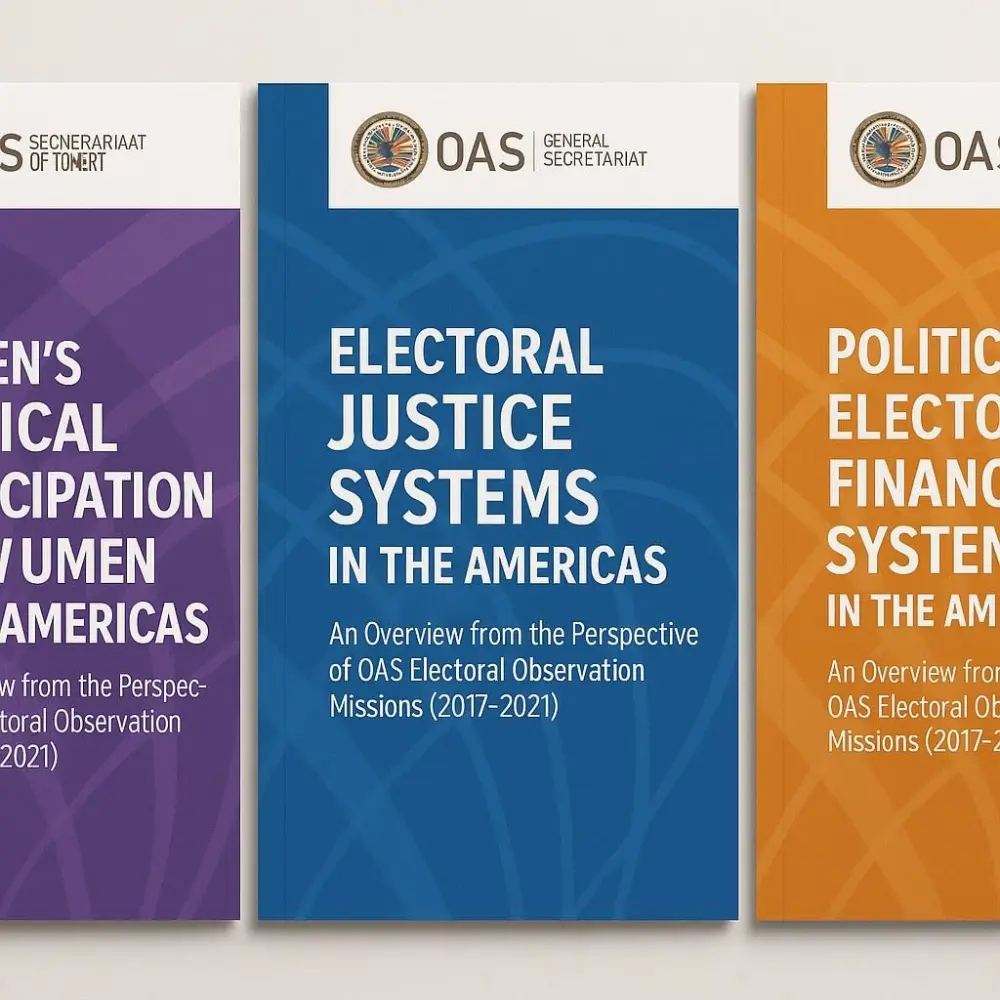
The recent reports from the Organization of American States on electoral systems represent a valuable contribution to regional democratic strengthening. This consolidated analysis examines three dimensions: electoral political financing, women’s political participation, and electoral justice systems, based on observations and recommendations from nearly 50 Electoral Observation Missions deployed in over 20 countries across our hemisphere during the five-year period of 2017–2021.
I. Electoral Political Financing: The Structural Foundation of Democratic Competition
Since the democratic transitions of the late last century, our nations have considerably strengthened their electoral processes. However, building robust political-electoral financing systems capable of balancing democratic competition remains an unresolved matter for many countries in the hemisphere. The Inter-American Democratic Charter, in its fifth article, already highlighted this priority by directing States to pay special attention to the problems stemming from the high costs of electoral campaigns and the establishment of balanced and transparent systems.
The detailed analysis of recommendations issued by the EOMs reveals that almost 30% focus on aspects related to public financing and resources. This is not coincidental; it reflects the concern for ensuring equitable conditions for all political actors, particularly for traditionally marginalized groups such as women and indigenous peoples. The EOMs have repeatedly insisted on the need to implement “second-generation quotas” that ensure not only nominal representation but also effective resources for the electoral competition of these groups.
Control and oversight represent another fundamental axis, accounting for more than 20% of the recommendations. The experience observed in the region demonstrates that the effectiveness of any regulation crucially depends on the technical, financial, and human capacity of the organizations responsible for its application. Establishing clear rules is insufficient if they cannot be verified and efficiently applied. In this sense, the implementation of technological tools such as the “Cuentas Claras” digital platforms in Colombia or the “Sistema Integral de Fiscalización” in Mexico represent notable advances that deserve to be studied and adapted to other national contexts.
Accountability, which accounts for about 16% of the recommendations, constitutes the necessary complement to any oversight system. The EOMs have pointed out the importance of standardizing accounting procedures and adjusting them to international regulations such as the International Accounting Standards (IAS) and the International Financial Reporting Standards (IFRS). This standardization facilitates both compliance by political actors and the work of oversight bodies.
The diversity of financing models in the region is notable: while Latin America tends toward mixed systems with a predominance of public financing and limits on private contributions, several Caribbean countries completely lack specific regulations in this area. This heterogeneity reflects both different political traditions and varying degrees of institutional maturity.
II. Women’s Political Participation: The Imperative of Substantive Parity
The second report analyzes the advances and challenges regarding gender equality in the hemisphere’s democratic systems. Since the adoption of the Inter-American Convention on the Prevention, Punishment, and Eradication of Violence against Women (Belém do Pará) in 1994 and the Beijing Declaration and Platform for Action in 1995, our nations have traveled a path of institutional, regulatory, and cultural transformations. As a region, the Americas now boast the highest percentage of female representation in national parliaments, exceeding the global average of 26.5% by more than eight points, according to data from the Inter-Parliamentary Union.
Of the total 239 recommendations analyzed in this area, about 58% focus on two fundamental categories: parity, quotas, and affirmative actions on one hand, and political violence against women on the other. This concentration reflects the hemispheric concern for ensuring equitable conditions for female political participation.
Of the 22 countries studied, 15 already have some legislative measure guaranteeing spaces for women in candidate lists for representative bodies. Of these, seven have advanced toward the implementation of parity, understood not as a temporary measure but as a conception that reformulates political power as a space to be shared equally between women and men.
Despite regulatory advances, structural challenges persist, such as political violence against women, a phenomenon that paradoxically has intensified as female participation in political spaces increases. The inequitable distribution of political financing constitutes another fundamental barrier: as the study points out, if these public resources do not reach women, they are not fulfilling their democratic function.
III. Electoral Justice Systems: Guarantors of Democratic Legitimacy
The third component analyzes electoral justice systems, based on their essential dual function in our political systems: contributing to political stability by providing institutional paths to resolve electoral conflicts and establishing a uniform legal framework that all process actors must respect.
The analysis of the EOMs has identified 234 specific recommendations on electoral justice, grouped into seven categories: independent and impartial tribunal (11%), regulations and norms (22%), access to justice (8%), management and transparency (18%), appeal processes and means (22%), electoral offenses and crimes (9%), and institutional design (4%).
Regarding institutional independence and impartiality, the EOMs have emphasized the need to guarantee the autonomy of jurisdictional bodies through selection procedures based on suitability and professionalism criteria, stability in office for judges, administrative and financial autonomy, and staggered renewal to avoid the influence of political-electoral conjunctures.
Regarding the regulatory framework, it has been identified that 17 of the 20 countries studied require improvements in their regulations. Recommendations include consolidating dispersed norms into a single regulatory body, establishing maximum deadlines for modifying electoral rules prior to elections, and guaranteeing immovability with a comprehensive system of responsibilities.
IV. Dominican Republic: Case Analysis
The Dominican Republic emerges as a valuable case study in all three reports. Regarding electoral financing, it is part of the group of nations that have established a public financing system for political activities during both electoral and non-electoral periods, a substantial advance in the institutionalization of parties as permanent entities of citizen representation.
The EOMs highlight as good practices the mandatory register of contributors that Dominican political organizations must maintain and the incorporation of a system of criminal sanctions in the legal framework, placing us among the countries with the most robust sanctioning regimes. Particularly notable is the authority granted to the electoral authority to implement immediate precautionary measures to cease the improper use of public resources in political campaigns.
Regarding female political participation, Law №33–18 on Parties, Groups, and Political Movements establishes a gender quota of 40% for party leadership bodies, constituting a significant step in the democratization of the internal structures of political organizations.
In the area of electoral justice, the Dominican Republic belongs to the institutional model where administrative and jurisdictional functions are executed by different authorities, which constitutes a strength aligned with international best practices by separating the competencies of electoral organization (Central Electoral Board) from those of dispute resolution (Superior Electoral Tribunal).
Despite these advances, the recommendations for the country focus on: 1) developing mechanisms to ensure a more equitable distribution of resources among the various candidacies, 2) strengthening mechanisms to allow public access to information on political financing, 3) expanding mechanisms for citizens to have greater access to the filing of challenges, and 4) consolidating electoral regulations to avoid legislative dispersion that can generate uncertainty.
V. Final Reflection
The comprehensive analysis of the three OAS reports presents us with a panorama of significant advances, but also pending challenges in the consolidation of robust, inclusive, and reliable electoral systems. The quality of our democracies depends, to a large extent, on our capacity to guarantee transparent, equitable, and legitimate electoral processes.
In this historical juncture, marked by growing challenges to democratic values, it is imperative to strengthen the advances achieved and address with determination the obstacles that still persist. The construction of robust political financing systems, the consolidation of women’s parity participation, and the strengthening of electoral justice constitute imperatives for our nations. Only thus can we ensure that the democratic ideal of political equality transcends rhetoric and materializes in genuinely equitable electoral processes for all citizens of the hemisphere.
The recommendations set forth in these reports constitute a valuable roadmap for OAS member states. Their implementation requires political will, adequate resources, and a sustained commitment to the democratic values we share as a region. We have the historic opportunity to deepen our democratic systems, making them more robust, inclusive, and resilient in the face of the challenges of the 21st century.
The time has come to move from declarations to concrete actions, from norms to effective practices, from formal democracy to substantive democracy. Our peoples expect it and deserve it.