- Crónica de un Viaje Imposible: La Representación Dominicana que Nunca Llegó a México (1910)
- Chronicle of an Impossible Journey: The Dominican Delegation That Never Reached Mexico (1910)
- La odisea diplomática y artística de la instalación del busto de Juan Pablo Duarte en la Unión Panamericana
- Primera Parte: El Panamericanismo antes de la Creación de la Unión Panamericana
- First Part: Pan-Americanism before the Creation of the Pan-American Union
- Segunda Parte: El Panamericanismo después de la creación de la Unión Panamericana
The American League of Nations: An Ideal Thwarted by the Interwar Crisis and Lack of Regional Unity
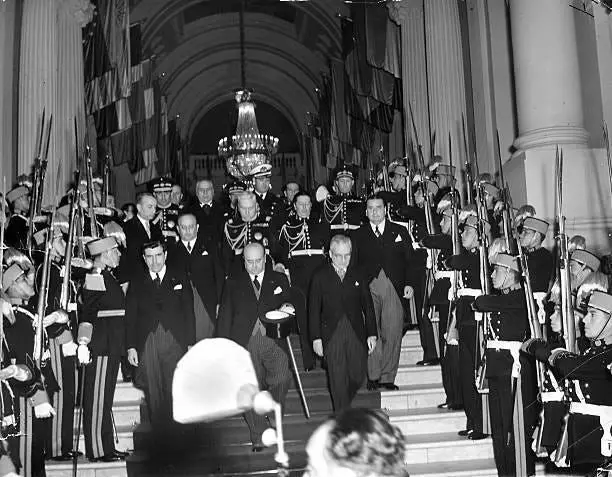
Since the emergence of Latin American republics, there has been a longing for integration and solidarity that transcends national borders. The idea of an American League of Nations has been a constant in the region’s history, a dream that inspired leaders and diplomats for decades, from the time of the Congress of Panama in 1826 to the more concrete efforts in the 1930s. However, this initiative faced the reality of a historical context marked by the interwar crisis and the lack of political consensus across the continent.
The first formal attempt to unite the nascent Latin American republics in a collective effort stemmed from the vision of Simón Bolívar, who convened the Congress of Panama in 1826. Bolívar dreamed of a confederation of nations that would protect their newly won independence and promote cooperation against foreign powers. Although the congress did not achieve all its objectives, it set a precedent for future regional integration efforts.
The Impact of World War I and the League of Nations
With the creation of the League of Nations (LN) in 1919, following the devastating conflict of World War I, a new era in international relations began. Latin America, seeing this organization as a model for cooperation, sought to replicate it in a hemispheric context. However, the LN quickly demonstrated its limitations, particularly its inability to curb the aggression of powers such as Japan in Manchuria and Fascist Italy in Ethiopia.
In this framework, various efforts emerged to build an alternative model in the Americas tailored to their own needs. The President of Uruguay, Baltasar Brum, played a prominent role in proposing the idea of an American League. In 1920, Brum publicly presented this vision in a lecture at the University of Montevideo, and in 1923, he published a complete draft of a statute for such an organization. However, Brum’s idea faced difficulties in gaining traction at subsequent Pan-American conferences, such as the one held in Santiago in 1923, where it was barely discussed and failed to yield concrete results.
A crucial global precedent was the proposal presented by U.S. President Woodrow Wilson in 1916 during the Pan-American Scientific Congress in Washington. Wilson advocated for a union of American republics to guarantee their political and territorial independence, resolve disputes through arbitration, and prevent support for armed movements in other countries. This project, though initially well-received, did not materialize in the Americas. However, its spirit influenced the creation of the League of Nations on a global scale.
In this context, the work of Eugenio Orrego Vicuña, a professor at the University of Chile, also stands out. In 1933, he published his influential essay “Sociedad de Naciones Americanas” (American League of Nations). This work represented one of the earliest theoretical analyses of the need for a regional organization exclusive to the Americas. It addressed the failures of the League of Nations and emphasized the importance of creating a structure that responded to the interests and realities of the continent.
Orrego Vicuña identified the lack of interest of European powers in Latin American issues and proposed an organization that, in addition to fostering peace, would promote economic and cultural integration. His proposal included measures such as eliminating economic barriers, creating an inter-American currency, and establishing a continental economic council. Furthermore, the author highlighted the failure of the League of Nations in conflicts like the Chaco War and stressed the need for an American mechanism that could overcome political divisions and foster genuine inter-American solidarity.
Finally, in 1936, the Pan-American Conference in Buenos Aires revived the debate on the creation of an American League of Nations. Proposals from countries such as Colombia and the Dominican Republic reflected complementary visions to address the challenges of the time, culminating in a joint project. Although it did not come to fruition, it laid the groundwork for future initiatives such as the Organization of American States (OAS). These efforts, guided by the ideal of continental solidarity and a belief in inter-American cooperation, represent a pivotal chapter in the history of regional multilateralism.
The 1936 Buenos Aires Conference and the Dominican Proposal
The 1930s marked a turning point in inter-American politics. During the Pan-American Conference in Buenos Aires in 1936, the Dominican Republic, under the regime of dictator Rafael Leónidas Trujillo, presented an ambitious proposal to create an American League of Nations.
The Dominican delegation was led by Max Henríquez Ureña and included Tulio M. Cestero and Enrique Jiménez. This delegation advocated for a model based on three fundamental principles:
- Non-intervention in internal affairs.
- Peaceful resolution of conflicts through conciliation mechanisms.
- Sovereignty protection without resorting to military sanctions, proposing expulsion of the offending state as a last resort.
Colombia’s Proposal: A Collective Security Approach
Colombia, meanwhile, presented a different vision during the same conference. The Colombian delegation was led by Jorge Soto del Corral and included prominent figures such as Miguel López Pumarejo, Roberto Urdaneta Arbeláez, Alberto Lleras Camargo, and José Ignacio Díaz Granados. This delegation proposed a more robust approach to regional security.
Key elements of the Colombian proposal:
- Military and economic sanctions: Colombia advocated for the possibility of applying severe sanctions, including the use of collective force in cases of aggression, to deter potential threats.
- Identification of the aggressor: Procedures were proposed to quickly identify the state responsible for a conflict, allowing for a coordinated and collective response.
- Collective security: A key principle of the Colombian proposal was that an attack on one American country should be considered an attack on all, anticipating the doctrine later inspiring the Inter-American Treaty of Reciprocal Assistance (TIAR).
Substantial Differences Between the Dominican and Colombian Proposals
Although both nations shared the goal of protecting the region from foreign interventions, their approaches differed significantly:
Security Approach
Dominican Proposal: Peaceful resolution and conciliation
Colombian Proposal: Military and economic sanctions
Punitive Measures
Dominican Proposal: Expulsion of the offending state
Colombian Proposal: Use of collective force
Resolution Mechanisms
Dominican Proposal: Conciliation before escalating to conflicts
Colombian Proposal: Rapid identification of the aggressor
Priorities
Dominican Proposal: Non-intervention and respect for sovereignty
Colombian Proposal: Collective security and joint actionAspect
The Dominican Republic promoted a more flexible approach that avoided militarization, while Colombia sought a stronger mechanism capable of applying collective sanctions and guaranteeing regional security.
The Fusion of Proposals: An Attempt at Compromise
In 1937, the Dominican and Colombian delegations decided to unify their efforts to present a joint project to the Pan-American Union. The new project attempted to combine the Dominican flexibility with Colombian firmness, balancing non-intervention with the ability to apply sanctions in extreme cases.
However, the lack of consensus among Latin American countries and the reluctance of the United States, which preferred to maintain its influence through bilateral agreements, prevented the creation of the American League of Nations. Additionally, the economic crisis and political tensions in the region further complicated the project’s viability.
The Legacy: The Founding of the OAS in 1948
Although efforts to create an American League of Nations did not materialize, its principles served as the foundation for the creation of the Organization of American States (OAS) in 1948. The OAS adopted many of the proposed ideals: hemispheric solidarity, non-intervention, and the peaceful resolution of conflicts.
The Colombian approach also influenced the development of the Inter-American Treaty of Reciprocal Assistance (TIAR), which established a mutual defense system in the hemisphere.
Conclusion
The proposals of the Dominican Republic and Colombia reflected complementary but distinct visions of how to address security challenges in Latin America during a period of great global instability. While their differences prevented the immediate creation of an American League of Nations, their legacy endures in today’s inter-American system.
The failure of these joint efforts, due to the interwar crisis and the lack of political unity, reminds us of the importance of regional cooperation and solidarity to face the challenges of the present and the future. Today, more than ever, the spirit of unity and self-determination remains vital for Latin America.
References:
- Wehrli, Yannick. “Los proyectos de ‘Sociedad de las Naciones americanas’: Intentos de integración política en las Américas durante el periodo de entre-guerras.” Revista Mexicana de Política Exterior, 2008.
- Alfaro, Ricardo J. “An American League of Nations.” World Affairs, Vol. 101, №3, September 1938, pp. 158–165.
- Villalta Vizcarra, Ana Elizabeth. La contribución de América al derecho internacional. Comité Jurídico Interamericano, 2006.
- Álvarez, Alejandro. Influencia de la América Latina en la futura vida internacional. University of Chile, June 22, 1923.
- Orrego Vicuña, Eugenio. Sociedad de Naciones Americanas. Cuadernos Jurídicos y Sociales, University of Chile, 1933.