- De la Visión a la Acción: La Diplomacia Silenciosa de RD hacia la X Cumbre de las Américas
- From Vision to Action: The Quiet Diplomacy of the DR Toward the X Summit of the Americas
- Negociando el futuro de las Américas: De Santo Domingo 🇩🇴 a Los Ángeles 🇺🇸
- Negotiating the Future of the Americas: From Santo Domingo 🇩🇴 to Los Angeles 🇺🇸
- La Cumbre de las Américas: Evolución, Desafíos y Perspectivas
- The Summit of the Americas: Evolution, Challenges and Perspectives
Hosts of the Void.
“The international system is an environment in which the logics of consequences dominate the logics of appropriateness.” — Stephen D. Krasner, Sovereignty: Organized Hypocrisy
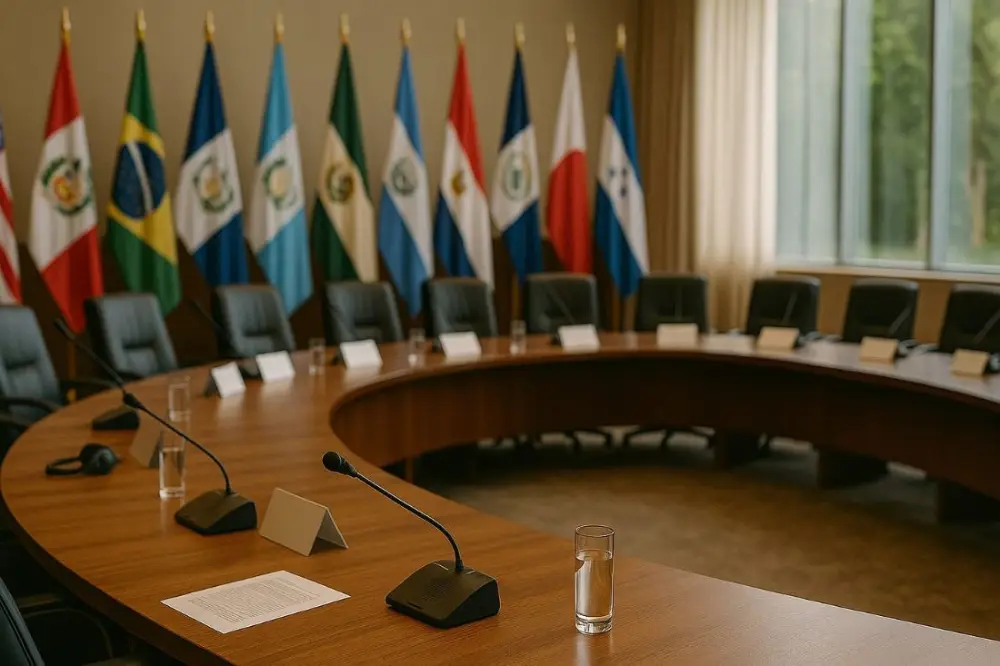
That logic explains the suspension of the Tenth Summit of the Americas in Punta Cana: a meeting without critical mass, with a fractured text, and with a host whose neutrality — a sine qua non condition of every successful mediation — had eroded, was avoided.
Three factors converged in the outcome: the structural gap between thematic ambition and the capacity for consensus that the hemisphere has carried since 1994; the fragmentation into fluid blocs where majorities formed and dissolved paragraph by paragraph; and the decisive weight of the United States in defining invitations, agendas, and drafting, whose domestic priorities and bilateral calculations conditioned the tone of the negotiation, the incentives for participation, and the political costs of dissent.
If consequences are what carry weight, it is time to recover the mediating role, simplify the format, assess risks, and exercise a self-critique that restores credibility. Based on my experience in the Summit process, I examine the anatomy of the misstep and propose an architecture to redirect hemispheric dialogue.
From the beginning, the choreography toward Punta Cana bore a tension: ambition without anchoring in consensus. The negotiations revealed how the system breathes through disagreement and how that air thickens when priorities, semantic bridges, and closure mechanisms are missing.
On democratic governance, the opening produced an unequivocal consensus: to combat all forms of corruption because they erode democracy, undermine trust, and strike at stability and growth. Left in consultations was the additional paragraph proposed by Uruguay, Chile, Guatemala, and Brazil — with Bolivia’s support — to reaffirm freedom of expression, investigative journalism, and the fight against deliberate disinformation, at the request of Jamaica, the United States, Canada, and Argentina. The absence of the Dominican Republic among the sponsors weakened a regional leadership that usually showcases itself on issues of a free press.
On citizen security, it was agreed to institutionalize and strengthen legal frameworks to prevent, combat, and eradicate terrorism — including its financing — and to deepen cooperation with the Financial Action Task Force (FATF), the Caribbean Financial Action Task Force (CFATF), the Financial Action Task Force of Latin America (GAFILAT), the Egmont Group, and the Americas Police Community (AMERIPOL). Hemispheric cooperation would also be reinforced to manage reliable, disaggregated, and evidence-based data on security and justice, with full respect for human rights and applicable data-protection laws, in order to design effective policies on the ground.
The objective was to reaffirm, as well, a non-discriminatory public space with prevention and sanctioning of violence and equal protection for all people, especially those living in vulnerable situations. In parallel, a majority pushed for paragraphs on police reform, human security, and accountability; Canada and Uruguay highlighted gender perspective and empirical evaluation. In that context, a clearer voice from the Dominican Republic was missing in the defense of the rights of women and girls.
Migration revealed the political edge of words. The attempt to introduce “illegal migration” reopened wounds. Chile, Brazil, Mexico, Guatemala, Uruguay, Honduras, and Ecuador defended referring to irregular migration and its structural causes, with cooperation and evidence-based policies. It was agreed that human security — which includes the management of mobility — must be anchored in human rights and due process.
The semantic field of “sustainable development” operated as a mirror of models. The United States proposed eliminating the term; Argentina suggested “three-dimensional development,” and Paraguay, “integral development.” A broad majority defended keeping it: this was not a comma, but the development model at stake.
On agri-food matters, the United States attempted to remove the reference to the empowerment of rural women and faced the rejection of a coalition — Bolivia, Colombia, Brazil, Uruguay, Chile, Canada, Mexico, the Dominican Republic, and Panama — that defended its inclusion for reasons of coherence and impact.
Along with this, agreements were consolidated: exchange of good practices in social protection linked to food security and the value of school feeding; responsible fisheries and aquaculture management, crucial for landlocked countries, SIDS (Small Island Developing States), and coastal communities; and the role of associative models and cooperativism for sustainable rural development, with frameworks that ensure affordable financing and collaborative work.
The fine knot was seeds. One current — Argentina, Ecuador, the United States, Peru, the Dominican Republic, El Salvador, and Paraguay — prioritized seed banks to preserve varieties adapted to local conditions and drought; Mexico sought to add “protection of local seeds” without Washington’s support. Another — Canada, Mexico, Chile — expanded to in situ conservation by farmers and community seed banks, and introduced plant genetic material with emphasis on vulnerable territories.
Water security condensed the central dilemma. The United States asked to eliminate “human right” and replace it with “critical need”; Costa Rica, Ecuador, and Guatemala proposed a bridge such as “fundamental right.” An overwhelming majority — Mexico, the Bahamas, Brazil, Bolivia, Chile, Barbados, Colombia, Guatemala, Honduras, Jamaica, Uruguay, Canada, the Dominican Republic, Ecuador, Trinidad and Tobago, Saint Lucia, Antigua and Barbuda — defended keeping “human right.” Provisional result: access to water and sanitation recognized as a basis for health and subsistence, “in accordance with national legislation.” This is not semantics: it defines whether water is a public good with common obligations or a strategic resource for internal administration.
On energy security, a clear social anchor was set: coverage above 90% by 2040, hemispheric cooperation, participation of multilateral banks and private capital, and affordable or concessional financing, particularly for developing countries. It was agreed to promote smart microgrids, and the role of ports and critical infrastructure for energy, fuels, and critical minerals was emphasized.
Paragraphs on climate and development financing with risk-adjusted innovative instruments remained under consultation, after objections by the United States and reservations from Peru, Argentina, and Paraguay. Also pending were terms on generation — “renewables and zero-emission technologies” versus “renewables and low-emission,” including hydrogen and nuclear — and the reference to traceability, sustainable standards, and emissions in critical minerals.
Subregional vectors ordered preferences: the Andes prioritized traceability and sustainability of critical minerals; the Southern Cone, bioeconomy and orderly transition; North America, robust supply chains; Central America, sanitary and phytosanitary interoperability; the Caribbean, concessional financing, microgrids, and resilience. All of this over a board crossed by the United States–China competition in technology (5G/6G, AI and cybersecurity), finance, and supply chains, which requires the region to cooperate with both poles without mortgaging sovereignties or standards.
Self-critique is not an ornament; it is the hinge between misstep and learning.
What we lacked was a 360-degree dashboard with metrics — process temperature, chapter-by-chapter map of reservations, projection of attendance — and “green rooms” with mandated facilitation to unblock without disrupting the plenary.
At home, higher-caliber sectoral references were missing: political leadership should have been accompanied by thematic leadership with technical authority and institutional memory. As in baseball, a World Series is not played with promises or improvisations; you do not bring up Double-A players nor call on retired legends when the game is on the line. You call those who maintain average and defense, those who deliver with runners in scoring position and keep their pulse steady to close the ninth with the stadium on edge. That was missing: specialists capable of turning principles into defensible paragraphs, translating priorities into operational clauses, and weaving each line with the calm of those who know the diamond and never lose sight of the scoreboard.
Responsible exit begins by looking inward.
Not to find culprits, but to reconstruct the real sequence: when traction was lost, which alarms did not sound, which signs were ignored, how the shifts were communicated, and at what point the text ceased to be governable due to the volume of reservations. Timeline of milestones, map of sensitivities by paragraph, record of démarches and prioritization criteria: that inventory is the antidote to repetition.
Then, reorganizing teams ceases to be a slogan and becomes architecture: political-technical pairs by axis, a sherpa who speaks the Caribbean idiom, and subregional liaisons with a mandate to build bridges. A small war room in the Summit Secretariat, synchronized with the Joint Summit Working Group (JSWG) and the Summit Implementation Review Group (SIRG/SISCA), can open discreet lanes when the main table stalls and reduce the distance between intention and execution.
With the team organized, setting bounded and measurable goals is the link between discourse and results, for example: transboundary water-alert protocols; verifiable reduction of food loss and waste with traceability; digital hygiene and protection of critical infrastructure; and a microgrid package for SIDS and remote areas.
On citizen security, these projects can translate MISPA (Meeting of Ministers Responsible for Public Security in the Americas) agreements into roadmaps: community prevention and social reintegration; police reform with a human-rights and accountability focus; strengthening of criminal justice; disaggregated data with privacy safeguards; protection of victims and witnesses; and cooperation against illicit flows (arms and ammunition, trafficking, money laundering, and related crimes). In light of an overwhelming majority, it must remain anchored that human security — which includes citizen security and migration — is assessed through the lens of human rights and due process.
All the above must be born financeable, with the IDB (Inter-American Development Bank), CAF (Development Bank of Latin America and the Caribbean), IICA (Inter-American Institute for Cooperation on Agriculture), and PAHO (Pan American Health Organization) seated from the design phase to ensure funding, metrics, and audit.
The method to unblock politics is variable geometry.
Not all countries will move at the same pace or with the same vocabulary, and insisting on uniformity invites paralysis. Hence the utility of voluntary modules with opt-in/opt-out; mirror paragraphs when the blockage is semantic; subregional pilots that test solutions before scaling; staggered timelines that allow convergence without forcing it; and clauses compatible with national legislation to safeguard sovereignty. One can imagine: a Caribbean leading energy resilience and sargassum response; an Andean axis ordering critical-minerals traceability; a Mesoamerica interoperabilizing sanitary and zoo-sanitary controls; a Southern Cone advancing in bioeconomy — affinity coalitions that add results to the common stock and reduce the anxiety for impossible unanimities.
None of the above will hold credibility if the process remains suspended in limbo. Setting a date soon is a sign of respect and avoids the perception of abandonment. A ministerial of the SIRG with a calendar of deliverables (30–60–90 days) will restore direction, discipline agendas, and close the vacuum that other forums might occupy. The Summit was not canceled: the method is corrected to arrive with real, measurable, and sustainable agreements. And this begins when we clearly state when we return to the table.
The year 2026 grants no respite: the OAS General Assembly (bicentennial of the Amphictyonic Congress of Panama), the G20 Summit in the United States, the Winter Olympics, the FIFA World Cup in the United States–Canada–Mexico, and a process that will shape the next Secretary-General of the United Nations will test everyone’s consistency.
I propose a closing that does not command: it invites.
This is a call to humility, to recognize what failed, correct without drama, and recalibrate expectations; to reduce the volume of promise and elevate the standard of delivery; to set short, measurable, and verifiable goals, with a near date and a public roadmap that restores direction.
Decision-makers must ask themselves the question that defines the future: do we want to be a bridge or a wall?
If we choose bridge, we must order priorities, narrow objectives, ensure accountability, and cultivate an equanimity that is not auctioned in bilateral contingencies nor ignores that the center of gravity is shifting; if we choose wall, there will come the breakdown of communication and the erosion of leadership, which is measured by results, not gestures, and — let us be candid — will amount to sidelining multilateralism and, in effect, renouncing the rules-based international order; in that case, we might never have set ourselves to host this event.
And if no one assumes responsibility, if we prefer to leave it to the ebb and flow of circumstances or to the mere passage of time, we will commit another great mistake: believing that we did everything right.
Dignity is upheld through consistency — fewer announcements, more deliverables; less epic, more method.
This is how trust is regained and the course is adjusted without renouncing ambition, but bringing it to the height of what is possible.