- “The Office of Ambassador in the Middle Ages” de Donald E. Queller
- “What Diplomats Do” de Sir Brian Barder
- "Diplomatic Tenses: A Social Evolutionary Perspective on Diplomacy" de Iver Neumann
- "Diplomatic sites: a critical enquiry" de Iver B. Newmann
- "Democracy from Above: Regional Organizations and Democratization" by Jon C. Pevehouse (2005)
- “Democracy from Above: Regional Organizations and Democratization” de Jon C. Pevehouse (2005)
Honor as Weight and Legacy: Condoleezza Rice and Foreign Policy from Within
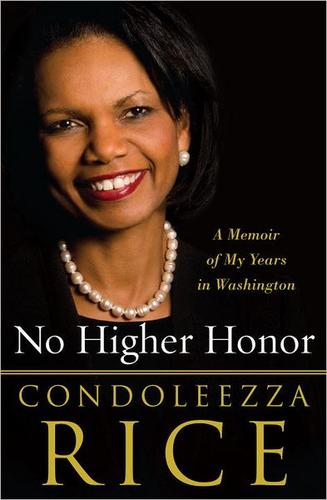
“Today’s headlines and history’s judgment are rarely the same.”
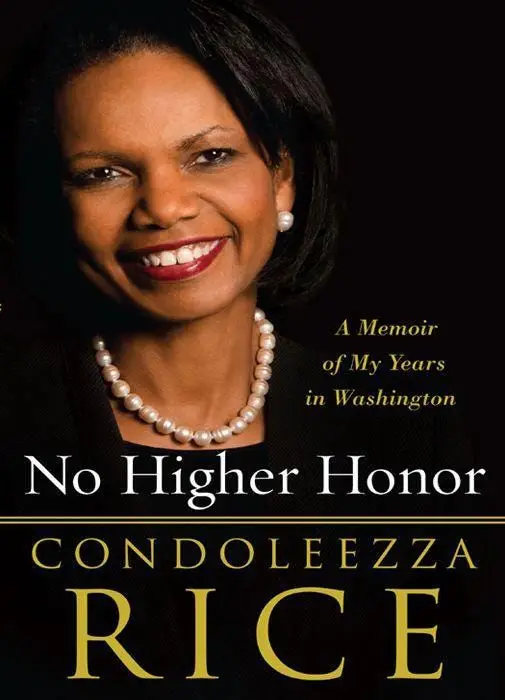
With this warning — resonating as an echo of responsibility and humility — Condoleezza Rice begins her most ambitious political memoir: No Higher Honor: A Memoir of My Years in Washington. Published in 2011, this book is not only the account of an extraordinary public life, but also a reasoned, reflective, and often emotional defense of the most controversial decisions made by the United States in its foreign policy between 2001 and 2009.
Rice was a central protagonist of that period. She was the first African-American woman to serve as National Security Advisor and later Secretary of State in the George W. Bush administration. Her role during the September 11 attacks, the war in Afghanistan, the invasion of Iraq, the response to the rise of China, the reform of U.S. diplomacy, and the failed peace efforts in the Middle East places her as one of the most influential — and also most criticized — figures of early 21st century international politics.
In over 700 pages, Rice offers a personal narrative of events, shaped by her intention to explain, defend, and at times reclaim decisions that remain intensely debated today. She does so in a voice that alternates between the technocracy of a public official and the sensitivity of a citizen who understands the human cost of every decision. Her style is direct, sober, pedagogical, and delicately emotional in the more intimate moments.
The book is structured in 58 chapters, many of them thematic — “Transformational Diplomacy,” “A Diplomatic Surge,” “The Financial Crisis of 2008” — and others focused on regions — “Democracy in Latin America and Beyond,” “War Breaks Out in Georgia” — which allows the reader to delve into the main fronts of U.S. diplomatic action without losing narrative continuity.
One of the most impactful moments in the book is her account of 9/11. Rice details her reaction to the attacks, the confusion, the anxiety, and the weight of knowing she was responsible, without understanding exactly how the system had failed. Her testimony before the 9/11 Commission, included in the text, is presented with honesty and without embellishment: “I’ve asked myself a thousand times what more we could have done. I know that if we had known an attack was coming, we would have moved heaven and earth to try and stop it.”
But No Higher Honor is not a book of regrets. It is a firm defense of the “idealistic realism” that guided Bush’s foreign policy, in which values — democracy, freedom, human dignity — had to be actively promoted, even through force. In that sense, the author justifies the war in Iraq as an attempt to change the balance of power in the Middle East and prevent future threats, although she admits execution mistakes, especially in the post-war period. Her view on Iraq is complex — more strategic than moral — though she does not ignore the human suffering.
Rice also devotes space to key bilateral relationships, such as her effort to strengthen the alliance with India, her interest in Latin America — especially Mexico and Brazil — and her frustrations with the Israeli-Palestinian peace process. In each of these chapters, she presents herself as a pragmatic official, aware of the limits of power but convinced that diplomacy must have a transformative purpose.
On the human side, the book reveals the constant tension between public life and the personal realm. Her relationship with her father, her family dilemmas, the loneliness of power, and the discomfort of being the only African-American woman in certain decision-making rooms run through the text with restraint. There is little sentimentality, but much dignity. When recounting her father’s death just before assuming the position of National Security Advisor, the reader sees not only the official, but the daughter.
Although some critics have accused the book of being excessively justificatory, its value does not lie in offering a mea culpa, but in opening the doors of the machinery of power to show how decisions that change the course of history are built, debated, and executed. Rice does not present herself as a heroine or a martyr, but as a committed witness. Her honesty is not always self-critical, but it is structural: she describes errors without drama, and achievements without vanity.
No Higher Honor is, ultimately, a book that vindicates public service as a vocation and the exercise of power as a privilege loaded with moral weight. It is a fundamental work for anyone seeking to understand from the inside the strategic architecture of the United States during the most turbulent years of its recent foreign policy.
And like every memoir of power, it will be judged not only for what it says, but for what time confirms, refutes, or revises. Because, as she herself reminds us, today’s headlines rarely align with the judgment of history.