- Panamá: Dignidad y Soberanía en los Tratados Torrijos-Carter
- Panama: Dignity and Sovereignty in the Torrijos-Carter Treaties
- Telenovelas de sangre: la ilusión fatal del cambio de régimen
- Cuando el «realismo» se vuelve excusa
- When ‘Realism’ Becomes an Excuse
- El Regreso de Monroe: República Dominicana ante la Estrategia de Seguridad Nacional 2025 de Trump
Telenovelas of Blood: The Fatal Illusion of Regime Change
After the failure at the Bay of Pigs, John F. Kennedy uttered words that would resonate for decades:
“Any unilateral U.S. intervention, in the absence of an external attack against us or any ally, would have been contrary to our traditions and international obligations. But let the record show that our restraint is not inexhaustible. Should the nations of this hemisphere fail to meet their commitments against external Communist penetration, then I want it clearly understood that this government will not hesitate to meet its primary obligations, which are the security of our nation.” — John F. Kennedy, April 20, 1961
The Blindness of Power
There are conversations that mark us like invisible scars. That afternoon, as the sun descended over Santo Domingo, a senior official inadvertently revealed to me the tragedy of our time: we govern facing forward, blindfolded by forgetfulness. “History is for academics,” he said — and in that phrase echoed the downfall of all empires that believed they could rewrite another’s destiny in ink made of blood. There is no greater threat to a nation than the arrogance of those who repeat past mistakes expecting different results. That thought haunted me during my years of study in Europe, which coincided with the 2003 invasion of Iraq, as I attended seminars and lectures on so-called regime changes — those mirages that promise order and sow ashes.
The seduction of simplicity — changing governments as one changes pieces on a board — has hypnotized strategists for generations. And local voices always emerge, those few irresponsible ones who, from the comfort of gilded exiles or protected privilege, call for foreign interventions so that others may do the dirty work they cannot or will not do. They demand invasions from Miami, beg for sanctions from Madrid, implore bombings from Manhattan.
Then, when the bill of blood and chaos arrives, they vanish like smoke.
They do not explain to the mothers why their sons never return; they do not stand before the tribunals of history. How many times must the tragedy repeat before we learn?
The Crushing Evidence
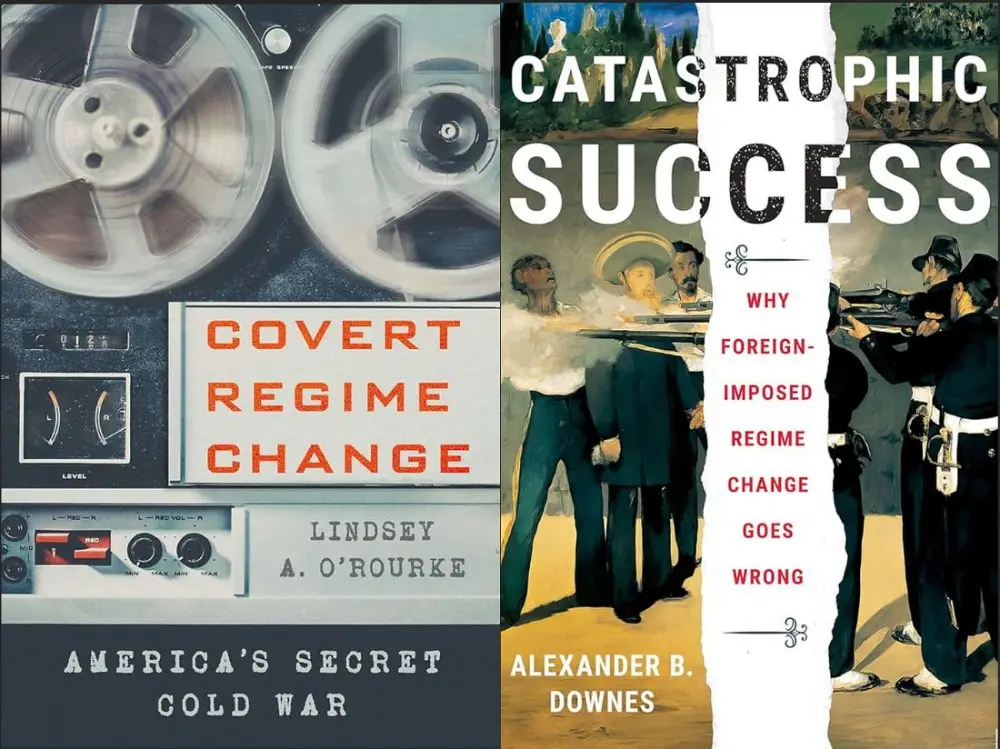
In the past decade, two scholars have dismantled this illusion with uncomfortable rigor. Covert Regime Change: America’s Secret Cold War, by Lindsey A. O’Rourke, and Catastrophic Success: Why Foreign-Imposed Regime Change Goes Wrong, by Alexander B. Downes, show — from complementary angles — that regime changes, overt or covert, begin with heroic fanfare and end with the laments of widows, orphans counting stars among ruins, and nations wondering how their dream turned to nightmare.
O’Rourke combs through declassified Cold War archives to assemble the most complete inventory of covert operations backed by the United States: sixty-four secret ones versus only six open interventions. The numbers thunder. The baseline probability of a country suffering a mass killing within a decade was about 16%; with covert intervention, the risk jumped to 55%. When such operations “succeeded,” the probability of mass murder tripled; when they failed, it nearly quadrupled. Cold numbers hiding faces, families, generations marked.
Numbers take on names and geographies. Iran, 1953: Mohammad Mossadegh overthrown for dreaming of Persian oil for Persians; the Shah restored and the SAVAK (secret police) perfecting terror for twenty-six years until the Islamic Revolution turned an ally into a permanent adversary. Guatemala, 1954: Jacobo Árbenz removed for touching United Fruit’s land; decades of civil war and two hundred thousand lives — mostly Indigenous — lost in silence. Chile, 1973: Salvador Allende falls at La Moneda as Hawker Hunter jets bomb democracy; Augusto Pinochet rises over corpses in the National Stadium; seventeen years of dictatorship and tens of thousands of victims still seeking justice. In every case, local voices had begged for military “salvation.” None returned to explain the ensuing hell.
The twenty-first century replayed the lesson with new uniforms. Libya, 2011: Muammar Gaddafi eliminated; celebrations — “we came, we saw, he died” — soon silenced by slave markets where schools once stood, militias fracturing the nation. Those who had pleaded for NATO (North Atlantic Treaty Organization) bombs now live in Paris or London; their compatriots live with the wreckage. Iraq, 2003: Saddam Hussein falls; from the vacuum emerges ISIS (Islamic State), a spiral of violence, hundreds of thousands dead, and a Baghdad raising orphans to the hum of drones. The flowers promised to the “liberators” withered before arrival.
The Numbers of Failure
Through statistical analysis of 120 cases of regime change (1816–2008), Downes finds patterns returning with the obstinacy of data:
- Regime change doubles the probability of civil war within the following decade.
- Leader-focused regime change triples the probability of civil war.
- Imposed leaders are removed violently in nearly half of cases.
- One third of all regime changes are followed by civil war within ten years.
- Regime change does not reduce the likelihood of militarized disputes between intervener and target.
These are not slogans; they are empirical truths no rhetoric can deny.
Anatomy of Disaster
These abstract patterns come brutally alive in the concrete cases Downes examines. The mechanisms explaining these outcomes recur relentlessly.
Military Disintegration
— Cambodia (1979–1992): The Vietnamese invasion dispersed the Khmer Rouge, which re-emerged as an insurgency for more than a decade.
— Afghanistan (2001–2021): The U.S. invasion shattered the Taliban, which reorganized its war of attrition until it reclaimed power twenty years later.
— Iraq (2003–2011): Dissolving the Iraqi army turned thousands of trained soldiers into flagless fighters, accelerating insurgency.
The “Competing Principals” Problem
This dilemma — the irreconcilable tension between the external sponsor and the local society — destroys any chance of effective governance:
— First Afghan War (1839–1842): Britain installed Shuja Shah Durrani, viewed as a puppet. Domestic backlash ignited a rebellion that annihilated the British expeditionary army.
— Nicaragua (1912): The United States backed leaders who pursued pro-American policies, fueling insurgencies against their rule for decades.
— Guatemala (1954): The CIA-backed coup against Árbenz installed Castillo Armas; his pro-U.S. measures fed an insurgency that lasted thirty-six years.
The Illusion of Possible Success
Serious discussions go beyond slogans. The literature identifies structural thresholds that increase the probability of post-regime-change stabilization, though never guaranteeing it. Four variables stand out:
- Economic Wealth — A broad material base — measured by per-capita Gross Domestic Product (GDP), solid tax collection, and functional markets — allows funding for public security, Disarmament, Demobilization and Reintegration (DDR) programs, judicial reform, and basic services. It also reduces zero-sum distributive struggles that fuel violence. Yet wealth without legitimacy opens fissures: buying peace is not the same as building it.
- Relative Ethnic Homogeneity — Fewer identity fractures lessen the ethnic-security dilemma — the fear that “the other” will capture the state. Homogeneity eases power-sharing deals and reduces incentives for community militias. Diversity can coexist with democracy, but after external intervention fragmentation magnifies the risk of armed enclaves and mutual vetoes.
- Democratic Experience — Societies with memories of electoral competition, plural media, and judicial arbitration better accept alternation and possess civic networks that cushion conflict. Such experience cannot be improvised by decree or brief missions: it requires social capital, known rules, and bearable losses for the losers.
- State Capacity — Paradoxically, where the state is weak — low revenue, poor administration, fragmented security forces — “success” collapses: no one can implement agreements or enforce the monopoly of force. Where capacity is high, order holds, but external overthrow becomes less necessary; gradual reform proves more feasible than imposition.
The Exceptions That Prove the Rule — Germany and Japan after 1945 combined rarely aligned factors: unconditional surrender, prolonged occupation with total security control, high-quality pre-existing bureaucracies, cohesive national identity, regional frameworks anchoring reconstruction, and sustained investment over decades.
Grenada (1983) and Panama (1989) are sometimes cited as partial exceptions: small states, short timeframes, absence of a great-power rival backing the losers, and pre-existing administrative apparatuses. Even there, the results are contested and hardly extrapolable to larger, more diverse, or volatile nations.
The sober corollary: even under “favorable” conditions, success hinges on clear legality, internal social legitimacy, and sustained external commitment — rare outside extraordinary scenarios. When these elements are missing, attempts to redesign a political order from outside feed spirals of resistance and violence.
Revealing Convergences
Though covering different terrains — Downes analyzing open and covert cases across two centuries; O’Rourke focusing on U.S. covert operations during the Cold War — their findings converge with unsettling precision:
- Regime change rarely works as promised and yields vast unintended consequences.
- The principal-agent problem is central: installed leaders face contradictory pressures from external sponsors and domestic audiences.
- Benefits are systematically overstated and costs understated by policymakers.
- Domestic conditions matter: success is likelier in wealthy, relatively homogeneous, democratically experienced countries.
- Germany and Japan after 1945 are exceptions, not the rule: they combined unique, irreproducible factors.
Dominican Memory
The Dominican Republic knows this script firsthand. In 1965, President Lyndon B. Johnson moved from shadow to open landing, convinced he would “restore order in days.” He bought time but left scars. (It is worth noting that O’Rourke dedicates an entire chapter — chapter eight — to the Dominican case, particularly illuminating in how she documents U.S. involvement in Trujillo’s elimination, the turbulent transition that followed, the coup against Juan Bosch, and systematic interference in subsequent elections.)
Some compatriots applauded the arrival of the Marines. From air-conditioned salons, they demanded a heavy hand against “the communists.” Later, when the dead numbered in the hundreds, those armchair patriots were already in Miami or hiding behind their surnames.
After the occupation, Washington returned to covert terrain to “arrange” elections and consolidate Joaquín Balaguer’s rise: stability through systematic repression. The result was a politically controlled yet deeply fractured nation. Even when intervention seems “successful,” it distorts the social balance and poisons civic trust.
The Ignored Warning
This tension is not new. In August 1959, in Santiago, Chile, during the Meeting of Consultation of OAS (Organization of American States) Foreign Ministers, U.S. Secretary of State Christian Herter warned:
“History has shown that efforts to impose democracy on a country by force and from outside can easily result in the mere substitution of one form of tyranny for another.”
The phrase captures the moral and strategic trap: imposition denies the very source of legitimacy it claims to promote.
The Sober Path
The data of O’Rourke and Downes — and our national memory — converge on the same truth: regime changes are no shortcut to peace; they multiply risk. They heighten the odds of civil war, trigger mass killings, shorten the lives of installed leaders, and erode the political and cultural fabric until it becomes unrecognizable.
Who, after looking at this evidence, can still believe a foreign country can be redrawn by the tip of a pen or the force of a fleet?
There exists a sober, humane route: strengthen local civic capacities, sustain negotiation channels, build incentives for inclusive settlements, safeguard credible electoral processes, and reserve the use of force — when inevitable and legal — for the protection of lives, not for designing political architectures from afar. Less epic, more patience. Less spectacle, more method.
Let decision-makers recall Herter’s warning, the caution implicit in Kennedy’s speech, the empirical record of O’Rourke and Downes, and the Dominican lesson: intervening to “fix” often breaks more. Prudence is not weakness; it is respect for what no power fully controls — the political will of a society.
There begins, and also ends, the real possibility of democracy.
The blood telenovelas have had too many seasons. The scripts are written, documented, quantified. All that remains is for those who pull the strings of global power to have the humility to read them before writing the next episode. For history does not forgive those who ignore it, and peoples do not forget those who played with their destiny.