- “The Office of Ambassador in the Middle Ages” de Donald E. Queller
- “What Diplomats Do” de Sir Brian Barder
- "Diplomatic Tenses: A Social Evolutionary Perspective on Diplomacy" de Iver Neumann
- "Diplomatic sites: a critical enquiry" de Iver B. Newmann
- "Democracy from Above: Regional Organizations and Democratization" by Jon C. Pevehouse (2005)
- “Democracy from Above: Regional Organizations and Democratization” de Jon C. Pevehouse (2005)
“Public Affairs and Democratic Ideals” by Curtis Ventriss (2021)
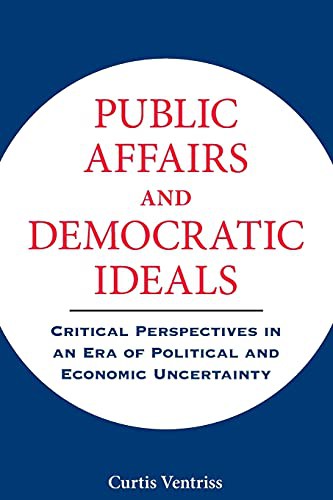
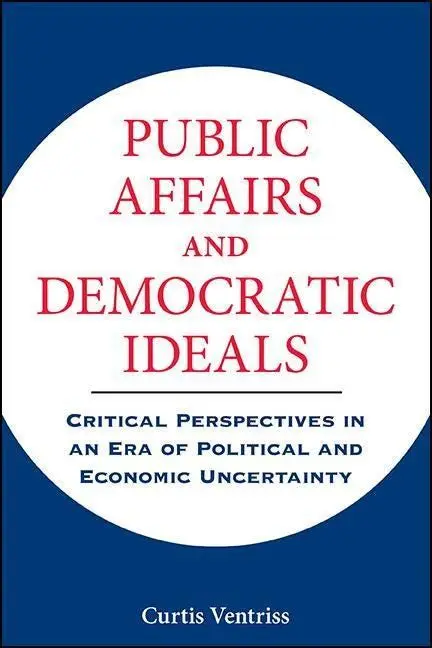
The book “Public Affairs and Democratic Ideals: Critical Perspectives in an Era of Political and Economic Uncertainty” by Curtis Ventriss offers a deep assessment of the challenges facing public administration and democracy in a context of economic and political uncertainty. Through a critical and normative approach, Ventriss examines the evolution of democratic thought, the crisis of the public sphere, and the limitations of citizen participation in policymaking.
1. Introduction: A Model of Democracy in Crisis
Ventriss begins his analysis by stating that the participatory model of democracy is at a crossroads. He argues that the notion of “publicness” must be rethought to revitalize citizen engagement and prevent public administration from being reduced to a mere technocratic exercise. Drawing on Benjamin Barber, he emphasizes that democracy must be based on civic education and collective action rather than altruism or individual interest.
2. First Part: The Importance of Publicness and Critical Democratic Thought
This section examines the erosion of the public sphere under the dominance of neo-managerialism and the influence of market economics on politics. Ventriss criticizes how public administration has become an instrument of bureaucratic efficiency rather than a means to foster democratic deliberation. He also introduces the idea of a “reinvigorated publicness,” which seeks to restore the connection between citizens and the state through genuine, rather than merely symbolic, participatory mechanisms.
In this framework, the author:
- Contrasts instrumental rationality (based on efficiency and utilitarianism) with substantive rationality (based on democratic and ethical values).
- Explores the thought of Habermas, Hannah Arendt, and Guerreiro Ramos, arguing that the public sphere should be a space where people can express their experiences and transform the social order, rather than a forum dominated by technocratic experts.
3. Second Part: Contemporary Challenges
Here, the author addresses three major challenges affecting public administration:
a) The Enduring Impact of the 2008 Economic Crisis
Ventriss argues that the financial crisis not only exacerbated economic inequality but also weakened public trust in government and its institutions. He explains how crisis management favored technocratic solutions at the expense of a democratic approach that would have given citizens a voice.
b) The Spatial Dimension of Government and Globalization
The author introduces the concept of spatiality in public administration, exploring how the reconfiguration of urban space and globalization affect citizen participation. He points out that the digital economy and global capitalism have created barriers that limit citizens’ access to public debate and decision-making.
c) Citizen Participation: A Myth or a Tool for Legitimation?
Ventriss critically analyzes the idea that increased citizen participation automatically leads to better policies. He argues that, in many cases, public consultation mechanisms are designed to validate pre-existing decisions rather than empower citizens to influence policies. He draws on Habermas to demonstrate how communicative rationality has been co-opted by bureaucratic structures that simulate democratic openness without generating real change.
4. Conclusion: A Call to Action
Ventriss concludes with a reflection on the need for a new public rationality that combines pragmatism with a bold normative vision. He argues that the challenge is not just to encourage citizen participation but to ensure that this participation is meaningful and leads to real changes in policymaking. To achieve this, he advocates for:
- Revaluing critical thinking in public administration.
- Channeling citizen conflicts constructively, rather than suppressing them in pursuit of consensus.
- Fostering a political culture based on deliberation and debate, not passive obedience to existing structures.
“Public Affairs and Democratic Ideals” is a work that challenges conventional conceptions of public administration and democracy. Ventriss presents a strong critique of the emptying of the public sphere and the co-optation of citizen participation by institutions seeking legitimacy rather than transformation. His call is clear: if we want a vibrant democracy, we must radically rethink the relationship between the state, citizens, and the common good.