- Tensión y Diplomacia: El 19 de Julio en la OEA
- Tension and Diplomacy: July 19 at the OAS
- Visión Hemisférica: Albert Ramdin y el nuevo liderazgo de la OEA
- Hemispheric Vision: Albert Ramdin and the Leadership of the OAS
- La Orquestación Diplomática: Del Senado Americano a la Casa de las Américas
- The Diplomatic Orchestration: From the American Senate to the House of the Americas
The Transformation of the OAS for the 21st Century Has Begun

The Awakening of an Institution at Its Historic Crossroads
In the corridors of the emblematic building at 17th Street and Constitution Avenue in Washington D.C., a transformation was gestated during the first months of 2025 that will mark the course of the inter-American system for the coming decades. On July 21, 2025, when the newly appointed Secretary General Albert Ramdin presented before the Permanent Council his structural reorganization proposal — document OSG/135–25 accompanied by a meticulously crafted fourteen-page rationale — he was not simply proposing administrative changes. He was responding to a hemispheric clamor for institutional renewal that resonated from Ushuaia to Nunavut, from Bridgetown to San Salvador.
The unanimous approval of this reform on August 6, 2025, through resolution CP/RES. 1289/25, represents much more than procedural consensus. It constitutes a collective recognition by the thirty-two active Member States that the status quo had reached its natural limit. As Ramdin expressed upon assuming office after his election on March 10, 2025: the four pillars of the OAS — democracy, human rights, security, and development — are not just work pillars, they are the heartbeat of the American hemisphere. This organic metaphor reflects a profound understanding that institutions, like living organisms, must adapt or perish.
The proposed reform emerges after an unprecedented consultation process that included bilateral meetings with all active Member States, exhaustive analyses of the external evaluation report by Álvarez & Marsal (CP/CAAP-3992/24 rev. 2), and the incorporation of written comments from ten delegations in addition to verbal observations from all sub-regional groups. This level of democratic participation in institutional design exemplifies the collaborative spirit that Ramdin seeks to institutionalize: an OAS that not only preaches democracy but practices it in its own internal governance.
The Architecture of a New Efficiency: Strategic Consolidation with Hemispheric Vision
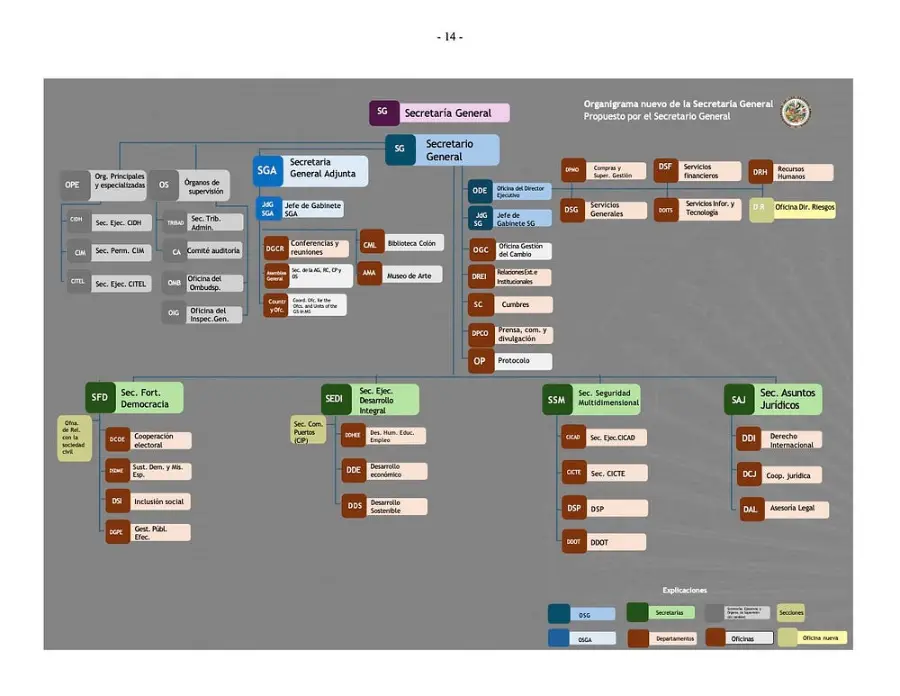
The reorganization proposal represents institutional surgery of surgical precision. From the seven existing secretariats plus the Strategic Counsel, the new organizational chart consolidates substantive functions into four technical secretariats aligned with the fundamental pillars of the OAS Charter: the Secretariat for Strengthening Democracy (SSD), the Executive Secretariat for Integral Development (SEDI), the Secretariat for Multidimensional Security (SMS), and the Secretariat for Legal Affairs (SLA). This 43% reduction in the number of secretariats is not an exercise in administrative minimalism, but a calculated response to years of fragmentation that, according to the Álvarez & Marsal diagnosis, had generated “functional overlaps, weakening of accountability, and unclear hierarchical lines.”
The elimination of the Secretariat for Access to Rights and Equity (SADyE), the Secretariat for Hemispheric Affairs (SHA), and the Strategic Counsel for Organizational Development and Management for Results (SCODMR) does not imply abandoning their mandates. On the contrary, their functions are organically integrated where they can generate greater synergy. The Department of Social Inclusion, for example, is transferred to the Secretariat for Strengthening Democracy, recognizing — as the rationale document notes — that “democracy must reach all population groups in our Hemisphere and be representative of diverse interests and needs.” This relocation is not merely administrative; it is a philosophical declaration about the inclusive nature of 21st-century democracy.
Particularly revealing is the decision to maintain the Secretariat for Legal Affairs as an autonomous entity, after initially considering its dissolution. The ten Member States that submitted written comments and the deliberations of sub-regional groups convinced the administration that the OAS’s legal work — from the Follow-up Mechanism for the Implementation of the Inter-American Convention against Corruption (MESICIC) to the Meetings of Ministers of Justice (REMJA) — requires a specialized and visible structure. This flexibility to adjust the initial proposal demonstrates institutional maturity and active listening capacity, essential qualities for leading a multilateral organization.
The Operational Nerve: Managerial Innovations for the 21st Century
The creation of the Office of the Executive Director (OED) represents perhaps the most significant innovation in terms of administrative management. This figure, which will consolidate functions previously dispersed in the Secretariat for Administration and Finance, will act as the operational arm of the Secretary General, directly supervising the departments of Human Resources, Financial Services, Information and Technology Services, Procurement and Management, and General Services. The inclusion of a Risk Director within this office — mandated by resolution AG/RES. 1 (LV-E/24) — introduces for the first time in OAS history a systematic approach to risk management, essential in a context of limited resources and growing challenges.
In parallel, the establishment of the Change Management Office (CMO) represents a mature recognition that institutional transformations require specialized accompaniment. As the concept document notes, this unit responds to “a widely observed challenge in multilateral environments: structural reforms often fail to achieve their intended impact when there is no specifically oriented change management capacity.” The CMO is not a bureaucratic luxury but a strategic investment in reform sustainability. Its mandate will include quarterly progress monitoring, early identification of organizational resistance, and facilitation of cultural transition toward a results-oriented organization.
The decision to place strategic functions directly under the Office of the Secretary General — including the Department of Press and Communications, the Department of External and Institutional Relations, and the Secretariat of the Summit of the Americas — reflects a sophisticated understanding of the political nature of these functions. In a hemisphere where the battle for narrative is as important as technical implementation, centralizing strategic communication under the highest political leadership ensures message coherence and response agility. The Summit process, in particular, requires coordination at the highest level to translate presidential commitments into concrete actions by the General Secretariat.
The Hemispheric Consensus in Action: Voices of Member States After the Historic Approval
The Permanent Council session of August 6, 2025, presided over with diplomatic mastery, revealed the depth of consensus achieved and the sophistication of the negotiating process that made it possible. Ambassador Alejandra Solano of Costa Rica, in her capacity as Chair of the Committee on Administrative and Budgetary Affairs (CAAP), articulated with precision the spirit that animated the deliberations: “This text represents the result of an intense and rigorous negotiation process, but also an exercise in constructive and good faith dialogue by all delegations.”
The proposal for approval by acclamation, followed by substantive interventions, demonstrated a mature understanding of the art of multilateral diplomacy: building consensus without suppressing diversity of perspectives. Each subsequent intervention revealed important nuances that enriched the collective understanding of the historic moment being experienced.
Mexico underscored that the restructuring allows the General Secretariat to optimize mandate management, eliminate duplications, facilitate synergies, and ensure efficient, austere, and transparent use of resources. But beyond administrative efficiency, Mexico placed fundamental emphasis on preserving the Secretariat for Legal Affairs as “recognition of its essential function in the progressive development of inter-American international law that for decades has enriched the national normative frameworks of our countries.” This defense of international law was not mere rhetorical formality but a clear political declaration about the need to maintain a robust and visible structure that guarantees respect for the rule of law throughout the hemisphere.
Guatemala highlighted institutional coherence as a strategic imperative, celebrating that “the implementation of this renewed structure, along with the firm commitment of all actors, will contribute to a more modern, coherent General Secretariat focused on obtaining concrete results.” Its emphasis on shared responsibility — “as Member States, we also have the responsibility to follow up on these advances” — recognizes that no institutional reform can succeed without the sustained commitment of its constituents.
For its part, Uruguay emphasized the importance of functional clarity derived from the reduction in the number of secretariats, arguing that it “contributes to greater functional clarity, avoids duplications, and improves institutional governance.” This perspective of administrative efficiency was accompanied by an explicit reiteration about the importance of preserving the autonomy of specialized organs created under Article 53 of the Charter, such as the IACHR and CIM. The Uruguayan position reflected a sophisticated understanding of the balance between efficient centralization and functional decentralization, something essential in complex multilateral organizations.
The Dominican Republic offered a specific strategic reflection on the Summit of the Americas process, showing satisfaction with the relocation of the Summit Secretariat under the direct authority of the Secretary General. The Dominican delegation also insisted on the importance of strengthening geographic equity in the organization’s staff distribution, thus promoting more balanced representation of Member States at all institutional levels.
Canada’s intervention introduced a constructive cautionary note by stating that while it recognized the positive changes in the new structure, it expressed concern about the speed of the negotiating process, suggesting that time limitations might have prevented a more exhaustive evaluation. Canada underscored the importance of having clear follow-up and continuous evaluation mechanisms to monitor the effective implementation of the reform, thus ensuring timely adjustments when necessary.
The United States, true to its concise diplomatic style, fully endorsed the reform as fulfillment of mandates previously defined by the General Assembly, highlighting that this structure “will modernize the organization, allowing us to face our new challenges while revitalizing our capacity to address fundamental thematic areas.”
Argentina explicitly recognized the leadership of Secretary General Ramdin and the Permanent Council, and celebrated the collaborative spirit of the negotiating process, highlighting that the new structure would allow the Secretary General to more effectively exercise his political and strategic leadership in service of all Member States.
Costa Rica highlighted the importance that the institutional structure of the General Secretariat clearly reflect fundamental commitments to human rights, as well as transparent, efficient, and responsible administrative management. It reiterated that austerity was not an end in itself but a means to ensure greater social impact with limited resources.
In synthesis, these interventions revealed that although each Member State emphasized different aspects according to their national priorities, all agreed on the need for an efficient, inclusive, transparent, and results-oriented organization. The consensus achieved represented a diplomatic victory in a hemisphere frequently characterized by deep political and economic divisions. The OAS thus showed that, even in complex contexts and with scarce resources, it is possible to reach significant agreements that collectively benefit all Member States.
The Challenges of Implementation: Navigating the Complexities of Institutional Change
The unanimous approval, while a historic achievement, should not obscure the enormous challenges that the effective implementation of this structural reform implies. As Canada warned, it is one thing to approve organizational changes and quite another to ensure their successful execution. The Change Management Office will face the delicate balance between driving necessary transformations and respecting the sensitivities of staff who have dedicated entire careers to now-dissolved structures.
International experience teaches that institutional reforms in multilateral organizations face particular resistance. Unlike the private sector, where decisions can be imposed vertically, international organizations continuously require building consensus, not only among Member States but within staff, who come from diverse organizational cultures.
Financial sustainability will continue to be a central challenge. Although politically necessary to achieve consensus, cost neutrality limits the capacity to mobilize additional resources for training, technological modernization, or change incentives. As Mexico warned, austerity must be understood as a means to maximize impact with limited resources, not as an end in itself. Chronic delinquency in quota payments by several Member States will continue to be a critical limitation. Institutional reform must be complemented by renewed financial commitment from Member States, or the OAS will continue operating more in survival mode than real transformation.
Finally, the true test of this reform will not be in the elegance of its new organizational chart, but in its capacity to produce tangible results in the four fundamental pillars. Establishing clear metrics and robust monitoring systems will be essential. Canada’s proposal for continuous evaluation should translate into a specific framework with measurable indicators and periodic reports to the Permanent Council. This transparency is not optional but essential to maintain Member States’ trust and institutional credibility.
A Call to Institutional Greatness: The Defining Moment of Hemispheric Multilateralism
The approved structural reform transcends administrative adjustments to constitute a declaration of faith in hemispheric multilateralism. In a context where international institutions face existential questioning, the thirty-two OAS Member States demonstrated that international cooperation is not only possible but indispensable.
Albert Ramdin, with his deep institutional knowledge, has presented more than an administrative reorganization; he has articulated a vision of renewal that honors the past while embracing the future. His capacity to incorporate diverse perspectives without sacrificing strategic coherence shows the adaptive leadership necessary for the 21st century.
The unanimity achieved must now translate into sustained commitment. As Guatemala affirmed, Member States have the ongoing responsibility to follow up on these advances. This follow-up requires active participation, constructive criticism, and strategic patience.
Finally, this reform will define whether the OAS can evolve from a mere guardian of the status quo to a true architect of the inter-American future. The four pillars are not Cold War relics but contemporary imperatives that demand innovative solutions.
We are before a kairos moment, a time that demands decisive action. The approved reform is not perfect, but it is a brave step toward a more agile, coherent, and effective OAS. As Argentina said, optimism is required based on the Secretary General’s commitment to “austerity, efficiency, and effectiveness.” Now it depends on everyone to convert this historic opportunity into real and lasting transformation.
The OAS has chosen to transform itself; now it must execute this transformation with the excellence that the moment requires. The hemisphere watches, history will judge, and future generations will reap the fruits of the decisions made in this decisive moment.