From Rhetoric to Governance: The OAS Session that Reorders the Haitian Board
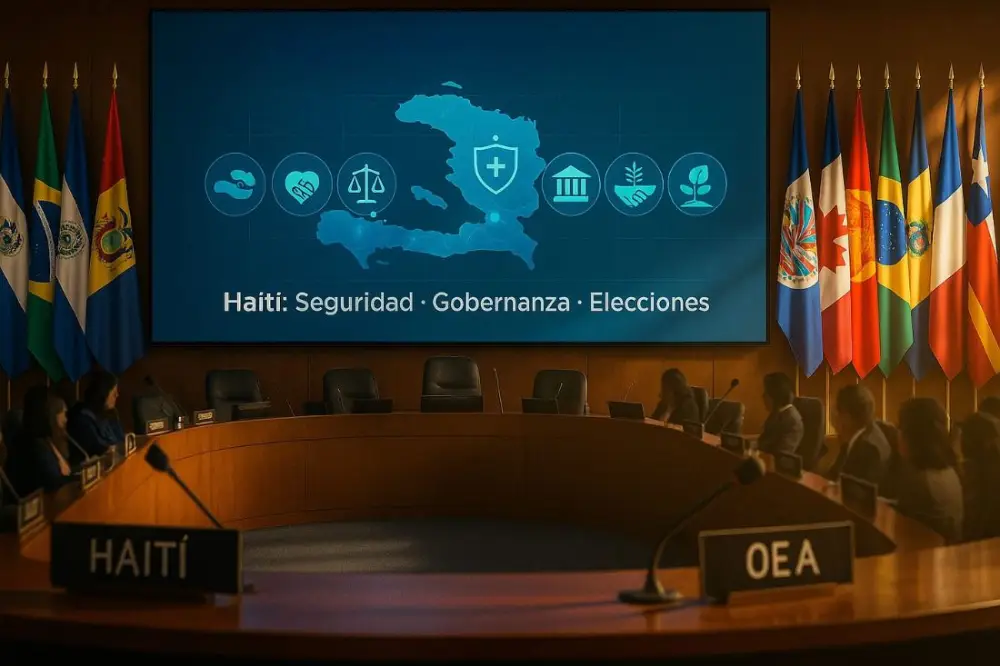
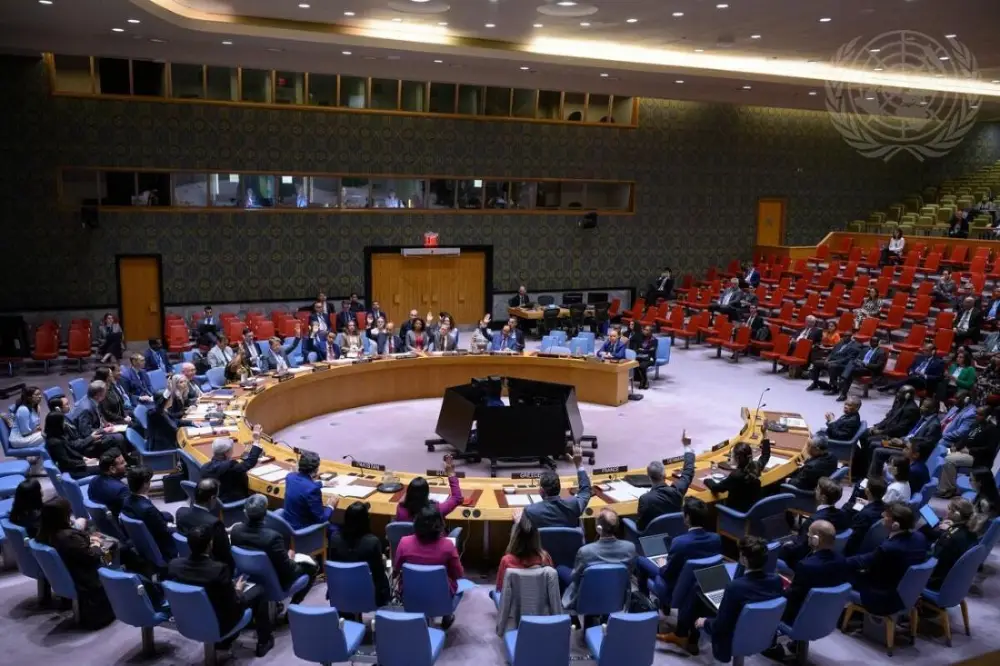
Today, November 5, in the Simón Bolívar Room, the OAS Permanent Council made clear that Haiti has entered a phase where words carry weight only if they push actions. The third revision of the roadmap — led by Haiti and backed by OAS, CARICOM and United Nations — acquired operational density, and with it emerged a practical question: can the OAS become an effective hinge between the urgency of security, political legitimacy and a credible electoral calendar?
A Roadmap with an Owner: Haiti
If anything ordered the discussion, it was Haitian ownership. The Haitian delegation set a guiding principle — “Nothing for Haiti without Haiti” — and a minimum stabilization sequence: Security–Humanitarian–Elections (SHA). The emphasis was not rhetorical: there are measures underway (draft electoral decree under consultation, evaluation of the electoral body and acquisition of 15,000 tablets to clean up the voter registry). But the warning was stark: without rigorous coordination among all actors and simultaneous action on the five pillars (security, humanitarian, governance/consensus, legitimacy/electoral and development), the process runs “risk of failure” and could repeat the post-earthquake disorder. Security and drastic poverty reduction were defined as preconditions for a non-ephemeral peace.
The New Security Architecture: Resolution 2793 and the GSF
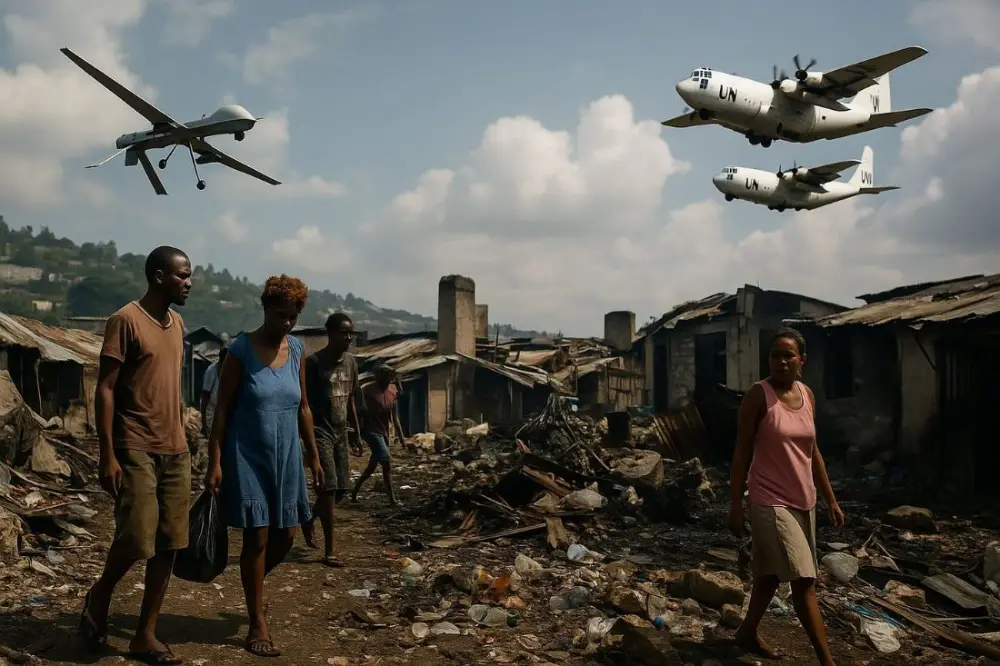
Secretary General Albert Ramdin anchored the debate in two realities: gangs that “wreak havoc” and an immovable political date — February 2026, when the Transitional Presidential Council’s mandate ends. Security Council resolution 2793 reconfigures the intervention: the Multinational Mission transitions to a Gang Suppression Force (GSF) and a UN Support Office. That transition opens an operational gap between January and April that demands resources, rules of engagement and a clear chain of command.
The OAS, for its part, invited States to submit candidacies for a Special Representative linked to the GSF and announced an internal “one-stop window” scheme to organize procurement, logistics and inter-unit coordination for an Organization Special Mission. Immediate milestones were set: on November 12 there will be a virtual UN–OAS–CARICOM–Haitian authorities meeting to close contributions, rules and force leadership, as well as governance framing and the electoral route. The Secretariat’s trip to Haiti, frustrated in October by Hurricane Melissa, was rescheduled for early December.
This architecture is, in fact, polycentric: the UN operates the security platform; CARICOM sustains political dialogue through the Eminent Persons Group; Haiti leads the priorities; and the OAS seeks to be the hemispheric gear that avoids overlaps and translates consensus into execution sequences.
The OAS in Its Zone of Advantage: Electoral Integrity, Rights and Coordination
The session consolidated a clear expectation about the OAS’s added value: electoral integrity, institutional strengthening, human rights and hemispheric political coordination. The Secretary General added three operational vectors: (i) advancing identity document issuance (requirement for voter registry and services), (ii) a Memorandum of Understanding with the Latin American Business Council for education, financial inclusion, food security and focused investment in secure zones, and (iii) support for reactivating two U.S. legal instruments that incentivize investment and employment in Haiti. Together, it’s an attempt to sustain security with economic and institutional anchors, not just patrols.
The limit was also drawn: the OAS is not the operational command of the GSF nor administrator of large humanitarian or development funds. Its effectiveness will depend on prioritizing, avoiding duplications and accountability with verifiable indicators.
The Hemisphere Aligns… with Fine Print
The regional echo was unusually convergent, but the interventions introduced “fine lines” that condition success.
- Tangible contributions. Guatemala announced it will reach 300 Military Police personnel deployed in Haiti by April 2026 (adding 150 new), plus technical cooperation in security, gang prevention, food security and disaster management. Mexico reported recent training of 143 Haitian armed forces members (including 15 women) and contributions to the UN Trust Fund; suggested making explicit the humanitarian–peace–development nexus. Brazil offered cooperation with the Haitian National Police, reactivating MINUSTAH learnings in disarmament, demobilization and reintegration and connecting security with professional training. United States reaffirmed measures of designating gangs as terrorist organizations, arms seizure and support for electoral integrity and regional coordination.
- Governance and financing. Canada requested a functions matrix distinguishing where the OAS executes, coordinates or advocates; and clarity about the relationship with the GSF, the Support Office, CARICOM and the IDB, plus sequencing resource mobilization to avoid duplications with the UN Fund and IDB. Chile underlined the role division between GSF/UN Office/CARICOM/OAS and that new commitments be financed with voluntary funds; demanded strict adherence to International Humanitarian Law and Human Rights Law, with special attention to women and girls. Uruguay proposed using the OAS SECURE-IT platform to coordinate with the GSF, align humanitarian response with the UN Response Plan and prioritize documentation and reparation of violence against women, girls, boys and adolescents (possible role of IACHR and IIN). Dominican Republic reiterated (again) responsible solidarity and recalled that everyone’s sovereignty, including its own, is a non-negotiable parameter.
The rest of the delegations — Costa Rica, Grenada, Colombia, Argentina, the Holy See — reinforced the idea that Haitian legitimacy, the human face of the crisis and multilateral coherence cannot be rhetorical decorations but design criteria.
What’s at Stake: Risks and Conditions for Success
The immediate risks are concrete. First, operational inertia: without rules, command and bridge financing, gangs will exploit the January–April gap. Second, blurring of responsibilities: without the functions matrix that several States demand, coordination becomes an exchange of communiqués. Third, transition legitimacy: if February 2026 arrives without elections or agreement on an accepted governance structure, the process can lose social traction.
Reversing the equation requires measurable decisions in weeks, not months: appointing GSF leadership and the OAS Special Representative; agreeing on rules of engagement and chain of command; closing a bridge financial package; establishing secure corridors and minimum targets for reducing homicides/kidnappings; publishing decree and electoral calendar and shielding identity cards issuance. All of this, with budget transparency of the OAS Mission and periodic reports to the Permanent Council.
Epilogue: From Paper to Metrics
The session was not a dramatic turn, but it was an inflection point. It placed the OAS where it makes most sense: as hemispheric conductor of politics, electoral integrity and rights, gluing together military, civilian and economic pieces it doesn’t control, but can orchestrate if the score is clear and timing is respected. November 12 will tell if consensus translates into operational sequence. The compass is chosen — Haiti at the helm — ; now the test will be whether the Organization can convert that principle into execution governance that withstands the terrain. Because the alternative was already named by the Haitians themselves: ending up in the “dustbin of history.” This time, the calendar offers a narrow but real opportunity to avoid it.