- Tensión y Diplomacia: El 19 de Julio en la OEA
- Tension and Diplomacy: July 19 at the OAS
- Visión Hemisférica: Albert Ramdin y el nuevo liderazgo de la OEA
- La Orquestación Diplomática: Del Senado Americano a la Casa de las Américas
- The Diplomatic Orchestration: From the American Senate to the House of the Americas
- Ramdin y la Transformación de la OEA
Hemispheric Vision: Albert Ramdin and the Leadership of the OAS
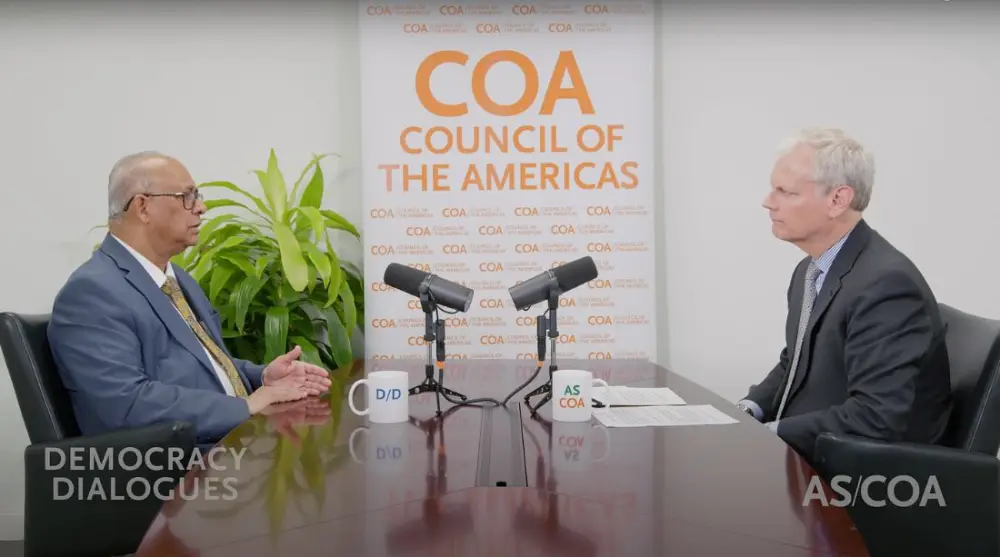
In a historic moment for regional diplomacy, Albert R. Ramdin assumes the position as the first Caribbean Secretary General of the Organization of American States (OAS), elected by unanimous acclamation of the Member States. His recent interview in “Democracy Dialogues” with Eric Farnsworth of AS/COA reveals a renewed vision for the hemispheric institution in complex times for the region.
A Call for Renewed Relevance
Ramdin articulates with conviction his vision of a revitalized OAS that rediscovers its fundamental purpose: “The OAS essentially represents hemispheric cooperation of independent democratic states… But today we see that the role of the OAS has become somewhat broader… in terms of truly bringing countries together around one table.” Recognizing current challenges, he notes that “Regrettably, some countries feel they had to leave the OAS,” a reality he deeply laments.
His perspective on the historical relevance of the organization is unequivocal: “The objectives and purposes of the OAS have never changed, they remain as relevant today as they were 78 years ago… in Santa Fé de Bogotá where the charter was signed.” However, he acknowledges that “circumstances have changed in today’s world with different interstate relations, challenging new policies.”
For Ramdin, this represents “an opportunity to regain its stature, to regain its relevance, to regain its importance,” something that can only be realized “if all countries are truly convinced and committed to working together.”
Pragmatic and Transactional Multilateralism
When questioned about how to revitalize multilateralism in times when it has lost some favor, Ramdin proposes a pragmatic approach: “If we want to be frank about this, very transactional, let’s demonstrate to the Member States who have doubts that the OAS stands for something,” emphasizing that the organization must show that it “not only stands for something but also fulfills those promises.”
This transactional vision is reflected in his approach to specific problems such as migration, where he maintains that “the problem of migration is not solved only with rules and regulations and legal terms. We need to examine the underlying causes.” To address these root causes, Ramdin proposes mobilizing not only countries, but also “the inter-American system, the Inter-American Development Bank, regional banks, the private sector.”
Private Sector Integration
An innovative proposal from Ramdin is the active participation of the private sector in the work of the OAS, “not simply for reasons of philanthropy or corporate social responsibility, it goes far beyond that, it is in the interest of the private sector to be involved.” He argues that the private sector should be engaged in “maintaining high levels of democracy, human rights protection, rule of law, because they benefit from that climate.”
For Ramdin, this implies that they “need to contribute as well because it is their interest we are serving,” proposing a “whole-hemisphere approach, a whole-society approach.”
Internal Institutional Reforms
The new Secretary General proposes reorganizing the institution without implying additional costs for Member States: “The institution itself has to reorganize, has to reinvent itself and you will see that when I make my first announcement in terms of how we strengthen the institutions from within at no cost.”
Ramdin acknowledges that eventually it will be necessary to discuss additional funding, but first he wants to “demonstrate to the Member States first that the OAS stands for something, is fulfilling their needs and priorities, but is also capable of reinventing itself.” He will achieve this through “efficient operations, better internal communication, better alignment of mandates and execution.”
Interinstitutional Articulation
A fundamental aspect of his strategy is to improve coordination with other regional organizations: “Better connection with other parts of the inter-American system, the IDB, with the Pan American Health Organization, the agriculture institution.” Ramdin has already initiated this process: “The day after being elected I had a meeting with the three heads of organizations of CELAC, PAHO and the IDB, and we are all on the same page.”
This coordination includes subregional political entities: “We need to work with the subregional political entities CARICOM, SICA, the Brasilia consensus.” The objective is to create a space for dialogue where “we need to accept the fact that we have one table where we can sit, listen and try to understand each other better.”
Regional Priorities: Haiti, Venezuela and Nicaragua
Ramdin identifies specific priorities for the organization, with Haiti being one of the most urgent: “Haiti is a case. In my opinion, but perhaps it’s more of a personal view, I have been involved with Haiti for almost 20 years.” He proposes to “reestablish the group of friends of Haiti that I chaired before, which was a useful platform in my view, in an informal way.”
Regarding Venezuela, he mentions that he has already requested “a thorough evaluation of the status of Venezuela in the Organization of American States,” immediately clarifying that “the OAS is not just Venezuela. It is much more.” However, he considers it important to develop “some kind of roadmap to start a process of engagement.”
On Nicaragua, although it has officially left the OAS, Ramdin affirms that “it does not mean that the OAS cannot monitor developments and make its voice heard when necessary.”
Intraregional Trade and Economic Development
A prominent aspect of his vision is the promotion of intraregional trade: “In the case of building resilient economies, I firmly believe that a hemisphere with almost 800 million people must be able to do more business with each other.” He proposes promoting “intraregional trade, intraregional investments,” which will “create a stronger bond as countries, but will also contribute to more stability, political stability.”
Ramdin observes a post-pandemic opportunity: “Due to COVID, we know that many countries are looking for shorter supply chains. Why not produce goods in this hemisphere and supply each other instead of depending?” This economic vision connects with his political perspective, where “if we have these realities, you can develop roadmaps on all these issues with the ultimate goal of having strong democracies with rule of law.”
Caribbean Perspective and Diversity as Strength
As the first Caribbean Secretary General, Ramdin brings a unique perspective: “I come from a region that does not have challenges with democracy or human rights, or politically stable societies or electoral systems as such.” He considers this experience can be an asset: “We have our own challenges here and there, but they are not as prominent as elsewhere. I think we can bring those assets, those experiences to the whole atmosphere.”
Additionally, he sees small countries as potential mediators: “Small countries like the Caribbean can also form a bridge between politically diverse opinions, the north, the south and others.”
His optimism is based on his personal experience: “I believe that if you don’t believe things can change for the better, don’t get involved, you absolutely need to believe that change is possible.” He describes Suriname as “a country that is enormous. It’s a small country but enormously diverse. The most diverse country in terms of ethnic composition, language and cuisine,” where they have achieved “a high degree of tolerance among ourselves, a high degree of stability as a consequence.”
Transformation with Purpose
Ramdin’s final vision focuses on a transformation with purpose: “Politicians are expected to deliver for the betterment of the people. So the inter-American system as a system, with its many institutions, with the OAS as the lead organization, is expected to respond to the needs of the peoples of the Americas.”
His ambition is to leave a legacy where “we have an understanding and the OAS has been transformed for that and with that make this hemisphere become a hemisphere with a larger footprint in the world.”
Strategic Communication
Ramdin concludes with a renewed communication strategy: “We will reach out more to societies and reach out more to countries and parliamentarians and share with them all the good things the OAS is doing.” He describes this as “a new outreach and media policy that will be much more active at all levels.”
He summarizes his approach with an observation made to him: “We need someone who understands the organization. We need someone who is willing to go the extra mile, but above all we want someone who can market the organization.”