- Tensión y Diplomacia: El 19 de Julio en la OEA
- Tension and Diplomacy: July 19 at the OAS
- Visión Hemisférica: Albert Ramdin y el nuevo liderazgo de la OEA
- Hemispheric Vision: Albert Ramdin and the Leadership of the OAS
- La Orquestación Diplomática: Del Senado Americano a la Casa de las Américas
- The Diplomatic Orchestration: From the American Senate to the House of the Americas
Ramdin and the Transformation of the OAS
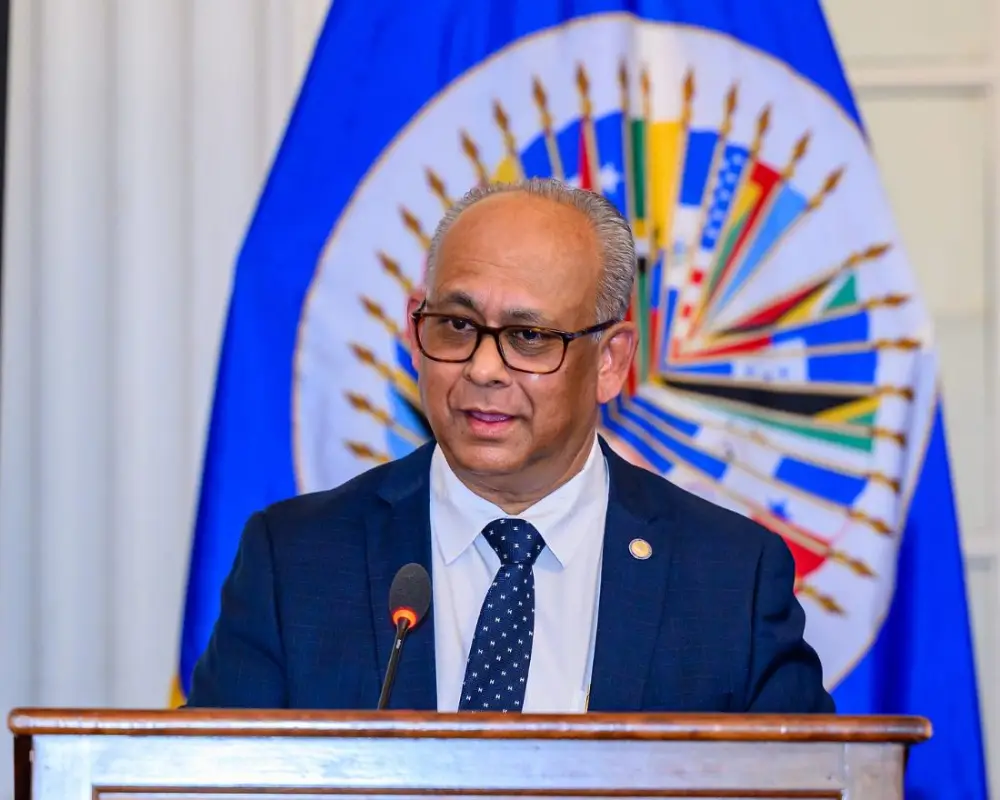
In the reverent silence of the Hall of the Americas, where echoes of decades of hemispheric dreams resonate, Friday, May 30, 2025, dawned with the promise of a transformation that transcends the protocolar to reach the profoundly human. Albert Ramchand Ramdin, son of the crystalline waters of the Surinamese Caribbean, assumed leadership of the Organization of American States with the solemnity of one who understands that he carries in his hands not merely an office, but the collective destiny of hundreds of millions of souls who inhabit from Alaska to Patagonia.
This historic moment — the first in 77 years where a Caribbean native ascends to the secretary generalship — represents much more than an alternation in power: it constitutes the materialization of a long-deferred promise, the recognition that diplomatic wisdom does not reside exclusively in the great capitals, but also flourishes in the islands where the sea teaches patience and history forges resistance.
From my experience as Dominican ambassador to this august institution, I have witnessed how the underground currents of hemispheric politics can converge in moments of exceptional clarity. Ramdin’s arrival embodies precisely one of those instants where history leans toward justice and representation finds its natural course.
The Architecture of Transformation
Ramdin has designed a transformation strategy that recognizes an uncomfortable but necessary truth: the OAS suffers from “counterproductive bureaucracy” that obstructs its potential. His internal organizational revolution includes implementing cabinet meetings every first Monday of the month, creating interdepartmental working groups, and systematically eliminating duplications that have fragmented institutional efficiency.
The implementation of cabinet meetings every first Monday of the month — “rain or shine,” as he declared with poetic determination — establishes an institutional rhythm that privileges constancy over improvisation. The four interdepartmental working groups he proposes — private sector, youth, environmental change, and Haiti — reflect a systemic understanding of the thematic intersections that define our hemispheric times.
His communication strategy transcends mere informational dissemination to embrace a philosophy of participatory diplomacy that brings the OAS closer to the common citizen. “Good work must be shared, reported, and recognized by all,” declared Ramdin with the conviction of one who has learned that excellence without visibility loses its transformative power. This vision contemplates dynamic content that speaks the language of each generation, multi-platform reach that arrives where people live their daily realities, and participatory tools that convert each citizen into a protagonist of hemispheric construction.
The financial diversification he proposes represents a fundamental paradigmatic change: from historic dependence toward strategic interdependence, where each hemispheric actor becomes an active partner in regional transformation. With pragmatic optimism, Ramdin identifies “an untapped well of external financial resources” that awaits activation through convincing demonstration of the OAS’s hemispheric impact.
His results-oriented approach establishes a diplomacy that privileges measurable action over elegant rhetoric. This is not reactive diplomacy that responds to crises when they have already consolidated, but proactive diplomacy that anticipates trends and builds response capabilities before urgency eliminates creative options.
Haiti: The Supreme Laboratory of New Hemispheric Diplomacy
If there exists a territory where the future credibility of the OAS is at stake, that territory is the sister republic of Haiti. Ramdin has elevated the Haitian crisis not as another problem on the hemispheric agenda, but as the defining challenge that can validate or discredit his entire leadership philosophy.
His arrival coincides, not accidentally, with a moment of intense U.S. pressure on the hemispheric organization. The statements by Secretary of State Marco Rubio on May 20th, questioning the very utility of the OAS if it cannot “respond collectively to such a grave catastrophe in our own hemisphere,” revealed Washington’s frustration with an institution it considers incapable of serving its immediate strategic interests.
As I have previously analyzed, the American proposal to revitalize the OAS as an instrument of collective intervention in Haiti ignores institutional realities that cannot be resolved with diplomatic voluntarism. The organization absolutely lacks operational capacity for complex security missions, has no military command structures, intervention protocols, or logistical experience for sustained deployments in hostile territories.
The symposium on Haiti held at OAS headquarters on May 22 — just two days after Rubio’s statements — evidenced strategic coordination between political pressure in Washington and hemispheric diplomatic mobilization. The participation of Barbara Feinstein, confirming the political line outlined by Rubio, and the formal introduction of the Responsibility to Protect doctrine by Jared Genser, evoked disturbing parallels with the justifications used for intervention in Libya, whose disastrous consequences the international community never adequately processed.
His relaunch of the Group of Friends of Haiti transcends traditional diplomatic mechanics to become a coalition of wills committed to tangible results. The establishment of a clear deadline — February 7, 2026, for the conclusion of the transitional framework — demonstrates operational urgency that contrasts favorably with decades of declarations without effective follow-up.
The comprehensive proposal he presents — support for a constitutional referendum, general elections, and an integral security strategy — recognizes that complex crises require multidimensional responses. But it transcends the technical to embrace the profoundly human: in Haiti, not only the stability of a nation is at stake, but the credibility of hemispheric democracy in its capacity to protect the most vulnerable.
From my diplomatic experience, I can attest that Haitian crises have been the Achilles’ heel of multiple OAS administrations. Ramdin seems to understand that successfully confronting this challenge would not only save lives and restore hope in Haitian territory, but would demonstrate to the entire hemisphere that multilateralism can be an effective instrument of transformation when practiced with genuine political will.
His strategic collaboration with CARICOM and the United Nations reflects mature diplomatic wisdom: he recognizes that no individual institution possesses all the necessary resources to confront crises of such magnitude, but that intelligent coordination can exponentially multiply available capabilities.
The Institutional Dilemma: Between External Pressures and Internal Limitations
Ramdin assumes OAS leadership at a moment when the institution faces contradictory pressures that test its capacity to maintain relevance without compromising its institutional integrity. On one hand, Washington demands operative responses that the organization is not equipped to provide; on the other, member states maintain historic skepticism toward initiatives that might transform the OAS into an instrument of American hegemony.
For us Dominicans, this dilemma carries particular gravity. As I have reflected in previous analyses, the 1965 intervention — when the OAS served as a multilateral facade for an occupation that was initially presented as a peace mission — left deep wounds in our collective memory.
The absence of significant Caribbean voices in the recent Haiti symposium reveals silent resistances to proposals that ignore the lessons of previous efforts. Jamaica, the Bahamas, and other immediate neighbors — who directly experience the consequences of the crisis — maintained discrete profiles, suggesting reservations about approaches that privilege force solutions over sustained investments in structural development.
The ideological divisions that paralyze the OAS represent another obstacle that Ramdin must navigate with exceptional skill. How can consensus be built in an organization where votes on less controversial issues end in paralysis?
Ramdin must demonstrate that it is possible to revitalize the OAS without converting it into an instrument of intervention, that it can respond effectively to hemispheric crises without repeating historic errors. His success will be measured not in his capacity to mobilize military contingents under new banners, but in his ability to build sustainable responses that attack the structural causes of regional crises.
The Hemispheric Economic Vision
Ramdin has articulated an economic philosophy that can revolutionize hemispheric commercial relations: “The path toward a more prosperous future does not lie in isolation but in unity.” This declaration proposes transforming hemispheric geography from obstacle into competitive advantage.
His concept of near-shoring recognizes that recent global events have “clearly highlighted the fragility of distant supply chains.” If global disruptions have demonstrated the risks of external hyper-dependence, the American hemisphere possesses all the elements to build regional value chains that generate employment, wealth, and economic stability from Alaska to Chile.
The proposal transcends the merely commercial to embrace a philosophy of strategic interdependence. When Ramdin declares that “what affects one inevitably reverberates through the others,” he is recognizing a geoeconomic reality that can become collective strength through intelligent policies of productive integration.
His emphasis on democracy and technology reveals profound understanding of our time. Digital technologies and artificial intelligence “can be a blessing but also a curse.” His proposal to leverage digital transformation as a “catalyst for sustainable progress” while strengthening electoral integrity represents a balanced approach to challenges that many governments still address in fragmented ways.
By citing Simón Bolívar — “The unity of our people is not simply desirable. It is essential for progress” — Ramdin connects his vision with the deepest historical roots of the American integrationist project. This reference does not constitute rhetorical nostalgia but practical inspiration: it recognizes that 21st-century challenges require the same visionary audacity that animated 19th-century liberators.
Reflections from Diplomatic Experience: Historic Opportunities and Structural Challenges
The Converging Strengths
Unprecedented Representative Legitimacy: As the first Caribbean at the head of the OAS, Ramdin embodies hemispheric diversity in a way no predecessor had achieved. He can speak from the lived experience of small and vulnerable nations, contributing perspectives that enrich hemispheric dialogue from previously underrepresented angles.
Proven Institutional Experience: His ten years as Deputy Secretary General (2005–2015) confer intimate knowledge not only of formal organizational mechanisms but of informal political dynamics that truly determine the success or failure of multilateral initiatives. This experience constitutes invaluable political capital in an institution where institutional memory and personal relationships significantly influence results.
Hemispheric Support Coalition: Unanimous CARICOM backing, complemented by decisive support from Brazil, Mexico, Colombia, Chile, Uruguay, and other influential nations, provides him with an exceptionally solid political base for implementing structural reforms. This coalition transcends traditional ideological divisions, suggesting that his leadership can build bridges where others have found abysses.
Integral and Systematic Vision: His four-pillar approach simultaneously addresses the institutional, communicational, financial, and operational dimensions of organizational transformation. This systemic understanding avoids the partial reforms that have characterized previous modernization attempts, offering instead a comprehensive strategy that recognizes interconnections between different aspects of institutional performance.
The Challenges That Await
Structural Financial Limitations: Historic dependence on U.S. contributions, in a context of growing multilateral skepticism from influential Washington sectors, presents budgetary challenges that may limit the capacity to implement ambitious reforms. The financial diversification he proposes, though conceptually sound, will require time to materialize into sufficient resource flows.
Regional Ideological Polarization: Divisions between progressive and conservative governments, exacerbated by crises in Venezuela, Nicaragua, and other national contexts, may complicate consensus-building on sensitive issues. Ramdin must navigate these political currents with the skill of an experienced diplomat who understands that institutional neutrality does not mean indifference to democratic violations.
Extraordinary Expectations: As the first Caribbean Secretary General, Ramdin faces expectations not only to lead effectively but to symbolically represent the aspirations of the hemisphere’s small nations. This symbolic pressure may complicate technical decisions that require delicate political calculations between different regional constituencies.
Simultaneous Crises and Limited Resources: The concurrence of crises in Haiti, Venezuela, Nicaragua, and other national contexts demands multiple response capacity that may overload already limited institutional resources. Strategic prioritization becomes critical when all crises seem urgent but resources are finite.
The Horizon of Possibilities
Albert Ramdin’s assumption coincides with a moment of exceptional opportunity to redefine the role of hemispheric multilateral institutions. The global pandemic has demonstrated both the vulnerabilities of poorly managed interdependence and the power of well-coordinated cooperation. His vision of a “more agile, cost-efficient, responsive, and impactful” OAS can translate into tangible reality if he manages to maintain the balance between transformative ambition and operational pragmatism.
Ramdin’s commitment to evidence-based policies, achievable objectives, and measurable results suggests an approach that privileges effectiveness over rhetoric. His previous experience has taught him that successful reforms require not only political will at the summit but cultural changes at the base, not only new structures but new organizational habits.
His explicit request for “input from all of you to make the OAS rise to the occasion” recognizes a fundamental truth: no secretary general can transform a multilateral institution without the active and sustained commitment of its member states. This collaborative approach reflects mature understanding of multilateral power dynamics, where international institutions are platforms where members coordinate objectives that none could achieve individually.
Call to Action: The Hour of Shared Responsibility
History will judge this moment not by the words pronounced in the Hall of the Americas — however eloquent they may have been — but by the actions implemented in the next five years in Washington’s diplomatic corridors, the university classrooms of our capitals, the innovative businesses of our countries, and the vulnerable communities that await concrete responses to immediate challenges.
Albert Ramdin has traced a conceptual map toward those more just, democratic, and united Americas he proclaims possible. But maps, however precise they may be, do not carry travelers to their destinations: only the sustained will to walk can convert traced routes into conquered territory.
His leadership will be especially critical in resisting pressures that seek to convert the OAS into an instrument of intervention under new multilateral garments. As I have maintained in previous analyses, true solidarity with peoples in crisis like the Haitian will not be expressed in geopolitical experiments, but in sustained commitments to structural development, institutional strengthening, and local capacity building. International experience has validated these alternatives as more effective than force solutions that have repeatedly failed in similar contexts.
It now corresponds to all hemispheric actors — governments, civil societies, private sectors, academies, media — to demonstrate whether we have the political maturity to rise to the historic moment we are living.
The Caribbean dawn in the OAS can illuminate a new day for all America if we know how to be worthy of the opportunities that open before us. In the cadence of Ramdin’s voice resonate echoes of hope that can become tangible realities if political will translates into sustained commitment, if solemn declarations convert into concrete policies, if hemispheric dreams find expression in measurable results that improve the lives of our peoples.
Diplomacy, in its noblest essence, is the art of building bridges where others see abysses, of finding common ground where others perceive irreconcilable differences, of creating shared future from divergent histories. Albert Ramdin has demonstrated possessing these qualities in abundance. It now corresponds to the entire hemisphere to demonstrate whether we possess the collective wisdom to seize the opportunities his leadership offers us.