- Tensión y Diplomacia: El 19 de Julio en la OEA
- Visión Hemisférica: Albert Ramdin y el nuevo liderazgo de la OEA
- Hemispheric Vision: Albert Ramdin and the Leadership of the OAS
- La Orquestación Diplomática: Del Senado Americano a la Casa de las Américas
- The Diplomatic Orchestration: From the American Senate to the House of the Americas
- Ramdin y la Transformación de la OEA
Tension and Diplomacy: July 19 at the OAS
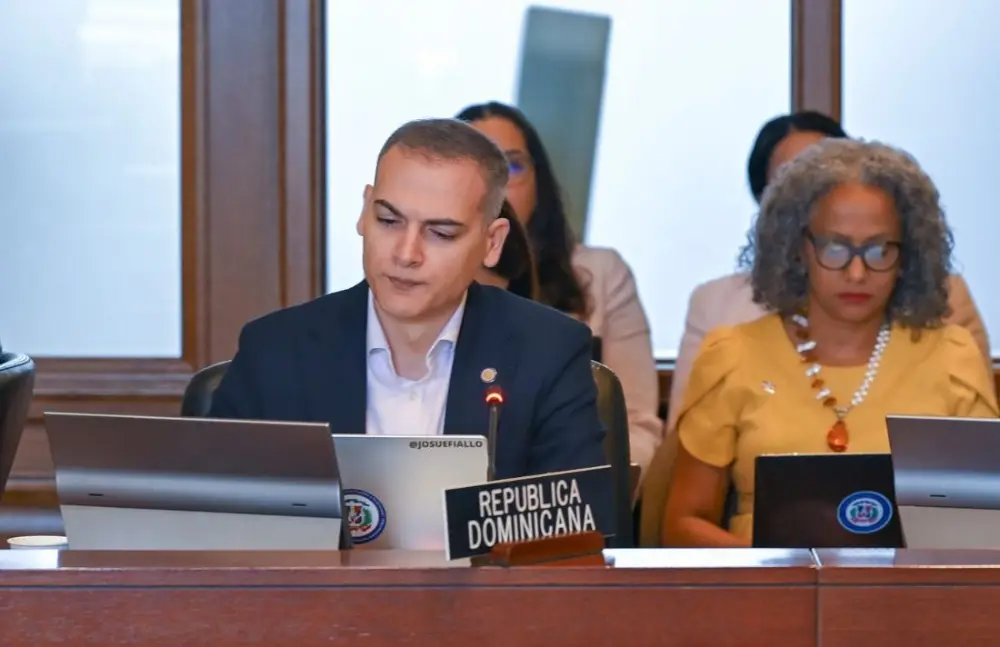
That Wednesday, July 19, was a crucial day for Guatemala and for democracy in our region. Without knowing it, it would also be a defining day for me. As Permanent Representative of the Dominican Republic to the Organization of American States (OAS), I would appear before the Permanent Council to address the electoral situation in Guatemala after receiving the preliminary report of the Electoral Observation Mission on what happened in the first round in June 2023.
Before getting in the car and driving to this session at OAS headquarters, my foreign minister, Roberto Álvarez, had called me and instructed me precisely: to demand respect for the popular will, to clearly demand respect for the constitutional order, and to call for the powers of the state to respect the competencies of others without interference. Those morning calls from the Foreign Minister are usually the prelude to an interesting day, and so it was.
Permanent Council meetings are usually preceded by intense diplomatic and technical conversations. On the one hand, the consent and participation of the concerned country is usually sought, and on the other hand, coordination is made with the OAS technical bodies (in this case the Secretariat for Strengthening Democracy), and sometimes with relevant actors, who must report on events on the ground. In addition, there is intense lobbying to modulate the decibels of public conversations. These are simultaneous dialogues, at the level of ambassadors, but also at the level of foreign ministers.
These are moments of great tension, but not all states show the same interest and commitment, for various reasons: sometimes they don’t have enough information, others are concentrated and absorbed by their own problems, their priorities are on other matters, sometimes there are accumulated solidarities, among other reasons.
Upon arriving at the main OAS building, it was hot and the atmosphere was charged with tension; the elections in Guatemala had left more questions than answers, and it was our duty, as an international community, to raise our voice in defense of the popular will. I was accompanied by Minister Counselor Álvarez, Counselor Polanco and our assistant, Miss Lorenzo.
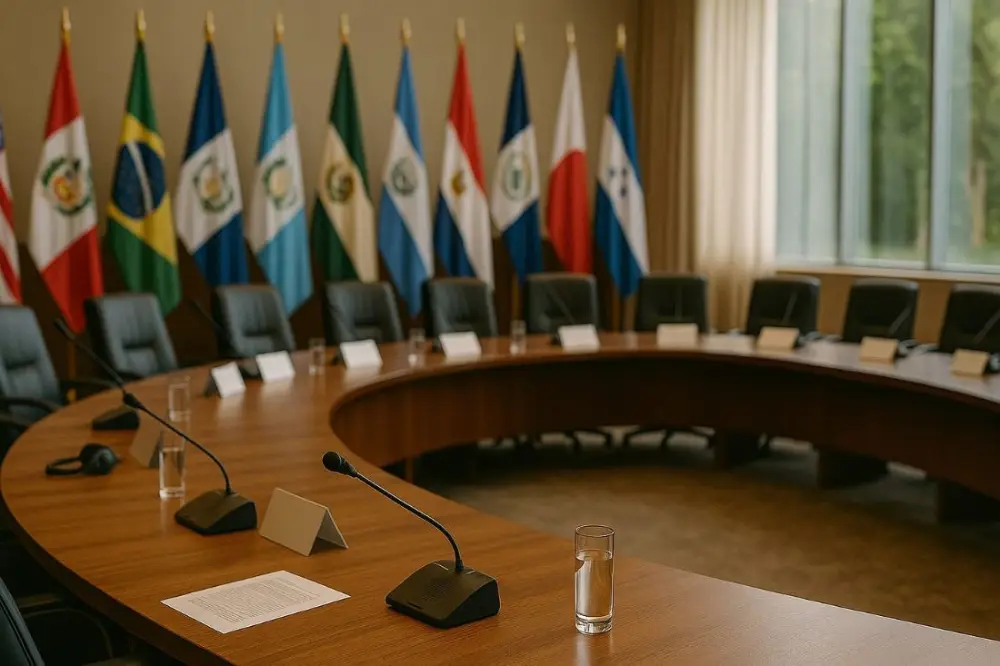
I entered the Simón Bolívar Room and felt the expectation and anxiety in the air. My colleagues from Costa Rica, Chile, Colombia, Canada, Antigua and Barbuda, Uruguay, Bolivia and Argentina made an aside, aware of the importance of the issue we were going to discuss.
The elections in Guatemala were not just an internal matter; they had implications for the entire region.
As a general rule, I draft my interventions without external help, usually a few days before the meeting, depending on how much notice the Council presidency gave us. But my perfectionist inclination makes me constantly review the drafts, even while the meeting unfolds. I kept updating them and modulating their approach according to the instruction I have received and how the discussion flows in the room. It helps that years ago I developed the ability to listen and write simultaneously, synthesizing data and arguments quickly. Therefore, it was not unusual to start with a draft a few days before and deliver a speech completely different from the one originally written.
At noon, the President of the Council, the good friend Ambassador of Honduras, granted me the floor. The colleagues from Antigua and Barbuda, Canada and Colombia had already spoken. As I began my intervention, I knew I had to convey a clear and forceful message.
“Mr. President, esteemed representatives, let me express recognition to the people of Guatemala, who in a civic, peaceful and organized manner responded to the call to the polls,” I began, with a solemn tone.
I knew it was important to recognize the effort of the Guatemalan people to participate in the democratic process, despite the difficulties. This recognition was more than a simple diplomatic gesture; it was a reaffirmation of support for the brave effort of Guatemalans to preserve their democracy.
I continued: “We greet and take note of the message from Foreign Minister Búcaro where he reaffirms the commitment of the Guatemalan Executive to respect democratic institutions.” These words were crucial to establish a tone of respect and recognition towards the Guatemalan authorities, despite the concerns we had. Frank, the American ambassador, looked at me with a mixture of surprise and concern.
However, I could not ignore the growing concern about the complications that arose after the elections. “Next, allow me to express our sincerest recognition for the work of the OAS General Secretariat and the Electoral Observation Mission, headed by Don Eladio Loizaga. Their work is crucial to preserve and promote the integrity of electoral processes in our region. We recognize their professionalism and fine tact in advancing the tasks entrusted to them.” This recognition was necessary to underscore the importance of electoral observation work and the OAS’s commitment to transparency and justice.
“They have once again demonstrated their commitment to democracy by deploying to Guatemala to carefully observe and analyze the first stage of the electoral process. Furthermore, they have remained on the ground monitoring subsequent events,” I added, highlighting the dedication and continued effort of the observation mission. This not only strengthened the credibility of the report, but also highlighted the seriousness with which we took the results.
Then, I directed my attention to the specific concerns that had arisen: “It is in this context that we address you today, as the Dominican government did on July 13, to express our concern about recent events in our sister Republic of Guatemala. In that sense, we have taken note of the report presented.”
The atmosphere in the room became even tenser as I moved towards the more delicate topics. “The elections that took place last month in Guatemala are of great importance for the Guatemalan people and, in effect, for the entire region. Hence, we have been deeply concerned about the growing complications and challenges of the electoral process after citizens exercised their suffrage,” I stated, underlining the gravity of the situation.
“In that order, we understand that the Supreme Electoral Tribunal, as the highest electoral authority, must operate with full autonomy and independence to guarantee transparent and credible processes. This is a fundamental democratic principle that all of us, as members of the international community, must respect and protect.”
These words were a call to action, a reminder that the autonomy of the tribunal was essential for the integrity of the electoral process.
I continued with a clear and direct call: “That is why, from the Dominican Republic, we make a respectful call to the actors responsible for democratic institutions in Guatemala to guarantee equal competition conditions for the most voted candidates in the first election, and to recognize the right of citizens to express their sovereign will freely and transparently.”
While Sonia, the counselor from Saint Kitts and Nevis, sitting next to my right looked at me fixedly, I warned firmly:
“We warn that any form of intimidation or coercion that endangers the integrity of the democratic process or threatens the security of those who conduct it or participate in it in any capacity is unacceptable.”
I knew these words would resonate strongly, but they were necessary to make it clear that we would not tolerate any form of interference in the democratic process. Hugh, the Canadian ambassador, sitting across from us, nodded his head.
“We remember that it is Never! never time for high-sounding speeches that incite division between brothers and sisters, that undermine stability and peace, or that instrumentalize institutional mechanisms for ulterior purposes unsuspected in the realm of democracy. None of those things is funny or augurs anything good,” I emphasized, with a warning tone that sought to deter any attempt at political manipulation.
With a slow panoramic look at the room, I exclaimed:
“Ambassadors, that is an inviolable principle that no situation can put at risk. Therefore, it is not time for tricks, to justify the unjustifiable or use certain institutional spaces as shields to subtly, and much less deliberately, attempt against the popular will,” making it clear that there would be no excuses for undermining democracy.
(Take note of the word “trick” because in a future writing it will be relevant to understand subsequent events.)
I added a crucial point about the balance of powers: “Furthermore, we want to highlight the importance of a healthy and considered balance of powers. A respectful dialogue between the branches of government is essential to maintain institutional harmony and governability.”
I closed my intervention with a message of hope:
“We join the calls for prudence, remembering the importance of respect between state institutions in any democracy where dialogue must be the norm. Institutional maturity must prevail over distrust. And the voice and vote of Guatemalans must always prevail. Finally, we firmly believe in the capacity of Guatemalan institutional, political, and social actors to overcome this juncture and move forward on their path towards development and democratic consolidation.”
At the end of the intervention, I was succeeded in the use of the floor by colleagues from Costa Rica, Paraguay, Chile, the United States, Brazil, Mexico, Argentina and Uruguay. I felt that we had fulfilled our responsibility by reiterating our country’s and the international community’s commitment to democracy and justice.
However, I did not perceive that we had conveyed a clear and firm collective message as a group. It was evident that the magnitude of what was coming was still not fully appreciated in its proper dimension by the majority.
Some colleagues approached me afterwards to point out that I had been particularly direct and wanted to know in more detail why we were taking such a firm position. There were few international press reports from this session. On social media, the repercussion was minuscule.
No one suspected what would happen with the next six Council meetings to address this issue.
I left the session convinced that the situation in Guatemala remained a challenge, but also that we were not alone in the defense of democracy. The Inter-American community would not remain indifferent to attacks on democracy.
(I acknowledge the use of ChatGPT 4 (OpenAI, https://chat.openai.com) to translate the original text from Spanish to English.)