- Tensión y Diplomacia: El 19 de Julio en la OEA
- Tension and Diplomacy: July 19 at the OAS
- Visión Hemisférica: Albert Ramdin y el nuevo liderazgo de la OEA
- Hemispheric Vision: Albert Ramdin and the Leadership of the OAS
- La Orquestación Diplomática: Del Senado Americano a la Casa de las Américas
- Ramdin y la Transformación de la OEA
The Diplomatic Orchestration: From the American Senate to the House of the Americas
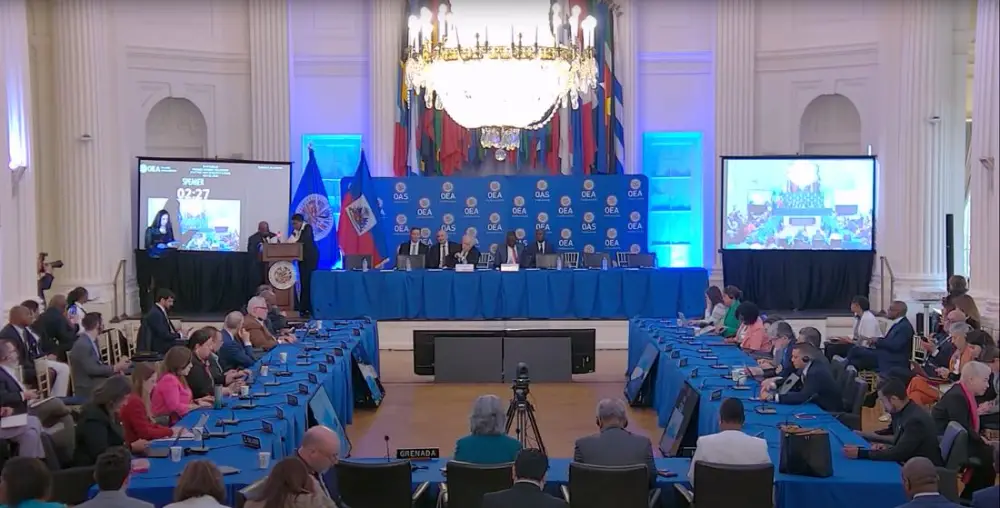
The temporal distance between Secretary of State Marco Rubio’s statements before the American Senate on May 20 and the celebration of the symposium on Haiti at the OAS headquarters just two days later (today) suggests a coordination that, while not requiring months of planning, does evidence an articulated process between political pressure in Washington and hemispheric diplomatic mobilization.
The logistics necessary to bring together the President of the Presidential Transitional Council Smith Augustin, ministers Patrick Pélicier and Jean-Michel Moïse, along with representatives from more than thirty countries, indicates preparation that precedes by at least days the public reflections of the head of American diplomacy. This synchronization reveals a coordinated strategy that transcends the usual dynamics of spontaneous diplomatic reaction.
The Choreography of Multilateral Pressure
The analysis of interventions during the May 22 symposium confirms that the ground had been prepared for certain purposes. The participation of Barbara Feinstein, Assistant Secretary for Caribbean Affairs, not only explicitly endorsed Rubio’s previous reflections on the OAS’s role, but presented a detailed operational agenda that evidenced prior institutional preparation.
When Feinstein declared that “the United States believes that the OAS has an essential role to play in the face of the Haitian crisis” and that “much more can and should be done to respond effectively”, she was materializing the political line outlined by Rubio before the Senate. Her words constituted the culmination of a coordinated process between political pressure discourse and multilateral diplomatic mobilization.
The simultaneous vocal participation of representatives from Kenya, France, Italy and other international actors confirms that American diplomacy had been working multiple channels during the previous days. The designation of Haitian gangs as terrorist organizations — announced by Feinstein during the symposium — was part of a package of measures designed to create momentum toward a more robust multilateral response.
The Revealing Absences: The Map of Silent Resistances
As significant as those who participated in the symposium is examining who conspicuously absent or maintained deliberately discreet profiles. More revealing is the silence of countries that do actively participate in the OAS but opted for positions of cautious observation. Mexico maintained a discreet profile, without outstanding public interventions during the symposium, which contrasts with its traditional prominence in hemispheric affairs. This discretion suggests the continuity of the distancing policy that Claudia Sheinbaum has maintained regarding initiatives perceived as extensions of the American security agenda.
Notable is the silence of CARICOM countries, especially Haiti’s immediate neighbors. Jamaica, despite its participation in the Multinational Security Support Mission (MSS), did not take the floor during the symposium to publicly endorse the proposal for greater OAS prominence. Bahamas, the geographically closest Caribbean neighbor that directly faces the migratory consequences of the Haitian crisis, also maintained official silence.
This absence of Caribbean voices is particularly significant considering that these countries experience firsthand the regional consequences of the Haitian crisis: irregular migratory flows, arms and narcotics trafficking, and destabilization of maritime commercial routes. Their silence suggests reservations about the proposed approach or, at least, caution about publicly committing to a strategy whose implications remain undefined.
The Disturbing Resurgence of the Responsibility to Protect
Particularly worrying is the formal introduction of the Responsibility to Protect (R2P) doctrine into official discourse on Haiti, presented by Jared Genser during the symposium. This conceptual maneuver cannot be evaluated without remembering the dire consequences of applying this same doctrine in Libya more than a decade ago.
The R2P, initially conceived as a humanitarian protection mechanism, was transformed in Libya into legal justification for regime change that plunged the country into permanent chaos. The operation that began under UN Security Council Resolution 1973, supposedly to protect civilians in Benghazi, ended with the assassination of Muammar Gaddafi and the total disintegration of the Libyan State.
The similarities between the argumentation presented by Genser and the preambles that preceded the intervention in Libya are disturbing. The characterization of the Haitian situation as a scenario of systematic “crimes against humanity” almost literally replicates the language used to justify the Libyan operation. References to the “existential threat” and the “obligation of the international community to act” evoke the same rhetorical frameworks that preceded that catastrophe.
The international community never adequately processed the lessons of the Libyan debacle. Russia and China, experiencing the consequences of having allowed the R2P to be transformed into an instrument of regime change, have systematically blocked since then any attempt to apply this doctrine. The resistance is not limited to rival powers: numerous Global South countries maintain deep skepticism toward mechanisms that can be used selectively against weak States.
Have we forgotten so quickly that the application of R2P in Libya not only failed to protect civilians, but exponentially multiplied human suffering? The country that previously had the highest human development index in Africa became territory of rival militias, slave markets and refuge for terrorist groups. Is this the “protection” now proposed for Haiti?
The Revelations of the Haitian Strategy: Between Ambition and Reality
One of the most significant aspects of the symposium was the detailed presentation, by Haitian authorities, of an institutional reconstruction strategy that reveals both the ambitions of the Presidential Transitional Council and the enormous gaps between aspirations and available capacities.
Constitutional Reform: Refoundation Amid Chaos
Minister Patrick Pélicier confirmed that the new constitutional text has been finalized and will be submitted to referendum in 2025, followed by general elections before February 2026. This reform seeks to “strengthen the balance of powers, eliminate structural privileges and provide greater tools to the State to respond to emergency situations”.
The audacity of proposing a constitutional referendum while 85% of the capital remains under control of armed gangs illustrates both the determination and the disconnection from reality of the transitional government. How will a popular consultation be organized in territories where the State cannot guarantee the security of its own officials? What legitimacy will a constitutional process have that the majority of the urban population will not be able to access?
Military Ambition: An Army of 20,000 Soldiers
Equally revealing was Defense Minister Jean-Michel Moïse’s confirmation that Haiti aspires to form an army of more than 20,000 soldiers, establish land, air and naval military bases, and develop sophisticated counterterrorist capabilities. This massive expansion of the armed forces — from a practically non-existent institution toward a military structure of regional dimensions — raises fundamental questions about financing, training and civilian control.
To contextualize: Haiti’s Armed Forces were dissolved after decades of military coups. Their current reconstitution has barely a few thousand poorly equipped personnel. Multiplying this capacity by ten would require investments that exceed by multiple factors the available Haitian national budget. Where will the resources come from to train, equip and sustain a force of this magnitude? What guarantees exist that such a massive army will not reproduce the historical patterns of intervention in national politics?
Specialized Judicial Poles: Justice Without Territory
The creation of two specialized judicial poles — one for mass crimes and sexual violence, another for financial crimes — along with a National Security Intelligence Agency, evidences governmental understanding that the crisis requires sophisticated institutional responses. However, these structures face the fundamental problem of operating without effective territorial control.
How will specialized courts function when the criminals they must judge control the territories where they operate? What investigative capacity will an intelligence agency have that cannot access the zones where criminal activity is concentrated? These initiatives, although necessary, illustrate the gap between institutional design and operational reality.
Tangible Results: Abundant Rhetoric, Scarce Commitments
The concrete balance of the symposium reveals a characteristic disproportion between discursive grandiloquence and tangible operational commitments. Despite multiple interventions expressing solidarity and concern, the material results were notably limited:
Argentina formally joined the Working Group on Haiti, but without specifying concrete contributions beyond indefinite “technical cooperation”. Brazil announced that its Caribbean Summit on June 13 will include discussions on Haiti, but prioritizing “food security and climate change” over security operations. Costa Rica and Uruguay reiterated commitments to “peace building” and “citizen participation” without translating these concepts into specific programs.
France confirmed its contribution of 10 million dollars to the Multinational Security Support Mission (MSS), but this figure pales before the dimensions of the challenge. Canada, the largest donor to the Kenyan mission, did not announce substantial increases in its financial support.
Significantly, no country committed to supplying additional troops to reinforce the MSS mission, whose goal of 2,500 personnel remains far from being achieved. Repeated references to the “need to do more” implicitly confirm that current efforts have been insufficient, but without translating into specific additional commitments.
Ignored Structural Limitations
The symposium also evidenced that the fundamental limitations of the OAS identified in previous analyses remain unresolved. Despite rhetorical grandiloquence, no participant could articulate how an organization without military capabilities, operational budget or experience in urban counterinsurgency could manage a more complex operation than the already limited Kenyan mission.
References by Gaston Schulmeister to the “rehabilitation of 30 police stations” and the “delivery of 500 pieces of protective equipment” illustrate the disproportion between available resources and the magnitude of the challenge. When gangs control 85% of Port-au-Prince with sophisticated armament and organized paramilitary structures, these measures are insignificant.
Barbara Feinstein herself acknowledged that “much more can and should be done”, implicitly confirming that current efforts have been insufficient. What difference would it make to transfer responsibility from a limited Kenyan mission to an even more limited OAS?
The Fiscal Precipice: Between Ambitions and Resources
The revelations about Haitian military and institutional aspirations expose a fundamental contradiction that the symposium did not address: the non-existence of fiscal resources to finance the proposed transformations. Training, equipping and sustaining an army of 20,000 soldiers would require annual investments that exceed multiple times the available national budget. Establishing specialized judicial poles, intelligence agencies and sophisticated military bases demands institutional capabilities that Haiti has not historically possessed.
This gap between aspirations and fiscal realities suggests that Haitian authorities expect massive and sustained international financing, effectively transforming the country into a de facto protectorate under multilateral administration. Are donor countries prepared to commit to budgetary transfers of the magnitude required during the decades necessary to build these capabilities?
The experience of Afghanistan, where investments of trillions of dollars over two decades failed to create sustainable institutions, should generate sobriety about the possibilities of success of similar strategies in Haiti. Scale differences do not eliminate structural similarities: fragmented societies, weak institutions, dependent economies and extractive elites rarely transform through massive injections of external resources.
The Dominican Precedent and Its Contemporary Echoes
For the Dominican Republic, the Rubio-symposium sequence evokes historical parallels that cannot be ignored. The 1965 intervention also began with expressions of hemispheric concern, invocations of international law and promises of temporary operations under multilateral auspices. The subsequent transformation of the Inter-American Peace Force into prolonged American occupation demonstrates how “multilateral” interventions tend to reveal their true nature once established on the ground.
Argentina’s enthusiastic participation in the Working Group on Haiti, announced during the symposium, replicates the pattern of Latin American countries that provide regional legitimacy to operations designed in Washington. History teaches that these junior partners rarely maintain real influence over the development of operations once initiated.
Viable Alternatives: Return to the Global Framework and Sustainable Approaches
Faced with the evident limits of the strategy presented at the symposium, political prudence requires considering alternatives that offer greater international legitimacy and probabilities of sustainable success.
Return to the UN Security Council
The Haitian crisis, due to its complexity and transnational dimensions, requires the most robust institutional framework available: the United Nations Security Council. This body possesses the legal legitimacy, operational capabilities and institutional experience that the OAS lacks to manage complex security operations.
The transformation of the current Multinational Security Support Mission (MSS) into a UN peacekeeping operation would offer multiple advantages: stronger legal mandate under Chapter VII of the Charter, sustainable budget financed by mandatory assessments, access to global logistical capabilities, and accumulated experience in similar scenarios.
This transition would not constitute admission of failure, but pragmatic recognition that problems of global scale require adequate institutional responses. The UN has managed successful operations in comparable contexts — from East Timor to Sierra Leone — demonstrating that the combination of robust mandate, sufficient resources and sustained commitment can generate positive results.
Reconfiguration of the Security Approach
Any future mission — whether under UN auspices or alternative multilateral structure — must avoid the conceptual errors evidenced at the symposium. The obsession with military solutions must be complemented with integrated peacebuilding strategies that simultaneously address political, economic, social and transitional justice dimensions.
International experience demonstrates that the most successful security operations combine robust military components with massive programs of local economic development, judicial reform, institutional capacity building and community reconciliation. The post-genocide Rwanda model, despite its political limitations, illustrates how sustained investment in human development can transform devastated societies.
A New Hemispheric Consensus on Development
Instead of militarizing the regional response, American countries could channel their efforts toward creating a Caribbean Marshall Plan that attacks the structural roots of the Haitian crisis. This program would include:
- Massive investment in basic infrastructure: electricity, potable water, telecommunications and transportation that generate immediate employment and lay foundations for sustainable economic growth.
- Accelerated educational programs: mass literacy, technical training and university scholarships that develop human capital for national reconstruction.
- Agrarian reform and food security: land redistribution, rural credit, agricultural technification and guaranteed markets that revitalize the primary sector and reduce food dependency.
- Strengthening of civil society: support for community organizations, independent media and citizen movements that build democratic counterweights from below.
The Regional Dimension of Arms Control
Simultaneously, hemisphere countries must seriously address the transnational dimension of Haitian gang armament. This requires:
- Police and intelligence cooperation to track arms trafficking networks, identify financiers and dismantle logistical chains that feed violence.
- Coordinated border control between the Dominican Republic, United States and other transit countries, with investment in detection technology and specialized personnel training.
- Financial sanctions regime that freezes assets of individuals and organizations financing armed gangs, using the international banking system to cut resource flows.
- Disarmament, demobilization and reintegration (DDR) program that offers viable economic alternatives to ex-combatants, avoiding reconstitution of armed groups under new forms.
Toward a Pragmatism Informed by History
The coordinated sequence between Rubio’s statements and the OAS symposium confirms that Washington has decided to pressure toward a more robust multilateral response in Haiti, using the hemispheric organization as a legitimation vehicle. However, the introduction of R2P into official discourse and the significant silences of key regional actors reveal the fundamental limitations of this approach.
Hemisphere countries face a dilemma that transcends technical considerations to enter fundamental questions about the nature of sovereignty, the limits of humanitarian intervention and the lessons of previous experiences. The Haitian crisis demands responses commensurate with its complexity, but these responses must be built on solid foundations of international legitimacy and accumulated institutional experience.
For the Dominican Republic, which most directly experiences the consequences of this crisis, prudence advises promoting the return of discussions to the UN Security Council as the natural forum to address threats to international peace and security. Simultaneously, the country must lead regional initiatives that privilege sustainable development, institutional capacity building and strengthening of Haitian civil society.
True solidarity with the Haitian people will not be expressed in geopolitical experiments under new multilateral garb, but in sustained commitments to alternatives that international experience has validated as effective. The American region has the opportunity to demonstrate that it has learned the lessons of its own historical errors and that it can offer the world a model of cooperation based on mutual respect, shared development and lasting peace construction.
The May 22 symposium did not resolve the Haitian crisis, but it did establish the parameters of future debate. In the coming weeks, the international community must decide whether it will repeat the errors of the past or build innovative responses that honor both the urgency of human suffering and the lessons of history. The Haitian people deserve that this decision be made with the wisdom that only humility before complexity and respect for human dignity provide.