- De la Visión a la Acción: La Diplomacia Silenciosa de RD hacia la X Cumbre de las Américas
- From Vision to Action: The Quiet Diplomacy of the DR Toward the X Summit of the Americas
- Negociando el futuro de las Américas: De Santo Domingo 🇩🇴 a Los Ángeles 🇺🇸
- Negotiating the Future of the Americas: From Santo Domingo 🇩🇴 to Los Angeles 🇺🇸
- La Cumbre de las Américas: Evolución, Desafíos y Perspectivas
- The Summit of the Americas: Evolution, Challenges and Perspectives
The Dilemma of Invitations: Democratic Commitment and Representativeness at the X Summit
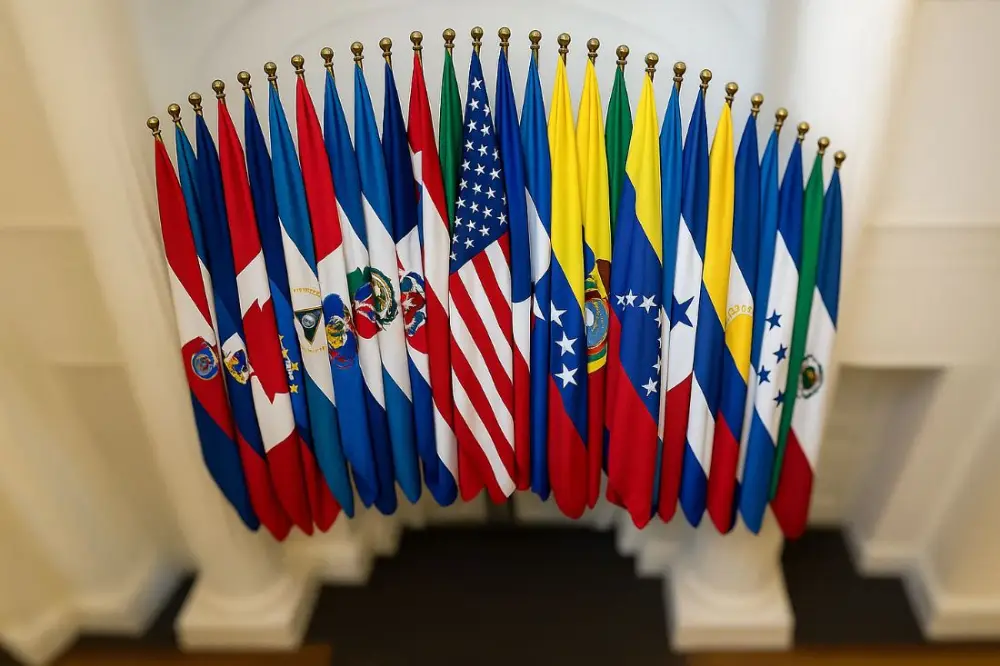
The definition of the criteria for issuing invitations to the X Summit of the Americas constitutes, without doubt, one of the most complex challenges that the Dominican Republic will face as the host nation. This dilemma, far from representing a mere protocol formality, evidences fundamental tensions about the organizing principles of the inter-American system and reflects substantive divergences regarding the very nature of the Summit process.
The Democratic Clause as a Founding Principle
Since the Quebec Summit in 2001, the inter-American system formally adopted the “democratic clause” as a guiding parameter for participation in this mechanism. This criterion establishes that only countries recognized as representative democracies can take part in hemispheric deliberations, assuming that this requirement guarantees that participants share fundamental values and commitments to essential rights.
The Quebec Declaration clearly established: “We recognize that the values and practices of democracy are fundamental for advancing in the achievement of all our objectives. The maintenance and strengthening of the Rule of Law and strict respect for the democratic system are, at the same time, a purpose and a shared commitment, as well as an essential condition of our presence in this and future Summits. Consequently, any unconstitutional alteration or rupture of the democratic order in a State of the Hemisphere constitutes an insurmountable obstacle for the participation of the Government of said State in the Summit of the Americas process.”
This categorical formulation represents a defining moment in the normative evolution of the inter-American system. The language used — particularly the characterization of democratic rupture as an “insurmountable obstacle” — establishes an unequivocal threshold for participation in the Summit process, transforming what could have been a collective aspiration into a binding requirement.
The adoption of this clause meant the normative crystallization of a principle that had acquired centrality in post-Cold War hemispheric diplomacy. The OAS Resolution 1080 (1991) and the Inter-American Democratic Charter (2001) had progressively established the bases for a collective commitment to the defense and promotion of representative democracy as the only legitimate political system in the continent, overcoming decades of coexistence between regimes of diverse nature.
However, the practical application of this principle has historically proven problematic due to various factors that transcend merely technical considerations and reflect substantive dilemmas about the relationship between national sovereignty and hemispheric commitment.
Conceptual and Political Complexities
The very definition of what constitutes a democracy is subject to divergent interpretations among member States of the inter-American system. While some nations emphasize procedural aspects such as the regular holding of elections with multi-party participation, others prioritize substantive dimensions related to socioeconomic rights or alternative models of citizen participation.
This interpretative plurality, far from constituting merely an academic debate, reflects diverse political traditions and differentiated conceptions about the relationship between State and society. The Western hemisphere houses a notable diversity of political systems that, even self-defined as democratic, present significantly different institutional characteristics and governmental practices.
To this conceptual complexity is added the tension with another fundamental principle of international law: non-intervention in the internal affairs of sovereign States. Numerous countries in the region invoke this principle to question the legitimacy of external assessments of their political systems, arguing that such assessments may constitute forms of interference incompatible with sovereign equality among nations.
This tension between democratic commitment and respect for self-determination manifests with particular intensity in the context of the Summits, where the decision on invitations implies, implicitly, a value judgment on the democratic quality of potential participants. Such judgment generates resistance, especially when it is perceived as selective or instrumentalized for specific geopolitical purposes.
The textual precision of the Quebec Declaration illuminates the magnitude of the challenge facing the Dominican Republic. The hemispheric commitment to democracy was not conceived as a flexible consideration but as an “essential” and “shared” condition. This generates a fundamental tension with any approach that exclusively prioritizes pragmatic inclusivity.
Simultaneously, this formulation raises questions about the mechanisms for determining what constitutes an “unconstitutional alteration or rupture of the democratic order.” The Declaration establishes the categorical principle, but does not develop specific criteria or institutional procedures for its consistent application in ambiguous or disputed contexts.
This absence of precise operational parameters has allowed divergent interpretations on how to instrumentalize the democratic clause. The dilemma for the Dominican Republic does not solely reside in deciding whether to apply this principle, but in determining how to interpret it in a hemispheric context characterized by political systems that defy simplistic categorizations between democracy and authoritarianism.
The Los Angeles Precedent and Its Implications
The experience of the IX Los Angeles Summit in 2022 is particularly illustrative of these tensions. The decision of the United States, as the host country, not to invite Cuba, Nicaragua, and Venezuela generated a domino effect of significant absences. Mexico, Honduras, Bolivia, and other countries declined to participate in solidarity with the excluded, compromising the representativeness and effectiveness of the meeting.
This precedent demonstrated that, in the current context, exclusions based on democratic criteria can be counterproductive to the objectives of the mechanism. The absence of actors limits the forum’s ability to effectively address shared problems that require concerted responses.
Simultaneously, the experience evidenced the political complexity of the democratic criterion when its application is perceived as asymmetric or influenced by geopolitical considerations unrelated to the quality of the political systems themselves. Several countries questioned the coherence of excluding certain nations while maintaining the invitation to others with comparable democratic deficits.
The results of this restrictive approach in Los Angeles were, in practical terms, suboptimal for the inter-American system as a whole. Reduced participation limited the legitimacy of the agreements adopted, while the notable absences diverted media attention to procedural differences rather than to the substantive contents of the hemispheric agenda.
Strategic Options for Punta Cana
For the Punta Cana meeting, the Dominican Republic will face the disjunction between strictly adhering to the criterion of democratic commitment, with the risk of reproducing the exclusions and absences that characterized Los Angeles, or adopting a more inclusive approach that could generate tensions with key actors of the inter-American system, particularly the United States and Canada.
The search for a satisfactory balance will require extraordinarily skillful diplomacy on the part of the host country, exploring innovative possibilities that allow maximizing participation without compromising fundamental principles of the inter-American system.
One possibility would consist of differentiating levels of participation, distinguishing between full participation or special guest that allow presence without greater decision-making capacity. This approach would allow wider inclusion while preserving incentives for democratic strengthening.
Another alternative could be the promotion of prior dialogues between the most polarized actors, seeking minimal agreements that facilitate expanded participation. Dominican diplomacy could promote sectoral thematic consultations that identify areas of shared interest as a basis for an inclusive agenda.
A third option would involve redefining the criteria for participation, emphasizing commitments to specific results in the hemispheric agenda rather than general assessments of political regimes. This pragmatic approach would allow incorporating diverse actors based on their capacity and willingness to contribute to shared objectives on concrete issues.
Whatever strategy is adopted, it is essential to develop a broad and transparent consultative process during the preparatory phase. Decisions about invitations should be built through sustained dialogue with various regional actors, avoiding improvisations and facilitating coordinated positions that minimize last-minute surprises.
Fundamental Considerations for the Decision
The definition of invitations must balance normative and pragmatic considerations that, while they may seem contradictory, are equally legitimate in the current context:
On one hand, the commitment to democratic values constitutes an essential normative heritage of the inter-American system that should not be abandoned for the sake of unprincipled inclusivity. The Inter-American Democratic Charter, beyond its limitations, represents a hemispheric consensus regarding minimum standards for legitimate political systems.
On the other hand, the practical effectiveness of the forum to address shared hemispheric challenges demands a degree of inclusivity that allows the participation of relevant actors for critical issues such as migration, security, climate change, or sustainable development, regardless of divergences about their political models.
The disjunction between principles and pragmatism, however, should not be conceived as an absolute contrast. The real challenge for the Dominican Republic will consist of developing an approach that integrates both dimensions, recognizing that democratic values are strengthened precisely through inclusive dialogues and that pragmatic cooperation is more sustainable when it is based on shared principles.
In this search for balance, it will be fundamental to differentiate between participation in a regional dialogue mechanism and the legitimization or endorsement of questionable practices. The presence of a State at a multilateral summit does not necessarily imply approval of its internal policies, but the recognition of its relevance to address shared problems.
Simultaneously, inclusion should contemplate tangible commitments with basic principles of international coexistence, such as respect for the sovereignty of other States, peaceful resolution of controversies, and observance of fundamental human rights, regardless of divergences on specific political models.
Towards a Renewed Hemispheric Consensus
Transcending immediate tactical considerations, the dilemma of invitations for the X Summit offers an opportunity to rethink the conceptual foundations of the inter-American system in the 21st century. The current geopolitical context, marked by competition between great powers and the emergence of a multipolar international order, demands adaptations in mechanisms conceived for different realities.
The Dominican Republic could take advantage of its role as host to promote hemispheric reflection on the nature of democratic commitment in a world characterized by the diversity of political and economic models. This conversation, far from questioning the value of democracy as a shared aspiration, would allow exploring more nuanced interpretations about its diverse institutional manifestations.
Such reflection could be inspired by experiences of other regional and global multilateral forums that have managed to balance normative commitments with diplomatic pragmatism. Examples such as the African Union, the Association of Southeast Asian Nations, or the United Nations itself offer references of inclusivity that, without renouncing essential principles, allow constructive dialogues between divergent political systems.
Ultimately, the most significant legacy of the X Summit could consist precisely in the conceptual renewal of the process, adapting it to the realities of the 21st century without sacrificing the foundational values that give it meaning. The ability to manage tensions between principles and pragmatism, between inclusivity and normative commitment, will define not only the immediate success of the Punta Cana meeting, but the future viability of the inter-American system as a relevant mechanism for hemispheric governance in times of global transformation.