- La OEA en Haití: El espejismo del multilateralismo americano
- The OAS in Haiti: The mirage of american multilateralism
- Cuando la desesperación abraza la barbarie tecnológica en Haití
- When Desperation Embraces Technological Barbarity in Haiti
- Haití: creer con cautela
- 30 de septiembre: Haití al borde del abismo
Haiti: Believing with Caution
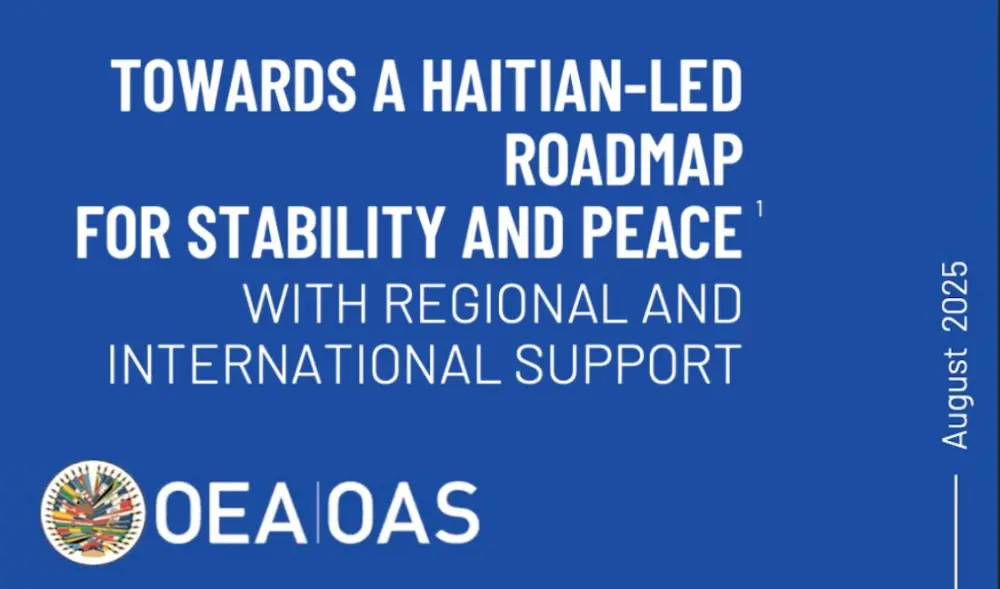
On August 20, in the Simón Bolívar Room, the Permanent Council of the Organization of American States (OAS) heard Secretary General Albert Ramdin present the evolving document “Toward a roadmap for stability and peace, led by Haiti, with regional and international support.” The text opens with a warning that keeps expectations grounded: implementation “depends entirely on the political, financial, and logistical support of international partners,” and all figures, timelines, and projections “are indicative and subject to modifications” as they are validated with stakeholders. That paragraph — on the very cover — sets the prudent tone that must be maintained in the face of any promise of reconstruction in such a volatile environment: it is a living document, which must mature based on the commitments undertaken and the results that follow.
What the Roadmap Proposes
The document structures the response into five overlapping pillars:
- Security and peace
- Political consensus and governance
- Electoral process and institutional legitimacy
- Humanitarian response
- Sustainable development and economic progress
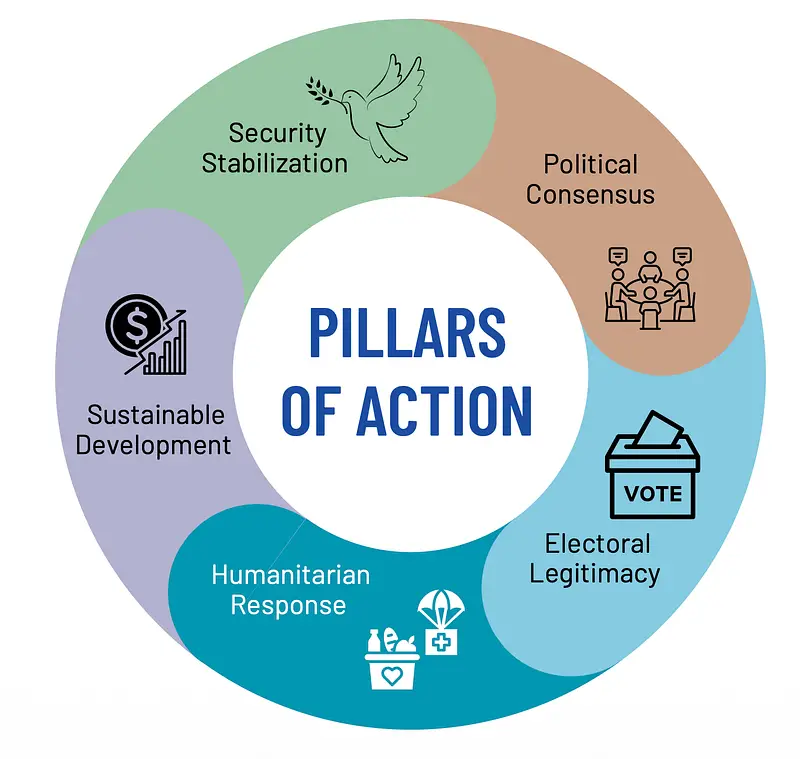
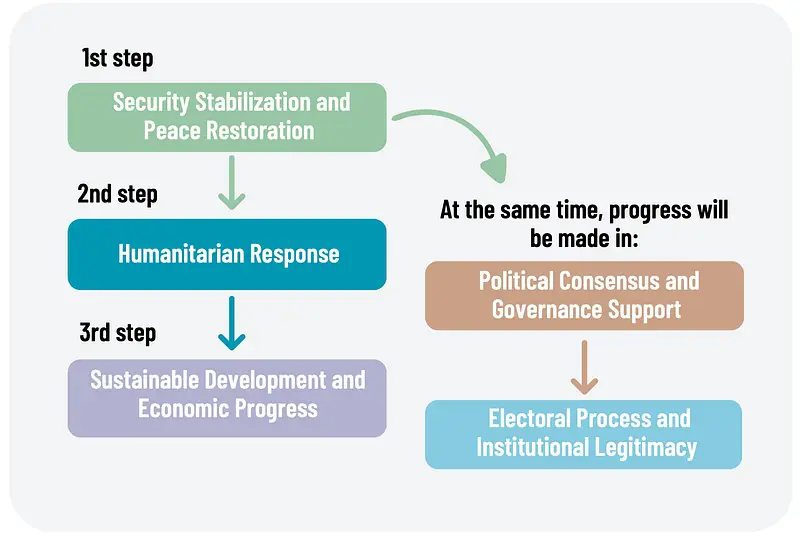
The architecture explicitly declares security as the enabling condition, without seeking to replace the ongoing initiatives of the United Nations (UN) or the Caribbean Community (CARICOM), but rather coordinating with them under Haitian leadership.
Pillar 1 — Security. This is not limited to operational support for the Haitian National Police (PNH). It proposes a dual design: an emergency phase to secure corridors and critical infrastructure, and a sustainability phase to rebuild a coherent security and justice system. The Multinational Security Support mission (MSS), authorized by the Security Council, leads the first phase; the OAS will complement it through its SECURE-Haiti program.
Pillar 2 — Political consensus and governance. The text stresses that only a broad dialogue process, led by the Haitian state with international accompaniment, can provide the coherence needed to sustain technical operations and legitimate agreements over time.
Pillar 3 — Electoral process and legitimacy. Constitutional and legal reforms are envisaged, along with strengthening the Provisional Electoral Council (CEP) and the National Identification Office (ONI), combined with civic education, secure technologies, and international observation. An OAS experts’ mission is also anticipated once elections are convened.
Pillar 4 — Humanitarian response. The document recognizes dramatic deterioration: mass displacement, food insecurity, and collapsed basic services. By mid-2025, only 9% of humanitarian needs were financed — placing at risk not only immediate assistance but also public confidence in the usefulness of the international effort.
Pillar 5 — Sustainable development and economic progress. It seeks to reactivate production and services within a minimal security environment, relying on the Inter-American Development Bank (IDB), the Pan American Health Organization (PAHO), and the Inter-American Institute for Cooperation on Agriculture (IICA), while drawing on existing cooperation frameworks.
Milestones, Timelines, and Resources
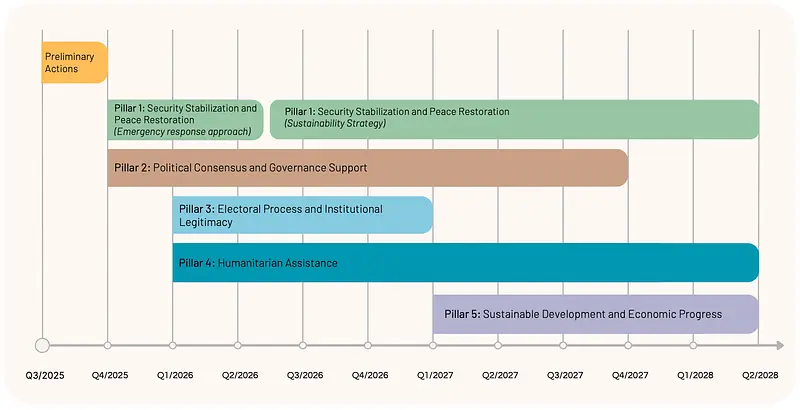
The schedule is explicit: from Q3/2025 to Q2/2028, with a preparatory phase of 0 to 3 months to set up teams, organize coordination, mobilize resources, and convene — together with the IDB — a donors’ conference. Ramdin emphasized that he could not be more specific at this stage because the process is still in development, with the first stage of planning only now underway. He also clarified that the 36 months should not be understood as a promise that all problems will be resolved by the end, but as a reasonable horizon to achieve a basic level of security stability and to ensure that humanitarian mechanisms are able to sustainably meet the most urgent needs.
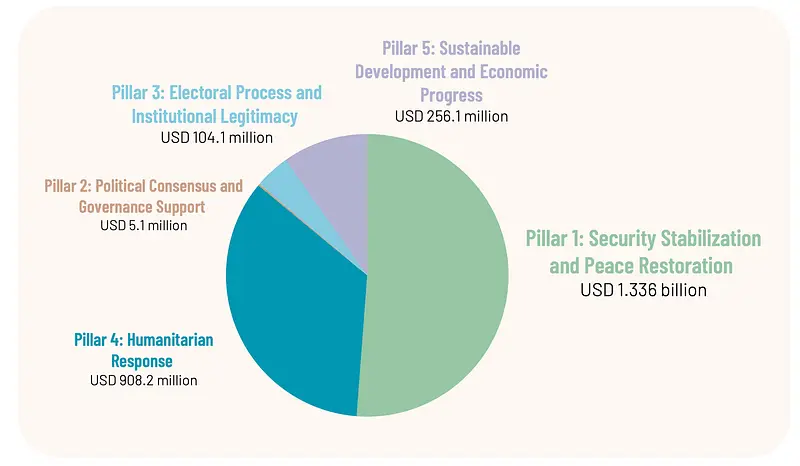
As for costs, the estimate amounts to USD 2.6035 billion: security (USD 1.336 billion), humanitarian (USD 908.2 million), electoral (USD 104.1 million), development (USD 256.1 million), and governance (USD 5.1 million). Ramdin explained that this is a preliminary estimate, which already includes explicit commitments from countries such as Canada and the United States. He stressed that security and humanitarian aid account for the largest shares; the electoral estimate was built on previous OAS missions in Haiti, while the development figure was drawn from a recent statement by the IDB president at the OAS. Ramdin devoted little time in his presentation to this section, which reflects the persistent uncertainty and lack of firm commitments that prevent him from announcing more. The document insists that these are indicative projections, subject to revision as agreements are finalized.
Coordination Still to Be Tested
The key question is how the UN, the OAS, and other actors will coordinate credibly and sustainably, without duplicating or competing. The plan outlines a Coordinating Group Mechanism (CGM), an OAS Special Representative, the Group of Friends of Haiti, and an OAS Interdepartmental Group, interfacing with BINUH (UN Integrated Office in Haiti), the MSS, the IDB, PAHO, and IICA. This is the architecture; it must still be turned into practice with clear rules, concrete products, verifiable milestones, and public transparency.
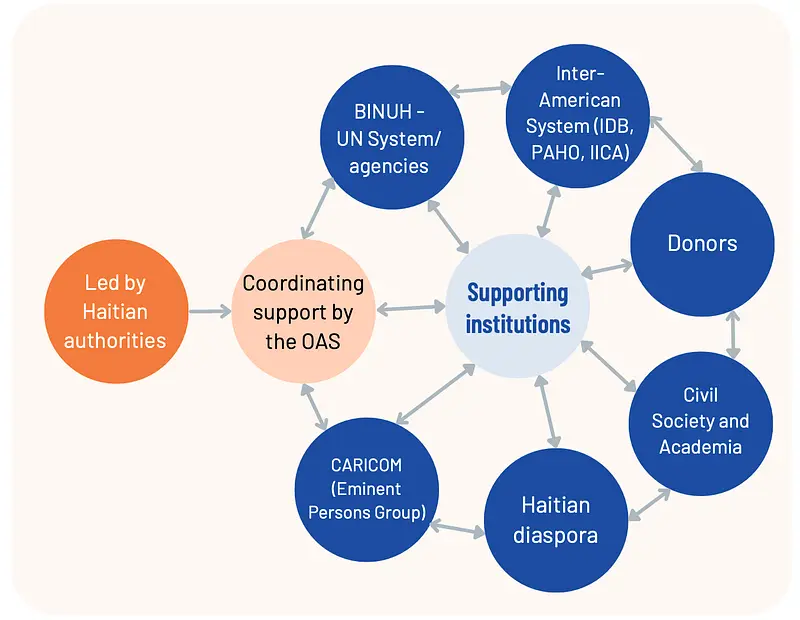
Ramdin acknowledged the limits: he reminded that the OAS is a convener, facilitator, and coordinator — not a direct implementer of security operations. He expressed his hope that the UN Security Council will soon adopt a resolution incorporating these coordination mechanisms, giving legal legitimacy and coherence to the roadmap.
He also announced that the MSS will provide a briefing next week to the Group of Friends of Haiti, with operational details of its upcoming actions. He reported that on August 27 a coordination meeting will be held with Miroslav Jenča, UN Assistant Secretary-General, the CARICOM Eminent Persons Group, and the OAS-UN-CARICOM tripartite mechanism, which will be expanded progressively. On the economic front, he mentioned that both the World Bank and the IDB have already identified specific funds for Haiti. He valued the Group of Friends of Haiti as a flexible and useful platform for strategic conversations. Thanking the OAS Inter-Agency Group on Haiti, he offered a revealing phrase: “sometimes we accelerate too much, but it is because we want to get things done.”
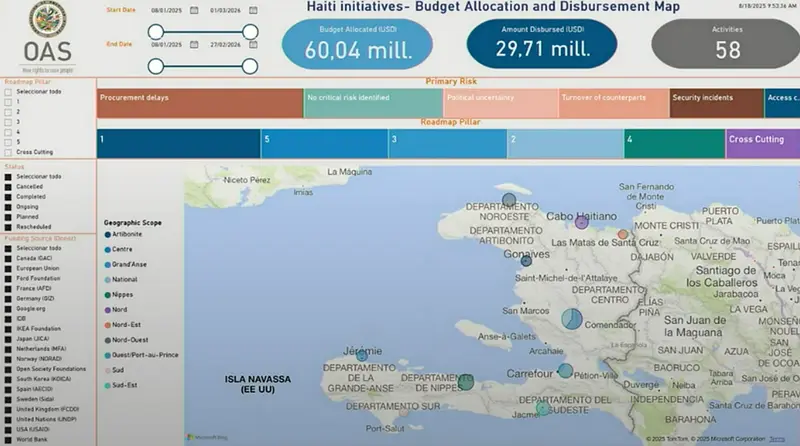
Ramdin added that once the roadmap is finalized it will be presented to observer countries to invite them to become directly involved, and that next Monday meetings with think tanks will be held to inform them of the process and help them better understand its direction. He also presented the idea of a public dashboard, which in two or three months could be live on the OAS website to track each pillar of the roadmap, offering unprecedented real-time transparency to member states, donors, and civil society.
Ambitious Timelines, Monumental Task
The MSS illustrates the challenge: 2,500 personnel were planned, but only 40% have been deployed, with a fund of USD 110.8 million that does not cover the estimated annual cost. By acknowledging this, the roadmap becomes more honest: it forces expectations to be aligned with capacities and compels prioritization where the impact will be immediate and visible.
The security pillar mixes urgent actions (corridors, arms control, MSS-PNH joint operations) with medium-term tasks (police professionalization, justice, border control, financial crime, community policing). If that balance is broken, the rest of the agenda will remain hostage to violence.
Will Resources Flow This Time?
This is the central doubt. With only 9% of humanitarian aid financed by mid-2025, the roadmap proposes shared responsibility: no one will bear the burden alone. The donors’ conference with the IDB will be the first reality test: what matters will not be the headline figure but the regularity and predictability of disbursements. Without initial commitments, the entire cycle risks losing credibility.
Why It Could Be Different… and Why Caution Remains
It could be different for three reasons:
- Clock and mandate. The OAS General Assembly gave 45 days for a consolidated plan with Haiti, the UN, and the MSS. That deadline forced choices and priorities from the outset.
- Explicit architecture. CGM, special representative, Group of Friends, and interdepartmental group: if activated with discipline, they can avoid the dispersion that undermined previous efforts.
- Clear principles. Haitian leadership, multilateral coordination, sequenced and integrated action, territorial and social focus.
Even so, prudence is essential: nothing will work without the coherence and consistency of Haitian leadership to stay the course, and nothing will advance without real and sustained financing.
The Role of the OAS: To Articulate, Not to Substitute
The OAS’s credibility is on the line. Assuming an articulating and convening role — more political and civilian than operational — is the sensible course. If it stays in that lane, connecting CARICOM, the inter-American system, the UN, and donors with Haitian priorities, it can provide what is most lacking: coherence and rhythm.
Five Signals to Watch in the Next Six Months
- Coordination: activation of the CGM and the special representative, with clear agreements, inter-agency roadmaps, and realistic timelines for each pillar.
- Security: verifiable progress in corridors and critical nodes, MSS-PNH joint operations with clear rules and sustained logistical support, and measurable improvements in maritime and port security, crucial to stop arms flows and protect the basic economy.
- Electoral process: a joint CEP-ONI work plan, with a civil registry schedule, transparent contracting, civic education under safe conditions, and technical support from the OAS DECO (Department for Electoral Cooperation and Observation) in organizing any electoral process.
- Financing: the donors’ conference must translate into firm, dated commitments. Without initial and verifiable disbursements in the short term, the entire roadmap risks delay and loss of credibility.
- International mandate: how the UN Security Council positions itself in its upcoming resolution on Haiti, expected in the coming weeks, and what concrete mandates emerge. The tone, scope, and strength of that resolution will largely determine the legitimacy and level of international backing for the coordinated effort.
Believing is not a leap into the void: it is an informed bet that accepts limits and defines who does what, when, and with what resources. Doubting is also healthy: timelines are short for enormous tasks, coordination must still be proven, and money is not guaranteed. For this roadmap to be different, it must prove it soon with visible results — starting with minimum security, sustained humanitarian assistance, and clear political rules. Haiti deserves that effort with a cool head and a willing heart; so does the region. And the OAS, if it sustains its role as articulator and avoids distractions of protagonism, can help ensure that this time the word “roadmap” means direction and not just rhetoric.